Pegaeophyton, Sro lo dkar po སྲོ་ལོ་དཀར་པོ
Sro lo dkar po (Tibetan)
Dan Hua Jie 单花芥 (TCM)
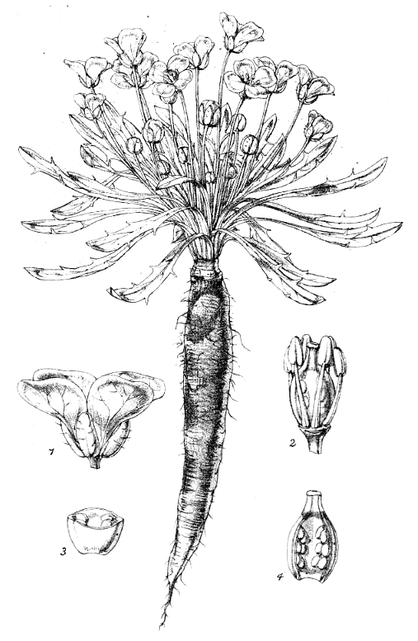
Pegaeophyton scapiflorum
The journal of the Linnean society, Botany, 1893
Botanical name:
Pegaeophyton scapiflorum (syn. Eutrema scapiflorum, Cochlearia scapiflorum)
Tibetan texts describe three types of Sro lo:
- Sro lo dkar po: Pegaeophyton scapiflorum
- Sro lo dmar po: Rhodiola spp.
- Sro lo smug po: Solms-laubachia
Parts used:
Whole plant, Root
Temperature & Taste:
Cool, Bitter, Sweet
Uses:
1. Clears Heat, Benefits Lung Yin, Stops Cough:
-Cough, Bronchitis, Wheezing from Heat and dryness or Yin deficiency
-excess Heat in the upper body
-as a solo decoction it is regarded as ‘Nectar’ for Pulmonary Tuberculosis
2. Clears Heat, Resists Poison:
-Epidemic and Infectious Fever
-especially Epidemic diseases attacking the Lungs
3. Clears Damp:
-accumulation of damp in the extremities
Dose:
Powder: 2–5 grams
Decoction: 3–9 grams
Comment:
The is the White variety of Sro lo. The Red Variety is Rhodiola Hong Jing Tian
Substitute:
1. Adenophora Sha Shen
2. Rhodiola is another (red) type of Sro lo and may be used in most cases.
3. Gypsophila paniculata root is used by Tibetans in Buryat region
Main Combinations:
1. Lung Heat Cough:
i. Pegaeophyton with Tabasheeer, Clove, Licorice
ii. Pegaeophyton with Aloeswood, Nutmeg, Elecampane, Triphala (as in Aloeswood 15)
2. Lung Heat Cough, Wheezing, Shortness of Breath, Pegaeophyton with Gentiana algida (Spang rgyan), Sandalwood, Tabasheer, Triphala, Safflower, Clove, Costus, Licorice (as in Gentiana algida 15)
Major Formulas:
Gentiana algida 15 (Spang rgyan dkar po 15) (Tibetan)
Aloeswood 15 (Tibetan)
Eliminator of All Lung Imbalances (Khrugs glo bcu gsum) (Tibetan)
Minister 9 (Tibetan)
Phlomis 7 (Lug mur bdun pa) (Tibetan)
Pneumonia All Curing Pill (‘Khrugs glo kun sel) (Tibetan)
Cautions:
None noted
Main Preparations used:
You must be logged in to view this content, please login. If you're not a member then Click this link to subscribe