Fumitory for Chronic Skin Disease
By Adam Tate, 2026
Introduction
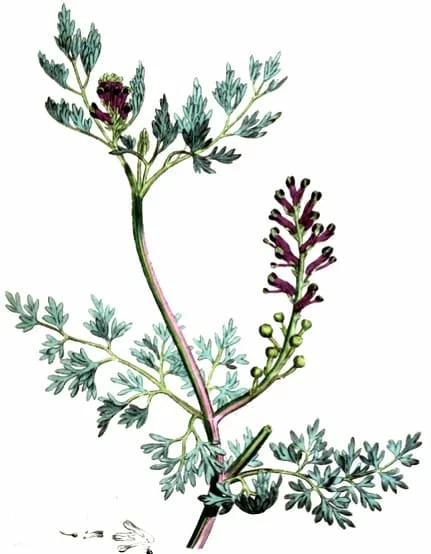
Fumitory has long been an important medicine for various chronic skin diseases including Dermatitis, Eczema, Psoriasis and even Leprosy (classically classed as an obstinate skin disease).
The official species used in the Western Tradition is Fumaria officinalis. There are around 25 species of Fumaria, most sharing similar properties. A number of species have been used in Europe and other medical systems, including Ayurveda and Unani.
Other species used include:
- F. claviculata (Climbing Fumitory)
- F. parviflora (syn. F. indica, Lesser or Small Fumitory, from hotter regions, used in India and Unani)
- F. densiflora (Southern Europe)
- F. capreolata (Ramping Fumitory, Europe and U.K.)
- F. muralis (Wall Fumitory)
- F. spiculata (Narrow Leaved Fumitory, Europe, Mediterranean)
- F. lutea (Yellow Fumitory, Barbary)
- F. capnoides (White-Flower, Southern Europe).
Ayurveda uses F. parviflora (syn. F. indica) and F. vaillantii synonymously with F. officinalis.
Constituents
- Isoquinoline Alkaloids (inc. protopine, fumarine, fumaricine, fumariline, fumaritine, fumarofine, fumarophycine, dihydrofumariline, bulbocarpnine, sanguinarine, dihydrosanguinarine, cryptocavine, cryptopine, canadine, coptisine, corydaline, sinactine, hydrastine, dicentrine, stylopine, parfumidine, scoulerine)
- Flavonoids (including rutin)
- Organic acids: Fumaric Acid (isomeric with malic acid), Maleric acid, Caffeoylmalic acid, Hydroxycinnamic acid
- Tannins
- mucilage
Traditional Uses
- Used for Acne, Itching, Scabies, Eczema, Psoriasis, Venereal diseases, Syphilis, Leprosy. It has been used internally and topically for skin diseases (1, 2)
- Liver disorders associated with Heat; Jaundice, Liver headaches
- Traditionally regarded as important to purge Melancholy (1, 2)
Melancholy
The word Melancholy is derived from Melan (Black) + Choler (Bile). Melancholy is Black or Burnt Bile as opposed to normal Bile which is Yellow. This Black or Burnt Bile is insidious and is the root of many stubborn and severe diseases. Chronic Skin diseases, Leprosy, Fibroids, Cancer, Depression, Schizophrenia and some other forms of Mental Disease were all recognised as being caused by Melancholy since the time of Hippocrates 2400 years ago. (3)
A bitter herb like Fumitory typically purges Bile, or to coin a TCM phrase, clears Liver heat. But Fumitory is different: it also purges Melancholy.
Melancholy is difficult to treat and is associated with chronic degenerative and destructive diseases. Fumitory has long been regarded as important to purge the Melancholy Humor.
Clinical Research applicable to Skin Diseases
- Anti-inflammatory: fumaric acid has this effect (4)
- Anti-bacterial: a number of species of Fumaria have demonstrated anti-bacterial activity. (5)
- Anti-histamine (6)
- Treatment of Eczema: A 4% alcoholic extract of F. parviflora applied in a cream base was found to be very effective in the management of hand eczema when tried in a double- blind placebo-controlled study in 44 patients. It was well tolerated by the majority of patients. (7)
Combinations
- Fumitory pairs well with Dodder herb (Cuscuta) for chronic skin conditions associated with Heat (Bile) or Melancholy. There are a number of examples, one being Decoction of Dodder and Fumitory of Mesue.
- Fumitory was combined with Hops to cleanse the Blood, as in Syrup of Hops.
- In melancholy diseases with Heat affecting the Heart, or for Toxic-Heat with Dryness, add Borage.
- Violet and Fumitory may be combine for Heat and Heat-Toxin, with or without Melancholy.
- To clear Liver and Blood heat, combine with Endive, Chicory (or Dandelion), Hops and Borage as in Decoction of Fumitory. This is sweetened with Raisins
- If a stronger cleaning effect on the Liver is indicated, Wormwood may be added.
- To more strongly purge Melancholy and Damp, combine with Polypody.
- Several Fumitory-based formulas contained Myrobalans as their basis, for example Syrup of Fumitory Greater of Mesue. A number of the medicines for Eczema and Psoriasis combined Fumitory with Yellow Myrobalan.
- To purge stubborn humors in chronic Skin diseases, it was combined with Aloe. This maybe accentuated with Scammony to facilitate removal of stubborn and deeply-seated Humors.
- 10. In modern times, Fumitory has been combined with herbs such as Yellow Dock, Cleavers, Heartsease etc.
- 11. A modern combination for Chronic Eczema combined Fumitory, Burdock root and Cleavers
Examples of Use
1. The acid (vinegar) Tincture is very good for all hot eruptions. (8)
2. The saline Tincture (prepared with hot salty water) can be used as a hot wash for various skin diseases including Acne, Eczema, Psoriasis, Spots and Freckles. (8)
3. The distilled water has been long used internally for skin diseases. (1, 2)
4. The Conserve of the fresh plant made with sugar was commended for ‘unclean Blood’ and skin diseases. (9)
Sample Combinations
Fumitory + Chicory clears Liver Heat
Fumitory + Borage clears Heat from the Blood
Fumitory + Hops clears Heat from the Blood
Fumitory + Dodder cleanses the Blood and reduces Melancholy
Fumitory + Senna purges Melancholy Humor
Fumitory + Aloe: used to cleanse the Blood and purge Melancholy Humor
Fumitory + Rhubarb to purge Bile and Melancholy, and removes Toxin from the Blood
Sample Formulas
Pills of Fumitory (Avicenna)
Pills of Fumitory and Senna (Unani)
Decoction of Fumitory of Mesue
Decoction of Fumitory of Andernacus
Syrup of Fumitory
Syrup of Fumitory Lesser (Mesue)
Syrup of Fumitory Greater (Mesue)
Syrup of Fumitory Compound (Augustana)
Electuary of Dodder and Fumitory (Mesue)
Electuary for Scabies and Pruritis (Rhazes)
COMPOUND DECOCTION of FUMITORY.
Fumitory 2 handfuls
Thyme
Chicory
Agrimony
Ceterach,
(Marsh) Wormwood 1 handful ea.
Polypody roots 1 oz.
Senna 4 drams
Licorice 1 dram
Decoct in 8 lbs. of Whey (or water) down to a half and strain hot; then infuse the following overnight: Rhubarb ½ oz., Spikenard 1 Scruple, Schoenanth ½ dram, boil a little, then strain.
Dose: 4 oz.
Safety
Fumitory species are safe as has been demonstrated in Chronic Toxicity tests. (11, 12)
A Personal Experience
Years ago, I has an physical education teacher come to see me who had experienced a recurrence of Psoriasis, primarily on his Elbows, but also on his knees and scalp. He had had Psoriasis as a teenager and it had spontaneously resolved years back. It had started returning about 6 months before coming to see me, and had been getting worse.
He was in fine health, very active and health conscious, and in his later 20’s. I, having recently made Pills of Fumitory (without Scammony), prescribed 7 pills to be taken, one per day over the following week. As his tongue was a little coated and he showed signs of mild heat, I thought a mild purge may be useful before beginning standard Chinese herbal medicine.
To both of out amazement, his skin had almost totally cleared up a week later. There was still the pinkish-red of new skin but the scaling and itchiness had gone totally. He was about to go away for 2 weeks on a school camp and said he didn’t want to take herbs with him but would come back when he returned. A follow-up several weeks later showed complete remission and no further treatment was ordered. Months later when he came for some back treatment, his skin was still totally clear.
Sources:
1. Culpepers Herbal and English Physician Enlarged
2. Salmon, William, Seplasium, 1693
3. Democritus Minor, Anatomy of Melancholy, 1847
4. Shakya et al., J Intercult Ethnopharmacol. 2014 Oct-Dec
5. Jaberian et al., Food Chem, Jan, 2013
6. Natural Medicines Comprehensive Database, 2007
7. Jowkar et al., Iran Red Crescent Med J, Nov, 2011
8. Grieves, Maud, A Modern Herbal, 1931
9. Wirtzung, Christopher, The General Practice of Physick, 1598
10. Salmon, William, Pharmacopoeia Londinensis, 1696
11. Sing et al., J Pharmacol Pharmacother. 2011 Jul
12. Sign & Kumar, J Ethnopharmacol. 2011 Apr 12
You may also like:
Materia Medica for Skin Diseases
Treatment of Skin Diseases
Examples of Pharmacological effects of Traditional Medicine Classifications
Difference between Ayurvedic and TCM Herb Classification
115 Herbs Common to Western Traditional Medicine and TCM
You must be logged in to view this content, please login. If you're not a member then Click this link to subscribe