
Centauri minus, Centaury the less
Common or Red Centaury, Feverwort, Febrifuga, Felwort, Christ’s Ladder, Centaury Gentian
Centaurea, Febrifuga, Fel Terra, Libadion (Pliny), Leptophyllum (Theophrastus)
Seigar (Arabic)
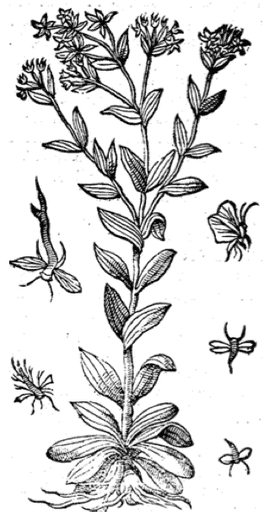
Mesuae Opera, 1570
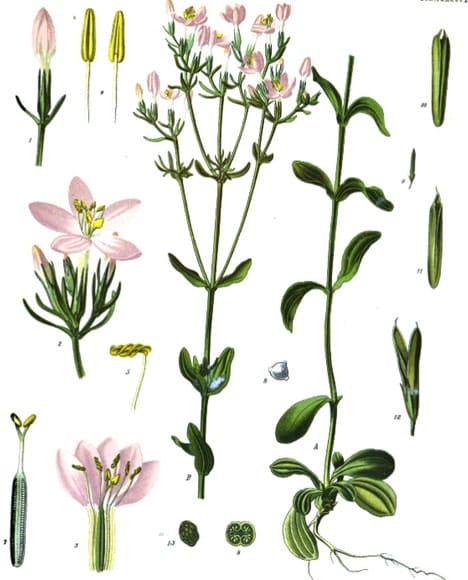
Kohler’s Medizinal Pflanzen, 1887
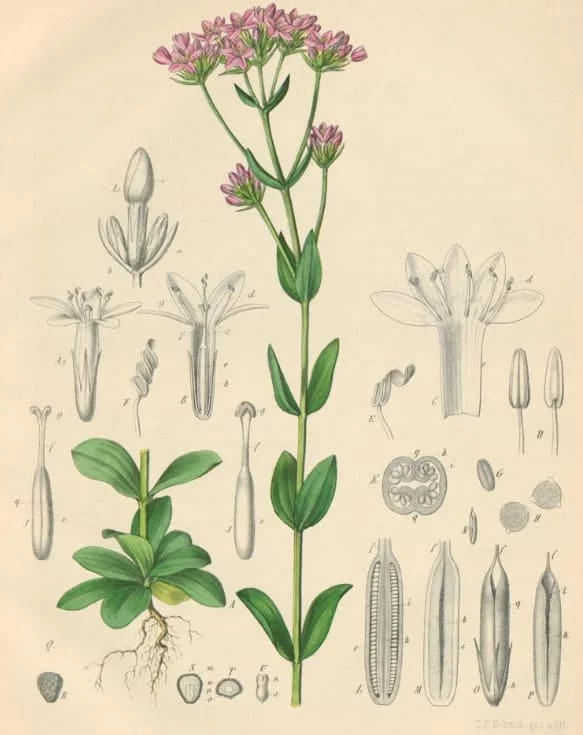
Atlas der Officinellen Pflanzen, Berg & Schmidt, Leipzig, 1893
Botanical name:
Centaurium erythraea (syn. C. centaurium)
Related species include C. tenuiflorum, C. littorale ssp. uliginosum, C. pulchellum and appear to be used synonymously.
Salmon (Botanologia) listed several varieties:
- Common Red Small Centaury
- White Flowered Centaury
- Small Yellow Centaury
- Branched Thourough-leaved Small Yellow Centaury
- Small Yellow Centaury, not branched
- Smallest Yellow Centaury
The Yellow and White flowered varieties are not Centaurea species, but closed related members of the Gentiana.
Yellow Centaury is Cicendia filiformis.
Parts used:
Herb in flower
Temperature & Taste:
Cold (said to be Warm), dry. Bitter
gently binding, cleansing, opening
Classifications:
2A APERIENT. 2B ATTENUATER. 2F. PURIFYING. 2G. CLEANSING. 2N. REPELLENT. 2S. STRENGTHENING. 2T. GLUTINATE
3C. ALEXIPHARMIC. 3G. EMMENAGOGUE. 3M. ARTHRITIC
4g. HEPATIC. 4k. ARTHRITIC
TCM:
B. Clears Heat and Damp
Uses:
1. Clears Heat and Damp, Opens the Spleen and Liver;
-purges Phlegm and Bile (Choler); Jaundice; pain of the sides
-hardness of the Liver and Spleen
-Hepatitis
-Edema, Gout
-Diabetes
-“dimness, mists and clouds that offend or hinder Sight”.
2. Clears Heat, Stops Cough, Resists Poison:
-Influenza
-Fevers: intermittent, chronic Fevers
-Cough, shortness of Breath, Wheezing, Lung Ulcers (juice mixed with Honey) (Salmon)
-Cough and Respiratory diseases in ancient Greece.
-Venomous Bites, chiefly for the bites of Rabid Dogs, Snakes (Viper, Adder), powder taken in Wine.
-“excellent good in Fevers”. (Culpeper)
3. Promotes Digestion:
-poor appetite, indigestion, heartburn, colic, mild constipation
4. Clears Heat, Reduces Spasms, Eases Pain, Strengthens Sinews and Joints:
-chronic joint Pain, Tendonitis, Lower Back or Hip Pain, Sciatica, Rheumatism
-infusion in wine or tincture is best for this function
–“Centaury is very good for all infirmities of the Sinews, howsoever they be”. (Wirtzung).
-“pains in the hips are relieved” by the decoction. (Dorsetn, 1540)
5. Moves the Blood, Promotes Menstruation:
-Amenorrhea; painful, delayed or scanty Menstruation associated with Heat
-decoction in wine promotes Labor and brings away afterbirth
-retained Placenta
-vinegar (acid) tincture for Hysteria and PMS.
-“Centaurea promotes the menstrual flow of women.” (Dorsetn, 1540)
6. Kills Worms:
-Tapeworm
-strong washes are used for Parasites
7. Externally:
-Pain of the Joints or Sniews (herb boiled in oil and applied)
-swollen, painful and hard lumps of the Breast (herb boiled in oil and applied)
-Back Pain (ointment)
-Rickets (ointment applied to the spine and joints)
-good for Wounds; old, moist and putrid Ulcers and Sores; Running Sores and Ulcers (Powder applied or Cataplasm)
-“The juice is efficacious for all wounds, both recent and old.” (Dorsetn, 1540)
-Ulcers, juice mixed with Honey and applied
-“For Fistulas which spread in all parts, an ointment made from the juice, and covered with Honey.” (Dorsetn, 1540)
-juice. decoction, distilled water or Saline Tincture as a wash to cleanse the skin; Freckles, Spots, Discolorations
-wash for “spreading Scabs of the Head”. (Culpeper)
-“Simon Paulli tells us, that there is not a more excellent Remedy against the Scurf or Dandruff, and Scab of the Head, than to wash it with the Decoction of the lesser Centaury made in that Water wherein Peas have been boiled”. (The Compleat Herbal, Tournefort, 1719)
-applied with Honey to Fistulas (Pliny)
-“When decocted with wine and mixed with olive oil, and applied to the abdomen below the navel, it relieves great pain in the loins, and opens up an obstructed Spleen”. (Dorsetn, 1540)
-“An ointment made from the juice with oil and wax is of great benefit to the spleen, if it is anointed from the outside”. (Dorsetn, 1540)
-Collyrium made of the juice with Honey is applied for dimness of sight, Sore, Inflamed and Tearing Eyes, Ulcers of the Eyes
-“The juice is useful as a medicament for the eyes. With honey it removes the darkness of the eyes, and those which hinder their clarity”. (Dorsetn, 1540)
Dose:
Powder: 500mg–3 grams
Infusion or Brief Decoction: 3–6 grams
Acid Tincture (in Vinegar): 20–40 drops
Juice mixed with Honey (equal parts): 1 teaspoonful–2 oz.
Juice: 1–3 oz. (Salmon said 4–6 oz. was taken 2 hours before the Fit of an Ague)
Fluid Extract (1:1 in 25% alcohol): 2–4 mls
Spirit: 1–2 spoonfuls
Fixed Salt: 1–3 grams
Essential Salt (used as as the Juice or Essence): 2–6 grams:
“Juice expressed from Centaurea root, and taken to half an ounce with olive oil, expels many evil humors from a person.” (Dorsetn, 1540)
Comment:
Culpeper says all the Centauries may be used similarly; however the Red is best for blood diseases, the Yellow is best for heat diseases, and the White is best for damp, phlegm, or water diseases.
Substitutes:
1. Gentian
2. Centaury and Swertia are good substitutes for one another
Main Combinations:
1. Indigestion::
i. Centaury with Camomile and Wormwood (as in Centaury Wine)
ii. Centaury, Agrimony, Raspberry leaf
2. To promote appetite:
i. Centaury with Balm, Juniper berry and Nettle
ii. Centaury with Chicory, Barberry, Wormwood, Blessed Thistle (as in Decoction to Promote Appetite)
3. Gastrointestinal Ulcers, Centaury with Cranesbill, Raspberry leaf and Agrimony
4. To clear Heat and Damp and open obstructions, Centaury with Camomile, Gentian, Senna, Blessed Thistle (as in Bitter Decoction)
5. To make Purging Bitter Decoction, add Agrimony, Calendula and Rhubarb to the above
6. Bitter Tincture, to stimulate appetite and digestion and open the Liver: Centaury with Gentian, Bitter Orange peel, Wormwood
7. Aromatic Bitter Decoction: Centaury with Calamus, Gentian, Galangal, Wormwood, Camomile, Stoechas (Fuller)
8. Obstruction of the Liver, Spleen or Gall Bladder, Centaury, Celery root, Fennel root; prepare a Syrup. (Dorsetn, 1540)
9. Jaundice, Centaury with Madder, Celandine, Sea Wormwood, Cinnamon, Saffron (as in Infusion for Jaundice)
10. Hepatitis, Centaury with Juniper berry, Agrimony, Cleavers, Yarrow (as in Decoction for Hepatitis)
11. Fever:
i. “Against all fevers, take half an ounce of Centaurea in powder, and drink it in wine with sugar; drink it in the morning for three days, this helps.” (Dorsetn, 1540)
ii. Centaury with Camomile
iii. Centaury with Wormwood, Feverfew, Calendula, Tormentil, Blessed Thistle, Camomile and Dandelion (as in Fever Water)
12. Asthma, Chronic Cough: “Take one handful of Centaurea and drink it boiled in water, then it cures asthma. Taken in the same way, it removes an old cough.” (Dorsetn, 1540)
13. Boils, Abscesses, Centaury with Horehound, Rosemary, Wormwood (as in Decoction for Boils and Abscess)
14. Poison: “To him who has taken poison, give him a small Centaury crushed in vinegar: let him drink it, and soon the poison will disperse”. (Dorsetn, 1540)
15. Rabies, Centaury with Rue, Vervain, Sage, Mint, Wormwood, Balm, Betony, St. John’s Wort (as in Powder Against Rabies)
16. Catarrh, Centaury with Marshmallow, Horehound and Peppermint
17. Anemia (from Liver congestion) Centaury, Nettle, Wormwood and Rose hip
18. Chlorosis, Amenorrhea, Centaury with Thyme, Rue, Maidenhair, Oregano (as in Decoction for Chlorosis)
19. Vertigo, Centaury with Juniper, Betony (as in Powder of Juniper for Vertigo)
20. Arthritis, Joint diseases:
i. Centaury with Gentian, Ground Pine, Germander (as in Powder for Gout of the Duke of Portland)
ii. Centaury with Gentian, Ground Pine, Germander, St Johns wort, Birthwort, Agaric (as in Antidote of Seven Things)
21. “Decoction of it in water drunk cures old ulcers.” (Dorsetn, 1540)
22. Piles, Centaury, Mullein, Barberry bark, Cayenne
Major Formulas
Bitter Decoction
Aromatic Bitter Decoction
Purging Bitter Decoction
Decoction for Boils and Abscess
Electuary of Centaury (Zenon)
Antidote of Seven Things (Paulus Aegineta)
Powder for Gout of the Duke of Portland
Invigorator of the Decrepit (Rhazes)
1. Bitter Powder:
i. Lesser Centaury, Fumitory, Buckbean, Germander, Hops (equal parts) (Niemann)
ii. Fumitory, Germander, Buckbean, Chicory, Ground Pine, Lesser Centaury, Hops, Blessed Thistle (equal parts) (Formulaire Pharmaceutitique a l’usage des Hospitaux Militaires de France, 1821)
iii. Yarrow, Lesser Centaury, Buckbean, Peppermint, Fennel (equal parts) (Hufeland)
2. Bitter Anti-Arthritic Powder:
i. Gentian, Round Birthwort (2 parts each), flowers of Lesser Centaury (4 parts), Germander, Ground Pine (2 parts). Powder. (Pharmacopoeia Gallica, 1818)
3. Bitter Wine:
i. Madder root, Swallow-wort, Lesser Centaury (1 oz. each), Rhenish Wine, Water (1 ½ pounds each). Boil down to two-thirds, and to the strained liquor add Syrup of Orange peel (2 oz.). Mix. Dose: a glassful morning and evening in Jaundice. (Pharmacopoeia extemporanea, Augustin, 1822)
4. Bitter Essence:
i. Tansy (1 oz.), Scolopendrum, Blessed Thistle, Lesser Centaury, Gentian, Patience Dock (each 3 drams), fresh peel of Unripe Oranges (half oz.). Alcohol (12 oz.). Digest, express, filter. Tonic, stomachic, carminative, anthelmintic. Dose: 50–70 drops in wine. (Pharmacopoeia Wirtembergica, 1798)
Cautions:
Generally Safe.
Toxicity
Research demonstrated Centaury extract to be without side effect in rodents. (see here)
Main Preparations used:
Distilled Water, Extract of the Juice, Salt of the Ashes
1. Extract of Lesser Centaury:
i. Lesser Centaury (1 pound), Water (8 pounds), Alcohol (1 pound). Digest for 3 days with gentle heat, then express, and gently distil off the alcohol then evaporate to an extract. (Pharmacopoeia Herbipolitania, 1796)
Click the above Tabs for more information on this medicine
-Its English name of Felwort came from Fel Terrae, an old name meaning ‘Gall of the Earth’, in reference to its extreme bitterness and Bile-cleansing properties.
-“Galen wrote a whole Treatise upon the admirable Qualities and Virtues of this Plant”
–Cheiron, the Greek Centaur famous for his use of herbs was said to have used this plant medicinally, especially for pussy wounds; he supposedly cured himself with it after being wounded by a poison arrow. This is the source of its name Centaurium.
-The name Centaury is derived from cent aurea– ‘one hundred gold soverigns’, probable in refernce to its medicinal value.
-One of the ‘15 Magical Herbs’ of the Ancients.
-“Very Wholesome, but not very Toothsome”. (Culpeper)
‘My flower is sweet in smell, bitter my juice in taste,
Which purgeth choler, and helps the Liver, that else would waste’.
(from Gerard)
-In older times it was used against Evil Spirits. Macer’s Herbal of the 10th C. gives this use in form of a poem.
-Centaury has been used in protection Spells; an herbal Bath may be made, a strong infusion can be used as a sprinkle or a wash, or water may be splashed with a piece of fresh Centaury. The herb may be hung in bunches to provide protection to an area.
Last Updated 01/24
GENERAL / REVIEW
–Phytochemical properties, biological activities and medicinal use of Centaurium erythraea Rafn.
–Carotenoids, tocopherols, organic acids, charbohydrate and mineral content in different medicinal plant extracts.
–Bioactivity of gentiopicroside from the aerial parts of Centaurium erythraea.
ANTIBACTERIAL
–Centauries as underestimated food additives: antioxidant and antimicrobial potential.
–Volatile organic compounds from Centaurium erythraea Rafn (Croatia) and the antimicrobial potential of its essential oil.
ANTIOXIDANT
–Bioactivities of Centaurium erythraea (Gentianaceae) Decoctions: Antioxidant Activity, Enzyme Inhibition and Docking Studies.
–Centauries as underestimated food additives: antioxidant and antimicrobial potential.
–Antioxidant activity of Centaurium erythraea infusion evidenced by its superoxide radical scavenging and xanthine oxidase inhibitory activity.
ANALGESIC:
–Analgesic effect of Centaurium erythraea and molecular docking investigation of the major component swertiamarin.
GASTROPROTECTIVE
–Gastroprotective effect of small centaury (Centaurium erythraea L) on aspirin-induced gastric damage in rats.
HEPATOPROTECTIVE
–Hepatoprotective activity of Centaurium erythraea on acetaminophen-induced hepatotoxicity in rats.
ANTIHYPERTENSIVE
–Bioactivities of Centaurium erythraea (Gentianaceae) Decoctions: Antioxidant Activity, Enzyme Inhibition and Docking Studies.
CARDIOVASCULAR DISEASE
–Medicinal plants used for cardiovascular diseases in Navarra and their validation from official sources.
ENZYME INHIBITION
–Bioactivities of Centaurium erythraea (Gentianaceae) Decoctions: Antioxidant Activity, Enzyme Inhibition and Docking Studies.
DIURETIC
–Experimental diuretic effects of Rosmarinus officinalis and Centaurium erythraea.
DIABETES
–Centaurium erythraea extract improves survival and functionality of pancreatic beta-cells in diabetes through multiple routes of action.
–A review of Algerian medicinal plants used in the treatment of diabetes.
–Centaurium erythraea methanol extract protects red blood cells from oxidative damage in streptozotocin-induced diabetic rats.
–Effect of Centaurium erythraea Rafn, Artemisia herba-alba Asso and Trigonella foenum-graecum L. on liver fat accumulation in C57BL/6J mice with high-fat diet-induced type 2 diabetes.
–Treatment of high fat diet induced type 2 diabetes in C57BL/6J mice by two medicinal plants used in traditional treatment of diabetes in the east of Algeria.
–Prevention of type 2 diabetes induced by high fat diet in the C57BL/6J mouse by two medicinal plants used in traditional treatment of diabetes in the east of Algeria.
CYTOTOXIC:
–Isolation and cytotoxic activities of undescribed iridoid and xanthone glycosides from Centaurium erythraea Rafn. (Gentianaceae).
ANTHELMINTIC
–In vitro anthelmintic activity assessment of six medicinal plant aqueous extracts against donkey strongyles.
You must be logged in to view this content, please login. If you're not a member then Click this link to subscribe

“it is a golden and excellent medicine for innumerable diseases” according to Galen. (Dorsetn, 1540)