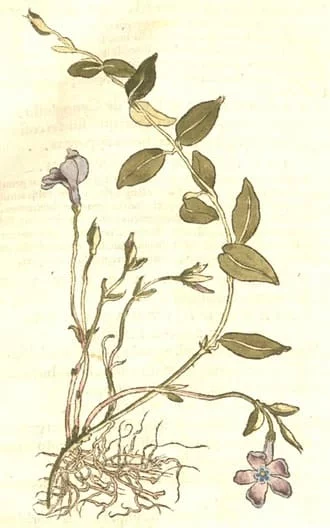
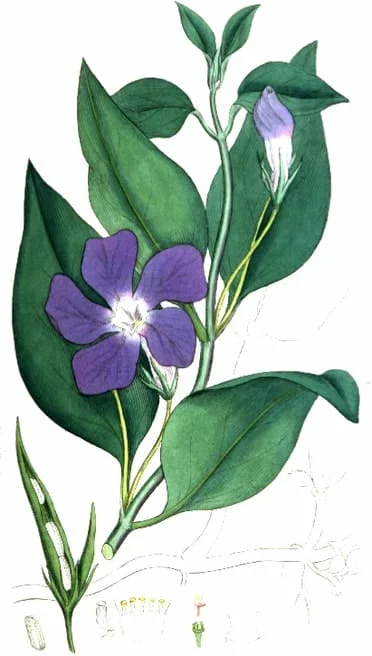
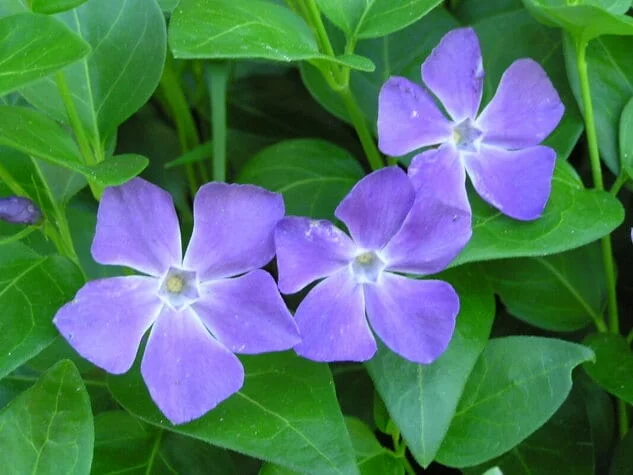
Vinca Pevinca, Periwinkle
Alexandria, Laureola, Lactago, Daphnitis,
Clematis Daphnoides, Chamedaphne, Hippoglossum

Botanical name:
Vinca major (Greater); V. minor (Lesser)
Parts used:
Herb
Temperature & Taste:
Warm, dry
Classification:
Uses:
1. Calms the Mind, Moves the Blood, Stops Wind:
-Dizziness, Vertigo, Headache, Tinnitus, Nervous Disorders, Hysteria, Fits, Cramps
-Nightmare, Terror
-‘pains of the Teeth’.
-Poor Memory, poor Concentration
-Loss of Speech; Speech Disorders have shown clinical improvement.
-Cerebral Arteriosclerosis; Sequelae of Strokes; impairment of Cerebral circulation.
-Behavioral Disorders, Irritability, Restlessness
-Traditionally to cure diseases of Enchantment and Possession.
2. Astringes and Stops Bleeding:
-excessive menstrual bleeding; Uterine Bleeding, Bleeding and Spotting between periods.
-Diarrhea, Dysentery
-Hemoptysis; other types of bleeding.
-Threatened Miscarriage (Lonicerus)
3. Astringes, Benefits the Yin:
-traditionally used as an adjunct in the treatment of Diabetes and Consumption.
-reputation for inciting ‘Lust’.
4. Resists Poison:
-Cold, Flu (Lonicerus)
-various Poisons including Snake Bite.
5. Promotes Milk
-promotes Breast Milk
6. Externally:
-ointment made from the leaves is soothing, healing and good for any skin inflammation, including Eczema.
-Applied to Bleeding Piles.
-for bleeding of the Mouth and Nose (the leaf is chewed).
-bands were traditionally fastened around the calves for cramps.
-loose teeth, toothache
Dose:
1. The herb will have to be given for a minimum of 4–6 weeks before any marked improvement in cerebral symptoms occurs.
INFUSION or DECOCTION: 2–6 grams, up to 9 grams (dried);
TINCTURE (1:5): 1–3 mls. (some said 2–10 drops), 2–3 times daily;
POWDER: 500mg–2 grams;
JUICE: 3–10mls.; the Juice of a small handful of fresh leaves is given with Wine to stop bleeding.
“In a Spitting of Blood, in an excessive menstrual or hemorrhoidal Flux, and to cure the Whites, pour two Pints of boiling Water upon three Handfuls of the Leaves of Periwinkle, cover the Pot, remove it from the Fire, and drink the Infusion”. (The Compleat Herbal, Tournefort, 1719)
Substitute:
Periwinkle has been used as a substitute for Cotton root.
Main Combinations:
1. Edema, Periwinkle with Tansy and Agrimony, steep in milk 1 day then distil, is “esteemed useful in a Dropsy”. (The Compleat Herbal, Tournefort, 1719)
2. Bleeding from the Lungs, Periwinkle with Willow leaf, Daisy, Knotgrass (Meyer)
3. Loss of Speech:
i. Periwinkle, Borage, Calendula
ii. Periwinkle, Sage, Saffron
iii. Periwinkle with Borage, Peony, Rosemary, Calamus, Storax, Calendula
4. Speech disorders, Periwinkle, Calamus
5. Nervous disorders, Nightmares:
i. the conserve made of the young leaves is useful.
ii. Periwinkle with Balm
6. Mental debility, Mental Illness, Periwinkle with Vervain and Blessed Thistle
7. Uterine Bleeding from Heat, Periwinkle with Golden Seal
8. Threatened Miscarriage, Periwinkle with Lobelia
9. Wounds, Trauma, Periwinkle with Wintergreen, Tormentil, Comfrey, Sanicle, Vervain (as in Universal Vulnerary Decoction)
10. As a gargle for Sore Throat, Periwinkle with Bistort, Agrimony, Hollyhock flower, Pomegranate flower (2 oz. each) (Pharmacia rationalis, 1806)
11. For Cramps, bands of fresh Periwinkle were bound around the calf.
12. Scrofula: “the fresh Leaves of this Plant laid upon coarse Paper, and smoked with Frankincense, by the Advice of a Woman, applied to a strumous Swelling, difeufled the Tumour in a very little Time, which, for a Year had resisted and baffled the Skill of a learned Physician”. (The Compleat Herbal, Tournefort, 1719)
Major Formula:
1. Swiss Purgative:
i. Wormwood, Betony, Bugle, Mint, Vervain, Water Germander, Germander, Hyssop, Ground Ivy, Yarrow, Marjoram, Periwinkle, Rosemary, Sanicle, Sage, Thyme, Wild Thyme, Arnica flowers, Coltsfoot flowers (equal parts)
This is a gentle cleanser which may safely be taken on an extended basis. It clears Heat and Phlegm, regulates the Stomach and Bowels, cleanses the Liver and Spleen etc. It is not debilitating as are stronger purgatives medicines, but rather works by stimulating healthy function. A tablespoonful may be steeped in a cup of boiling water, and honey added to taste.
2. Vulnerary Spirit:
i. Comfrey root, Herbs of Comfrey, Bugle, Sanicle, Betony, Figwort, Plantain, Agrimony, St. Johns wort, Periwinkle, Ground Ivy, Mugwort, Veronica, Vervain, Lesser Houseleek, Yarrow (4 oz. each), Sage, Angelica, Tansy, Wormwood, Celandine, Fennel, Clematis, Mint, Hyssop, Tobacco (8 oz. each), Rue, Camomile, Scordium, Marjoram, Rosemary (4 oz. each), Lavender, Oregano, Calamint (6 oz. each). White Wine (50 lbs.) Distil half. (Pharmacopoeia Wirtembergica, 1798)
Cautions:
1. Avoid during pregnancy
2. Avoid in Hypotensives
3. Toxic in overdose.
Main Preparations used:
Distilled Water of the Root, Leaf and Flower, Conserve of the Young Leaves
Click the above Tabs for more information on this medicine
GENERAL / REVIEW
–Non-alkaloid constituents of Vinca major.
–Alkaloids of Vinca major cv. Variegata.
–Studies on Vinca major (apocynaceae) II: Phytochemical investigation
–Biochemical analysis of flowers of Vinca major, a medicinal weed plant of hilly areas of Pakistan
–ON SOME PHARMACOLOGICAL PROPERТIES OF ТНЕ ALKALOIDS OF VINCA MAJOR
ANTIOXIDANT
–Antilipase, antiproliferatic and antiradical activities of methanolic extracts of Vinca major
ANTIBACTERIAL
–Potential antibacterial activity of crude extracts from Aloe vera, Zingiber officinale and Vinca major medicinal plants
–Volatile constituents and antimicrobial activity of Vinca major L. subsp. hirsuta (Boiss) stearn grown in Turkey
LEISHMANIA
–In vitro and in vivo evaluation of therapeutic effects of Vinca major alkaloids on Leishmania major.
ANTI-DIARRHEA
–Evaluation of antidiarrheal activity of aerial parts of Vinca major in experimental animals
TYROSINASE INHIBITOR
–Tyrosinase inhibitory effects of Vinca major and its secondary metabolites: Enzyme kinetics and in silico inhibition model of the metabolites validated by pharmacophore modelling.
ANTI-LIPASE
–Antilipase activity guided fractionation of Vinca major
ENZYME INHIBITION
–In vitro α-glycosidase and urease enzyme inhibition profile of some selected medicinal plants of Pakistan.
DIABETES
–Effect of ethanolic leaf extract of Vinca major L. on biochemical parameters and glucose level of alloxan induced diabetic rats
CANCER
–Antilipase, antiproliferatic and antiradical activities of methanolic extracts of Vinca major
You must be logged in to view this content, please login. If you're not a member then Click this link to subscribe