Articles on Traditional Medicine – MedicineTraditions
Toxic Aconites and the Antidote Aconites
By Adam Tate, 2026
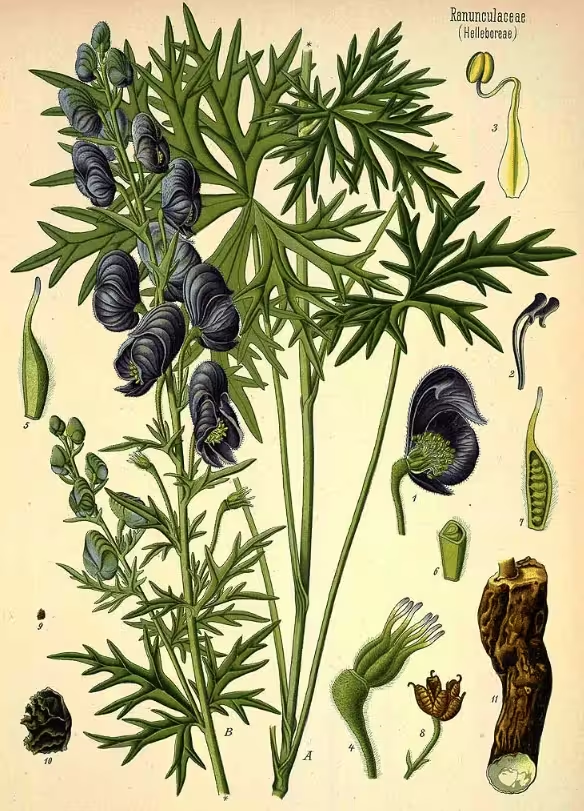
Aconitum ferox
F.E. Kohler, Medizinal Pflanzen, vol. 3 (1890)
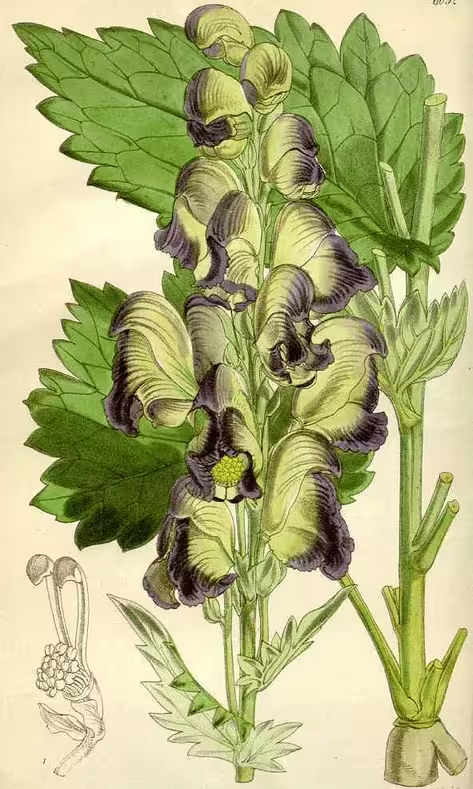
Aconitum heterophyllum
Curtis’s Botanical Magazine, 1874
There is an amazing and parallel relationship between Toxic Aconites and their Antidotes which are also Aconites, found between the Western and Indian Traditions.
The Deadly Thora
In the European Alps, old herbalists and hunters feared a highly toxic, low-growing plant known simply as Thora which is typically identified as Aconitum napellus, the Blue Monkshood (equated with the toxic Aconites of the East), The juice of Thora was historically used as a potent arrow and bait poison to kill wolves and leopards. Like its eastern cousins, this contains highly toxic aconitine diterpene alkaloids.
The Antidote Anthora
Because Aconitum anthora grew on the exact same alpine slopes and produced a highly bitter, non-lethal, yellow-flowered root, European physicians believed nature had placed the antidote right next to the poison. The root of Anthora was considered a supreme counter-poison. It was ground up and administered to treat accidental poisonings, lower high-grade malignant fevers, and purge intestinal worms. Like its eastern cousin A. heterophyllum, A. anthora contains bitter, non-toxic atisine-type alkaloids.
We can see the same remarkable similar duality in Aconite species of Ayurveda.
The Deadly Vish
In Sanskrit, Vish translates literally to “Poison” and is specifically applied to Vatsanabha (Aconitum ferox / Black Aconite). It is incredibly hot, lethal if unpurified, and acts as a violent, channel-piercing toxin.
The Antidote Ativish
To balance this, Ayurveda relies on Ativisha (meaning “Against Poison” or “Antidote”), which is botanically Aconitum heterophyllum. Just like European Anthora, Ativisha produces light-colored, whitish-grey tubers that are remarkably non-toxic and highly bitter. Ayurveda uses Ativisha without intensive purification to neutralize systemic venoms, halt infectious diarrhea, and cool pediatric fevers—mirroring exactly how European doctors deployed Anthora against Thora. This non-toxic Aconite also relies on Atisine-type Alkaloids which are highly bitter and non-toxic.
Research supporting the Antidotal effect against the Toxic Aconites
Fascinatingly, modern research has supported and confirmed the efficacy of using non-toxic diterpene alkaloids against poisoning from the highly toxic Aconites.
Competitive Antagonism
Research confirms that low-toxicity diterpenoid alkaloids structurally alter or block the effects of highly toxic diester diterpene alkaloids such as aconitine. Atisine-type alkaloids (found in Aconitum anthora and Aconitum heterophyllum) bind to receptor cites on sodium channels and stop the aconitine alkaloids from binding, thereby shifting the dose-response and acting as an antidote.
Electrophysiological Proof
In animal models, when isolated cardiac or neural tissues are flooded with lethal doses of aconitine, they experience complete loss of the normal electrical “population spike”. When an atisine-type or lappaconitine-type alkaloid is co-administered, the complete suppression of the electrical spike is reversed or heavily attenuated. The lower-toxicity alkaloid stabilizes the cell membrane, preventing the delayed after-depolarizations (DADs) that trigger aconite-induced cardiac arrest.
Conclusion
Not only is it amazing that a species of Aconite that usually grows near the highly toxic Aconite species has traditionally been regarded as an antidote to that species, but it is even more amazing that exactly the same thing is found in both East and West (Europe and India). And it is even more profoundly amazing that modern research has demonstrated this to be rational due to competitive antagonism, and has also shown direct cardioprotective effects when the 2 alkaloids are co-administered.
When traditional systems combine small amounts of processed Vish (Aconitum ferox) with Ativish (Aconitum heterophyllum), they are deliberately creating a built-in pharmacological buffer. The atisine molecules act as a chemical safety valve, occupying cardiac sodium channels just enough to shield the heart from being overwhelmed by residual aconitine. This is particularly seen in a number of Tibetan formulas, where both “Black” and “White” Aconites are combined with a single formula.