Articles on Traditional Medicine – MedicineTraditions
The confusion of the Tibetan Aconites
Trying to understand the Aconite species used in Tibetan Medicine
By Adam Tate, 2026
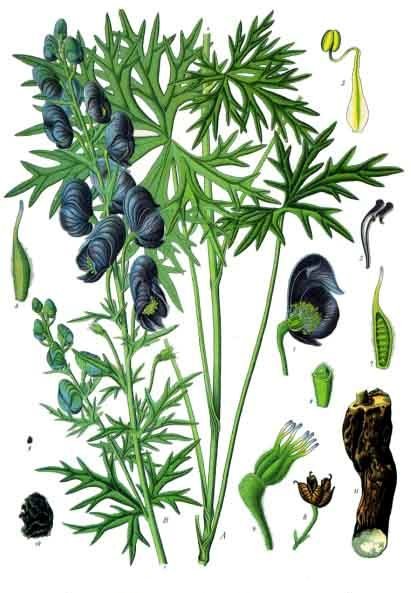
Köhler’s Medizinal-Pflanzen (1897)
The therapeutic brilliance of traditional Tibetan medicine (Sowa Rigpa) relies heavily on its unique botanical classification systems. Tibetan Medicine uses Aconite species more regularly than any other Tradition. Whereas in TCM, Aconites are relegated to Heating formulas used to clear Cold and warm the Yang, the Aconites are used for more widely in Tibetan Medicine.
However, few genera present as many identification, processing, and naming challenges as Aconite (Aconitum spp., known vernacularly as Bong-nga བོང་ང་). This is partly because Tibetan Medicine is used over such a vast area, from the Tibetan Plateau, Northen India, Western China, Nepal, Bhutan, Mongolia and the Buryat region of Russia, thereby meaning various different species of any herb can supply the same Tibetan Medicine.
In the high-altitude regions of the Tibetan Plateau and the Himalayas, Aconite is highly valued. It is used as a powerful metabolic stimulant, a treatment for chronic joint inflammation, and an antidote to internal toxins. It is also often added to potencies larger formulas. Yet, misidentifying these plants can lead to severe consequences. The species can range from non-toxic medicinal plants to some of the most lethal plants on Earth.
This article explores the classification of Tibetan aconite into four color groups, examines the specific categories of sMan-chen, Bi-sha, and ’Dzin-pa, and highlights why botanical confusion remains common in Himalayan ethnopharmacology.
The Four Color Groups: A Visual and Toxicological System
Classical Tibetan treatises, such as the 18th-century Shel gong shel phreng (The Crystal Orb and Crystal Rosary), categorize Bong nga (Aconites) into four distinct color groups. This classification is primarily based on the external and internal characteristics of the root caudex or tuber. Crucially, this color coding correlates directly with the plant’s natural toxicity and therapeutic application.
| Group | Tibetan Name | Principal Species | Nature & Use | Toxicity |
|---|---|---|---|---|
| Black | Bong-nga nag-po (བོང་ང་ནག་པོ་) | Tibetan Plateau: A. pendulum, A. flavum, A. sprootianum Nepal: A. ferox, A. laciniatum, A. spicatum Bhutan: A. falconeri, A. violaceum Buryat / Mongolian: A. kusnezoffii, A. baicalense, A. napellus | Extremely Hot. Drives metabolic fire, resolves severe structural tumors, and stops nerve pain. | Lethally High (Rich in diester diterpene alkaloids like aconitine) (Requires intense processing). |
| White | Bong-nga dkar-po (བོང་ང་དཀར་པོ་) | Tibetan Plateau: A. handelianum, A. tanguticum Nepal: A. palmatum, A. heterophyllum Buryat: A. barbatum, A vulparia | Bitter and Cooling. Used to clear infectious bile disorders (hepatitis) and neutralise systemic poisoning. | Low to Non-Toxic (Contains safer alkaloids like atisine & palmatisine; not processed). |
| Red | Bong-nga dmar-po (བོང་ང་དམར་པོ་) | Tibet: A. balfourii, A. brunneum. Nepal: A. contortum, A. amplexicaule. Bhutan:,Delphinium densiflorum, D. brunonianum Buryat: Aconitum fischeri | Neutral to Warming. Clears blood heat, resolves internal stagnation, and treats reproductive swelling. | Moderate to High (Requires light processing). |
| Yellow | Bong-nga ser-po (བོང་ང་སེར་པོ་) | Tibet: A. naviculare. Nepal: A. hookeri, A. orochryseum Bhutan: A. ludlowii Buryat / Mongolian: A. barbatum va puberulum, A. lycoctonum | Cooling and Astringent. Primarily formulated for acute diarrhea, intestinal infections, and paediatric fevers. | Low (Safe for gentle, clearing formulas). |
The Specialized Triad: sMan chen, Bi sha, and ’Dzin pa
Beyond the broad color classifications, Tibetan pharmacology organises active aconite recipes around three distinct functional categories: sMan chen, Bi sha, and ’Dzin pa.
Note that the following Tibetan names and species have been equated variously, making exact identification difficult. You can find sources listing ‘Dzin pa and Bi sha as highly toxic species, and you can find various species applied to the different Tibetan names. However, the following appears to be the most correct.
1. sMan chen (སྨན་ཆེན་) — The “Great Medicine” Anchor
- Species Used: Aconitum ferox and Aconitum pendulum. (In Buryat, A. czekanovskyi and A. uncinatum are used)
- The Blueprint: sMan-chen is the ultimate manifestation of the Black Aconite group. In its raw form, it is highly toxic. It contains heavy concentrations of aconitine, which disrupts the central nervous system and cardiovascular paths.
- The Tibetan Method: It is never used raw. It undergoes a rigorous, multi-day detoxification process (Dug-dul). It is calcined, boiled in milk or urine, and bound to neutralizing herbs. This chemical process hydrolyzes deadly diester alkaloids into much safer monoester compounds. Once processed, it becomes a powerful medicine to revive cardiovascular function and treat deep-seated diseases.
2. Bi sha (བི་ཤ) — The Safe Antidote
- Species Used: Aconitum bisma (syn. Aconitum palmatum).
- The Blueprint: Representing the White Aconite group, Bi-sha naturally lacks the deadly aconitine matrix. Instead, its roots are light-colored and contain milder alkaloids like palmatisine. Its action is bitter and cooling, and it is formulated to clear fevers and soothe inflammation without requiring intense chemical processing.
NOTE: The Bish (derived from the Sanskrit Visa=poison) in Ayurveda denotes the highly toxic Aconitum ferox. The Tibetan Bi sha should not be confused with the Ayurvedic Bish.
3. ’Dzin pa (འཛིན་པ) — The “Flower-Gathered” Aromatic
- Species Used: Aconitum gymnandrum. (In Nepal and Bhutan, A. violaceum or variants of A. nepalense are used)
- The Blueprint: ’Dzin-pa (meaning “to hold or grasp”) breaks the rule of focusing entirely on aconite roots. Tibetan medicine specifically harvests the aerial parts (the vibrant purple/yellow bellflowers and green leaves) of Aconitum gymnandrum. It features a low-to-moderate toxicity profile and is used to treat infectious skin conditions, throat swelling, and contagious respiratory fevers.
‘Dzin pa has been classified with the “Black Aconites” in traditional texts, but is far less toxic than A. ferox, and it is the aerial parts that are typically used. However, “Secret” names reveal that the “outer” ‘Dzin pa refers to the leaves and flowers, while the “inner” ‘Dzin pa refers to the roots.
Where the Confusion Arises
The identification of Tibetan aconite species can be complicated by centuries of overlapping vernacular terms, cross-border trading, and lookalike plants. Two main factors contribute to this confusion:
The Linguistic Crossover: “Bish” (Sanskrit) vs. “Bi-sha” (Tibetan)
The most notable point of confusion is the Sanskrit loanword for poison, Viṣā (विषा).
- The Ayurvedic/Trade Context: In Northern India and Nepal, the word mutated into the vernacular Bish or Bikh. In local trade bazaars, this label became associated with the deadliest plant available: raw, toxic Aconitum ferox (Black Aconite).
- The Tibetan Textual Context: Tibetan scholars phonetically translated the word as Bi sha (བི་ཤ). However, because they already used the term sMan chen for toxic black aconite, they assigned Bi sha specifically to the non-toxic, cooling White Aconite (Aconitum bisma).
As a result, historical records show that a trader in a Himalayan market using the word “Bish” was often selling a highly toxic poison (A. ferox), while an amchi (Tibetan physician) reading a text calling for “Bi-sha” was expecting a safe, cooling antidote (A. bisma).
The Physical Harvest and Substitution Reality
Before they flower, many Aconitum species look almost identical in the wild. High-altitude herb gatherers often harvested non-toxic White Aconite (Bi-sha / A. bisma) and toxic Black Aconite (sMan-chen / A. ferox) from overlapping slopes.
When these stocks entered major trade networks, batches of non-toxic aconite could be contaminated with highly toxic roots. To mitigate this risk, Tibetan medical text traditions established strict organoleptic tests. Physicians were trained to chew a microscopic fraction of the root; if it produced an immediate, violent numbing of the tongue, it was recognised as toxic Black Aconite (sMan chen) rather than the bitter, cooling White Aconite (Bi sha) requested by the formula.
Caution
As clearly stated, the Aconites are both essential medicines in the Eastern Traditions, but also contains some of the most toxic plants of the Materia Medica. These should never be used by the inexperienced. When used, they should be purchased from reliable sources, not harvested and processed by the practitioner. In addition, it is standard practice for the practitioner to always taste a small piece of a new batch. If the root is immediately numbing when a tiny piece is tasted, this batch is still too toxic to be safely used.
Of course, in most developed countries, the use of the toxic Aconites is heavily regulated and usually illegal.
Conclusion
The study of the Tibetan Aconites highlights the precision required in traditional pharmacology. By combining physical observation with careful classification into Black, White, Red, and Yellow groups, Sowa Rigpa (Tibetan Medicine) created a framework to navigate a complex and potentially lethal genus. Modern researchers and practitioners must look beyond simple vernacular names to understand the specific species, processing steps, and traditions that define these potent medicines.