Swertia, Chiretta
Kirata, Katutikta (Ayurveda)
Tig Ta ཏིག་ཏ (Tibetan)
Chiraita (Unani); Qasab al-dhariarah (Avicenna)

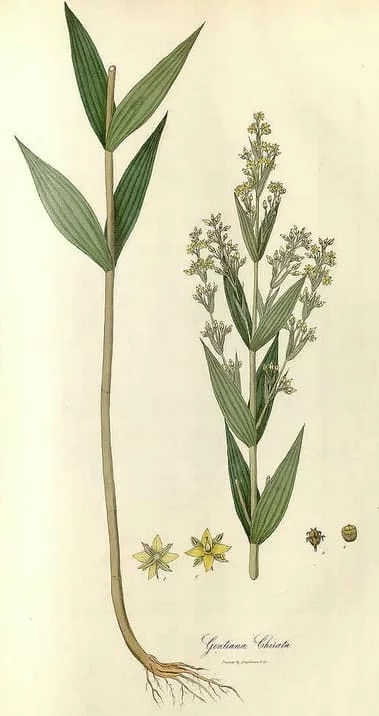
Swertia chirata
Wallich, Plantae Asiaticae Rariores, vol. 3: 1832
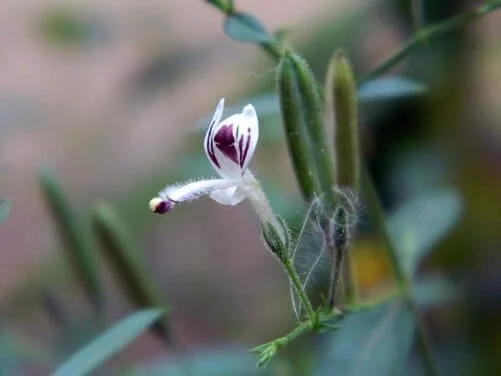
Swertia chirata
(Photo by Rison Thumboor) (Wikimedia)
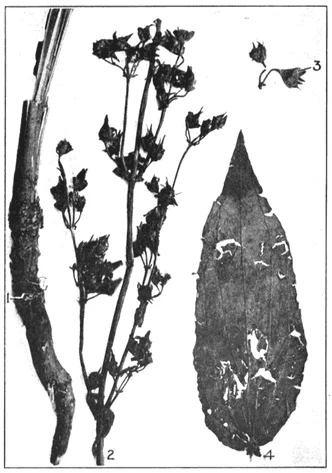
1. Root. 2. Flowering and fruiting top. 3. Fruit.
4. Leaf showing characteristic venation.
(Squibb’s Atlas of the Official Drugs, Mansfield, 1919)
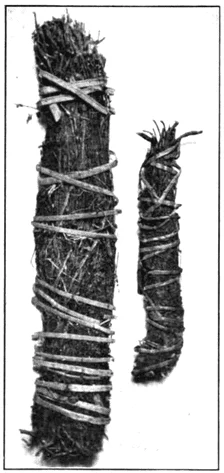
Swertia tied into bundles with bamboo as imported.
(A Text Book of Pharmacognosy
Heber Wilkinson Youngken, 1921)
Botanical name:
Swertia spp.
Several species are used:
1. S. chirata (syn. S. chirayita, S. tongluensis, Gentiana chirayita, G. chirata, Ophelia chirata) (Ayurveda, Unani, Tibetan Medicine)
2. S. mileensis (TCM)
Tibetan Medicine recognises 3 main types of Tig ta:
- India Swertia, S. chirata, S. racemosa (Rgya tig)
- Nepalese Swertia, S. ciliata (Bal tig)
- Tibetan Swertia, Swertia spp. (Bod tig)
A number of local species and varieties are used including
Tibetan:–.S. bimaculata, S. dichotoma, S. erythrosticta, S. franchetiana, S. leducii, S. mussotii, S. nervosa, S. paniculata, S. punicea, S. speciosa, S. wardii, S. younghusbandii, S. yunnanensis
China:–S. angustifolia, S. alata, S. cincta (Sichuan and Yunnan)
Tibetan Medicine recognizes a number of varieties of Tig (a group of medicine) in addition to the above-named species:
- Zangs tig: Genrianodes elwesii, Gentianella moorcroftiana, Saxifraga moorcroftiana
- Icags tig nag po: Halenia elliptica, H. corniculata
- Gser tig mchog: Saxifraga lychnitis, S. parnassifolia
- Sum chu tig ta: Saxifraga umbellulata
- Zangs tig ‘dra ba’i lcags tig nag po: Gentianella azurea
- Lcags tig: Jaeschkea oligosperma; Gentianopsis barbata (in Buryat region)
- Lcags tig dkar po: Swertia petiolata
- Lcags tig nag po: Swertia multicaulis
These may suggest the use of Swertia spp. when these medicines are called for in prescription.
Parts used:
Whole plant
Temperature & Taste:
Cold, dry. Bitter, Pungent
“Hot and dry in the second degree” (Avicenna)
Classification:
2F. PURIFYING
3B. FEBRIFUGE & ANTIPYRETIC 3H. LACTAGOGUE
TCM:
B. Clears Heat and Damp
Uses:
1. Clears Liver Heat and Damp: (Ayurveda, Tibet)
-‘inflammatory conditions of the Stomach, Intestines and Liver’. (Avicenna)
-Liver heat disorder with red eyes, irritability
-Gall Stones and Cholecystitis
-Hepatitis, especially Hepatitis B (see research below).
-Jaundice with dark colored urine (S. mileensis, Chinese Pharmacopoeia)
-Conjunctivitis associated with Liver heat; ‘Clears the Vision’ (Avicenna)
2. Clears Heat, Resists Poison: (Ayurveda, Tibet, Unani)
-various types of Fever including Fever from Liver Heat or Bile, Epidemic Fevers, Chronic Fevers and Malaria (Unani, Tibet)
-Fever caused by aggravation of all 3 Dosas (Wind/Bile/Phlegm) with sweating and thirst (Ayurveda)
-Snake Bite
-Laryngitis, Tonsillitis
-skin diseases with Heat and Redness, Itching; Scabies
-Ulcers.
-Syphilis and Gonorrhea.
–Duke listed it for Cancers of the Colon and Abdomen.
3. Clears Stomach Heat:
-Gastritis, Colitis
-Diarrhea and Dysentery.
-Hyperacidity
4. Clears Heat and Damp, Promotes Urine:
-Damp-Heat urinary disorders such as Strangury and Dysuria
-acute urinary tract infection with difficult painful urination (S. mileensis, Chinese Pharmacopoeia)
-Stones.
-Edema
5. Benefits the Stomach, Promotes Digestion:
-low doses or short term use is good to stimulate the Stomach and Digestion, promote Appetite, and stimulate Bowel movement.
-indigestion, poor appetite and flatulence.
-Atony, Emaciation and after chronic illness when the digestion is poor to stimulate appetite and digestion.
6. Moves the Blood, Promotes Delivery:
-promotes menstruation in Amenorrhea and Dysmenorrhea
-Uterine pain (Avicenna)
-“Useful in cases of bluish discolouration of skin” (Avicenna)
-“It dissolves the swellings” (Avicenna)
-used to promote Delivery. It appears to have been as a Folk remedy for this purpose.
7. Externally:
-strong decoction is applied to all types of inflammation
-as a Folk remedy it is applied as a poultice to Paralyzed Limbs and Rheumatic swellings.
-Burns (Avicenna)
Dose:
Decoction: 5–20 grams (up to 30 grams in Ayurvedic Pharmacopoeia)
Powder: 250mg–3 grams
Tincture (1:5 in 25% alcohol): 3–10mls.
Correctives:
1. Avicenna often combined it with Celery seed.
2. As for Gentian
Substitutes:
1. Among the local species used as substitutes in Ayurveda and Tibetan Medicine are:
a. Clerodendrum inerma
b. Enicostemma littorale (syn. Exacum hyssopifolium, Adenema hyssopifolium)
c. Erythraea roxburghii
d. Exacum spp.
e. Limnanthemum cristatum (syn. Menyanthes hydrophyllum, Nymphoides hydrophyllum)
f. Limnanthemum indicum (syn. Menyanthes indicum, Nymphoides indicum)
g. Gentiana barbata (in Buryat)
h. Lomatogonium carinthiacum, L. rotatum (in Buryat)
i. Schizonepeta (Buryat)
2. Centaury and Gentian are acceptable substitutes.
3. ‘Green Chiretta’ is Andrographis which may be used synonymously.
Main Combinations:
1. Fever:
i. Swertia with Coriander (Ayurveda)
ii. Swertia with Ginger (Ayurveda)
iii. Swertia with Tinospora, Raisins, Emblic Myrobalan, Zedoary
iv. with Diarrhea, Swertia with Cyperus rotundus, Tinospora, Ginger (Chakradatta)
v. Swertia with Camphor, Nutmeg, Clove, Tabasheer, Safflower, Lesser Cardamon, Greater Cardamon, White Sandalwood, Water Buffalo horn (as in Camphor 14 of Tibetan Medicine)
vi. Chronic Fever, Lung Infection, Swertia with Tabasheer, Safflower, White Sandalwood, Picrorhiza, Adhatoda (as in Principle 8 of Tibetan Medicine)
vii. Vetiveria with Swertia, Sandalwood, Cyperus rotundus, Long Pepper, Black Pepper, Ginger (equal parts) (as in Nilavembu Kudineer of Siddha Medicine)
2. Liver Fever, Liver Trauma, Liver Pain, Blood disorders, Swertia with Bezoar, Shilajit, Safflower, Costus, Adhatoda (as in Bezoar 9 of Tibetan Medicine)
3. Hepatitis, Swertia, Celery seed with Honey (Avicenna)
4. For Bile disorders with headache, inflammation, fever, bitter taste and yellowish complexion, Swertia with Costus, Aconitum heterophyllum, Picrorhiza, Barberry (as in Swertia 8 of Tibetan Medicine)
5. Cholecystitis, early Jaundice, Hepatitis, Swertia with Picrorhiza, Barberry bark, Costus (as in Swertia 8 of Tibetan Medicine)
6. Stomach Heat, Gastritis, Colitis:
i. Swertia with Cardamon, Picrorhiza and Turmeric (Ayurveda)
ii. Swertia with Licorice, Costus
7. Thirst, Swertia, Emblic Myrobalan, Coriander, Raisin (Tibet)
8. Kidney Heat, Nephritis, Pyelonephritis, Hematuria, Kidney pain, Swertia with Chebulic Myrobalan, Safflower, Madder, Lacca, Shilajit, Juniper, Mucuna, Lesser Cardamon (as in Chebula 10 of Tibetan Medicine)
9. Strangury, difficult or painful Urination:
i. Swertia, Celery seed (Avicenna)
ii. Swertia with Tribulus, Barberry
iii. Swertia with Plantain seed
10. Menorrhagia from Heat:
i. Swertia, Barberry extract, Amaranthus spinosa (equal parts), taken with Honey and Rice rinse water.
ii. Swertia with Barberry, Cyperus rotundus, Adhatoda (Vasaka)
iii. Swertia with Red Earth
11. Uterine pain, “Oral intake of its decoction or a sitz-bath in it is useful in uteralgia.” (Avicenna)
12. Edema or Fever, Swertia with Ginger (Ayurveda)
13. Skin diseases, Swertia with Neem, Madder and Gotu Kola (Ayurveda)
14. ‘Nothing is more useful in burns than chiratta with rose oil and vinegar.’ (Avicenna)
Major Formulas:
Ayurveda
Sudarshan Churna (Auspicious Sight Powder)
Tibetan:
Conqueror of Brown Phlegm (Smug po gyul rgyal)
Cowrie Ash 6 (Mgron thal drug pa)
Goethite 25 (Mdung rtse nyer lnga)
Great Black Combination (Sman nag chen mo)
Great Decoction 25 (Thang chen nyer lnga)
Lunar 5 (Zla ‘od lnga pa)
Safflower Supreme 7 (Gur gum mchog bdun)
Swertia 5 Decoction (Tig ta lnga thang)
Swertia 8 (Tig ta brgyad pa)
Swertia 25 (Tig ta nyer lnga)
Cautions:
1. Cold, so not suitable in cold and weak Stomach
2. Not used in Pregnancy
3. Not used in Vata/Wind conditions.
Main Preparations used:
Click the above Tabs for more information on this medicine
‘Kirayat has long been an important article of the Hindu Materia Medica. It is mentioned by Susruta and other Sanskrit writers under the name of Kirata-tikta, which means the bitter plant of the Kiratas, an outcaste race of mountaineers in the north of India. It is also called Anarya-tikta, “the bitter plant of the non-Aryans.” Another Sanskrit name is Bhunimba, “ground-nim.” The herb is much esteemed by the Hindu physicians on account of its tonic, anthelmintic and febrifuge properties, and is prescribed in masked forms of malarial fever in which the chief symptoms are dyspepsia; it is usually combined with aromatics, such as ginger and lemon grass.
It is also considered to be laxative, anthelmintic and alterative. In the Bhaishajya-ratuavali, a decoction is directed to be made of equal parts of chiretta, Tinosposa stems, raisins, emblic myrobalans and zedoary root. Chiretta is one of the 54 ingredients of the compound powder known as Sudareana churna, and it gives its name to a compound oil called Kiratadi-taila, in which it is combined with 26 other drugs, mostly aromatics and stimulants. This oil is rubbed on the body in obstinate cases of ague, causing emaciation and anaemia. (Bhaishajya-ratnavali.) Mahometan writers upon Indian drugs have identified Chiretta with the Kasab-ed-darira of the Arabs, and Calamus aromaticus of Dioscorides. Guibourt was also of the same opinion, but Fee and Royle dissent from it.
The author of the Makhzan-el Adwiya gives at the end of his article upon Kasab-ed-darira the following short summary of the manner in which Chiretta is used by the Hindu physicians :— “They consider it to be cold and dry, light and flatulent; a remedy for colds and bilious affections, burning of the body, and the fever arising from derangement of the three humors which they call sannipat (fever with delirium).”
The plant was first described by Roxburgh under the name of Gentiana Ghirayita in 1814. Ainslie notices it, and remarks that it appears to be much used in Bengal; it was probably rather a scarce drug in Southern India in his time, as he says little about it. In England it began to attract attention about the year 1829; and in 1839 was introduced into the Edinburgh Pharmacopoeia. It is now official in the British and Indian Pharmacopoeias, and is generally accepted as a valuable bitter tonic. In Western India it has a reputation as a remedy for bronchial asthma, and in some cases we have known it used with success. (Pharmacographia Indica, Dymock, 1891)
GENERAL / REVIEW
–Swertia L.: A comprehensive review of its genetic relationship, chemical compositions, pharmacological effects, toxicities, and applications.
–Swertia chirayita: A comprehensive review on traditional uses, phytochemistry, quality assessment and pharmacology.
–Swertia chirata: A Comprehensive Review with Recent Advances.
–A Review of Swertia chirayita (Gentianaceae) as a Traditional Medicinal Plant.
–Phytochemistry and Pharmacological Activities of the Genus Swertia (Gentianaceae): A Review.
–Progress in Pharmacokinetics, Pharmacological Effects, and Molecular Mechanisms of Swertiamarin: A Comprehensive Review.
–Chemical Characterization and Anti-Inflammatory Activity of Phytoconstituents from Swertia alata.
–[Chemical constituents from petroleum ether fraction of Swertia chirayita and their activities in vitro].
–[Research on origin, property and efficacy of Tibetan medicine “Dida”].
ANTI-INFLAMMATORY
–Anti-inflammatory effects of amarogentin on 2,4-dinitrochlorobenzene-induced atopic dermatitis-like mice and in HaCat cells.
–Anti-inflammatory Effects of Sweroside on LPS-Induced ALI in Mice Via Activating SIRT1.
–Anti-inflammatory activity of compounds isolated from Swertia mussotii.
–Anti-inflammatory and Anti-HIV Compounds from Swertia bimaculata.
ANTIOXIDANT
–Antioxidant and Hepatoprotective Effect of Swertiamarin on Carbon Tetrachloride-Induced Hepatotoxicity via the Nrf2/HO-1 Pathway.
–Evaluation of antioxidant, antibacterial, and antidiabetic potential of two traditional medicinal plants of India: Swertia cordata and Swertia chirayita.
–Comparative phytochemical, hepatoprotective and antioxidant activities of various samples of Swertia Chirayita collected from various cities of Pakistan.
ANTIBACTERIAL
–Antibacterial Activity of Economically Important Medicinal Plants in Pakistan Against Different Bacterial Strains.
–Evaluation of antioxidant, antibacterial, and antidiabetic potential of two traditional medicinal plants of India: Swertia cordata and Swertia chirayita.
ANTI-HELICOBACTER
–Anti-Helicobacter pylori activity of swertianolin, isolated from swertia herb.
ANTI-VIRAL
HEPATITIS B
–Anti-hepatitis B virus active constituents from Swertia chirayita.
–Chemical constituents of Swertia delavayi and their anti-hepatitis B virus activity.
–Chemical constituents of Swertia mussotii and their anti-hepatitis B virus activity.
–Three new secoiridoids, swermacrolactones A-C and anti-hepatitis B virus activity from Swertia macrosperma.
–Chemical constituents of Swertia yunnanensis and their anti-hepatitis B virus activity.
–Xanthones with anti-hepatitis B virus activity from Swertia mussotii.
–Seven new secoiridoids with anti-hepatitis B virus activity from Swertia angustifolia.
HIV
–Anti-inflammatory and Anti-HIV Compounds from Swertia bimaculata
COVID
–Swertiamarin and sweroside are potential inhibitors of COVID-19 based on the silico analysis.
ANTICONVULSANT
–Anticonvulsant Effect of Swertiamarin Against Pilocarpine-Induced Seizures in Adult Male Mice.
NEUROPROTECTIVE
–Neuroprotective Effects of Isolated Mangiferin from Swertia chirayita Leaves Regulating Oxidative Pathway on Streptozotocin-Induced Diabetic Neuropathy in Experimental Rats.
–Screening of radical-scavenging natural neuroprotective antioxidants from Swertia chirayita.
HEPATOPROTECTIVE
–UPLC-QTOF-MS based targeted metabolomics to unravel the hepatoprotective marker compounds of Swertia chirayita.
–Swertiamarin or heat-transformed products alleviated APAP-induced hepatotoxicity via modulation of apoptotic and Nrf-2/NF-κB pathways.
–Swertia bimaculata moderated liver damage in mice by regulating intestine microbiota.
–Exploration of the Hepatoprotective Effect and Mechanism of Swertia mussotii Franch in an Acute Liver Injury Rat Model.
–Analyzing the hepatoprotective effect of the Swertia cincta Burkillextract against ANIT-induced cholestasis in rats by modulating the expression of transporters and metabolic enzymes.
–Antioxidant and Hepatoprotective Effect of Swertiamarin on Carbon Tetrachloride-Induced Hepatotoxicity via the Nrf2/HO-1 Pathway.
–Comparative phytochemical, hepatoprotective and antioxidant activities of various samples of Swertia Chirayita collected from various cities of Pakistan.
–The hepatoprotective effect and chemical constituents of total iridoids and xanthones extracted from Swertia mussotii Franch.
–Hepatoprotective activity of Andrographis paniculata and Swertia chirayita.
CHOLESTASIS
–Total Iridoid Glycosides from Swertia mussotii Franch. Alleviate Cholestasis Induced by alpha-Naphthyl Isothiocyanate through Activating the Farnesoid X Receptor and Inhibiting Oxidative Stress.
GALL STONES / CHOLECYSTITIS
–Therapeutic effect of iridoid and xanthone glycosides components extracted from Swertia Mussotti on calculous cholecystitis and its clinical complications by targeting COX2.
FATTY LIVER DISEASE
–Swertianin Suppresses M1 Macrophage Polarization and Inflammation in Metabolic Dysfunction-Associated Fatty Liver Disease via PPARG Activation.
DIABETES / HYPOGLYCEMIC
–Anti-diabetes activity of (R)-gentiandiol in KKAy type 2 mice.
–Swertiamarin ameliorates type 2 diabetes by activating ADRB3/UCP1 thermogenic signals in adipose tissue.
–Utilization of Swertia chirayita Plant Extracts for Management of Diabetes and Associated Disorders: Present Status, Future Prospects and Limitations.
–Reverse Phase-ultra Flow Liquid Chromatography-diode Array Detector Quantification of Anticancerous and Antidiabetic Drug Mangiferin from 11 Species of Swertia from India.
–Evaluation of antioxidant, antibacterial, and antidiabetic potential of two traditional medicinal plants of India: Swertia cordata and Swertia chirayita.
–Xanthones from Swertia mussotii as multitarget-directed antidiabetic agents.
–Hypoglycemic Activity and Antioxidative Stress of Extracts and Corymbiferin from Swertia bimaculata In Vitro and In Vivo.
–Antidiabetic effects of Swertia macrosperma extracts in diabetic rats.
–In vitro and in vivo anti-diabetic activity of Swertia kouitchensis extract.
–Phenolic-linked biochemical rationale for the anti-diabetic properties of Swertia chirayita (Roxb. ex Flem.) Karst.
CANCER
–Swertia chirayita suppresses the growth of non-small cell lung cancer A549 cells and concomitantly induces apoptosis via downregulation of JAK1/STAT3 pathway.
–Therapeutic potential of xanthones from Swertia chirata in breast cancer cells.
–Swertia mussotii extracts induce mitochondria-dependent apoptosis in gastric cancer cells.
–Reverse Phase-ultra Flow Liquid Chromatography-diode Array Detector Quantification of Anticancerous and Antidiabetic Drug Mangiferin from 11 Species of Swertia from India.
ANTI-METASTATIC
–Anti-Metastatic Potential of a Novel Xanthone Sourced by Swertia chirata Against In Vivo and In Vitro Breast Adenocarcinoma Frameworks.
You must be logged in to view this content, please login. If you're not a member then Click this link to subscribe