
Rhabarbari, Rhubarb, Da Huang 大黄
Rha Barbarum, Raved Sceni, Turkey Rhubarb
Da Huang: ‘Big Yellow’ (TCM)
Amla-Vetasa or Amla Parni (Ayurveda)
Chutsu (Tibet)

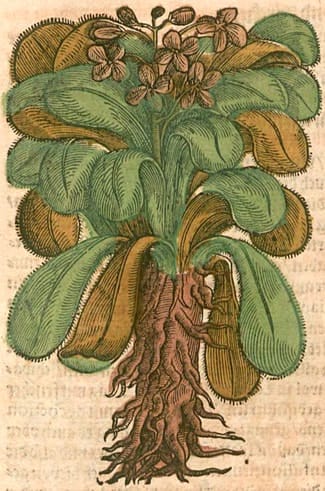
Krauterbuch, Lonitzer, 1578
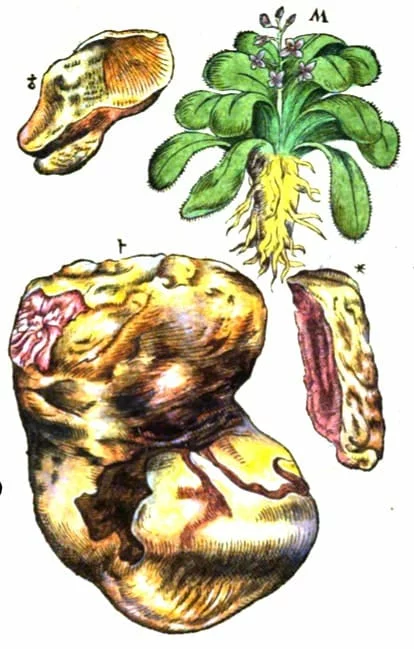
Kreutterbuch, Matthiolus, 1586
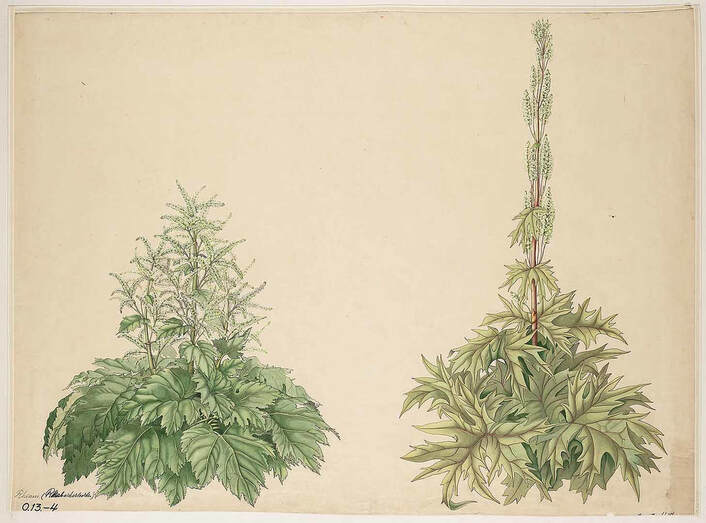
Two forms of Rhubarb
Botanische wandplaten, (1904–1914)
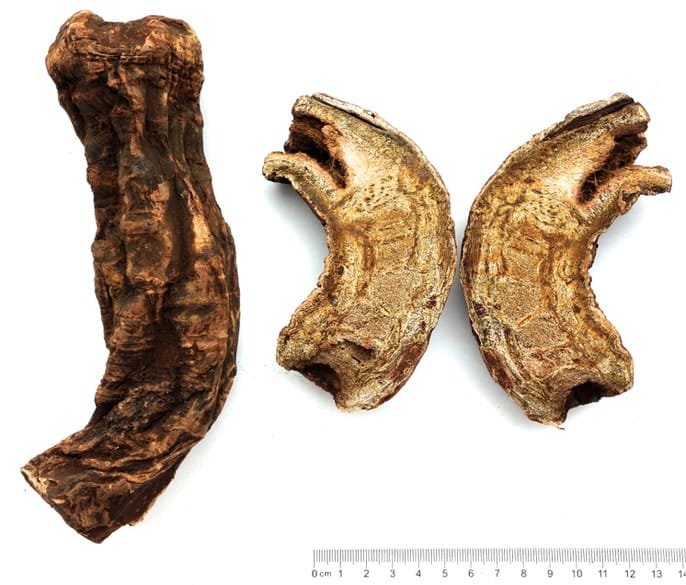
Wild-crafted Rhubarb: whole (left) and sliced (right)
(Chengdu, 2016, photo by Adam)
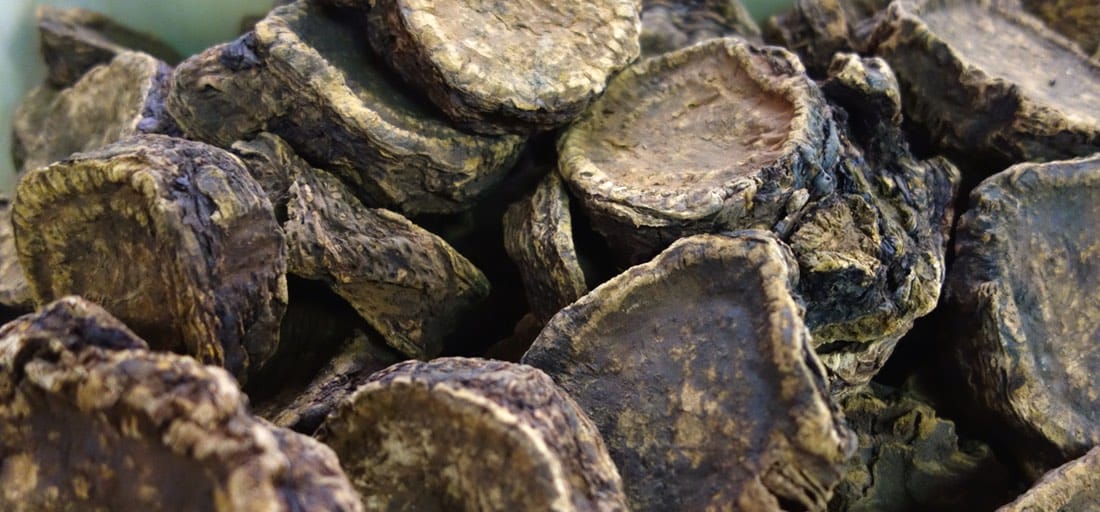
Large slices of Wild Rhubarb (Adam, 2016)
Botanical name:
Rheum palmatum, R. officinale
Parts used:
Root (Rhizome)
Temperature & Taste:
Cold, dry. Bitter.
Classifications:
2A APERIENT. 2D ATTENUATERS OF CONGEALED BLOOD. 2F. PURIFYING 2G. CLEANSING. 2O. ASTRINGENT. 2P. HEMOSTATICS
2S. STRENGTHENING
3B. FEBRIFUGE & ANTIPYRETIC. 3M. ARTHRITIC. 3Q. ANTHELMINTIC
4a. CEPHALIC. 4e. STOMACHIC. 4g. HEPATIC
Uses:
1. Clears Heat, Purges Accumulations, Promotes Stool (TCM, West, Ayurveda, Tibetan):
-purges Bile, stagnant food, congested Blood, and Ama (toxic residues of digestion).
-heat and obstruction of the Stomach, Liver and Bowels.
-Constipation and abdominal fullness with heat symptoms
2. Clears Heat and Toxin (TCM, West, Ayurveda, Tibetan):
-clears Heat and Toxin from the Stomach, Bowels, Liver and Blood
-Chronic Fever; Influenza; acute excess Heat and Toxin including Acute Sore Throat, Tonsillitis
3. Moves the Blood, Clears Stasis (TCM, West, Ayurveda, Tibetan):
-Blood stagnation after Trauma, Bruising, Fractures
-Amenorrhea and Dysmenorrhea
-“Most useful in cases of Injuries caused by Falls and Beating”. (Avicenna)
4. Guides Downward:
-Wind-Heat Headache, Dizziness, Vertigo, Hypertension
-sensation of Qi rising in the body; excess in the upper body
5. Benefits the Stomach and Digestion:
-various old authors recommended small doses as a strengthening tonic. (Haller, Lexicon, 1755)
-small doses are used to improve digestion, resist fermentation and increase gastric acid
-Childhood Nutritional Impairment; chronic digestive weakness in infants, including that caused by Worms
6. Clears Heat, Opens the Lungs:
-Cough, Breathless, Asthma coming from Heat
-Pleurisy, inflammation of the Lungs; Spitting of Blood. (Dioscordies)
-“It is useful in Asthma and Hemoptysis”. (Avicenna)
7. Clears Heat, Stops Bleeding:
-charred Rhubarb has been used in TCM and the West to stop bleeding, especially of the gastrointestinal tract
-Hemoptysis. (Dioscordies)
-bleeding from the bowels with constipation; Dysentery with Blood
8. Kills Worms:
-Worms in children (Matthiolus)
9. Externally:
-applied to Boils, Burns, Carbuncles, Herpes and various skin problems with heat and toxin. (wash, powder, or ointment)
-the powder mixed with vinegar was applied to Eczema, Ringworm, Bruises and Burns.
–Dioscorides said ‘it dissipates all inveterate inflammations being applied with water’.
-applied with Wine to Masses, Lumps, Swellings and Tumors
-removes Freckles, Naevus, Moles, and Spots, powdered and mixed with vinegar (Dioscorides, Unani)
-powder is applied to stop Bleeding
-a piece of the root chewed each morning was recommended to preserve health (Matthiolus)
Dose:
Powder: 200mg–4 grams
Brief Decoction: 2–9 grams
Correctives:
Preparation:
Main Combinations:
1. Rhubarb combines well with Madder to clear Heat and Toxin, as well as for Blood stagnation. Together, they cleanse the Blood, clear Bruising and open obstructions. They have been combined in a number of formulas in both East and West.
2. Chronic illness, Cachexia, Jaundice; obstructions of the Liver or Spleen, Rhubarb with … available in PRO version
3. Jaundice in Children, Rhubarb … available in PRO version
4. As a Cholagogue, Rhubarb with … available in PRO version
5. Liver diseases, and Spitting of Blood from Heat, Rhubarb with … available in PRO version
6. Hepatitis and Uterus pain from Heat and obstruction, Rhubarb with … available in PRO version
7. To purge various humors from all parts of the body, Rhubarb with … available in PRO version
8. Obstructed Urine, Rhubarb with … available in PRO version
9. Ascites, Rhubarb with … available in PRO version
10. Hematuria, Rhubarb with … available in PRO version
11. Diarrhea, Rhubarb with … available in PRO version
12. Dysentery, Rhubarb with … available in PRO version
13. Laxative, Rhubarb with … available in PRO version
14. Constipation with Cold, Rhubarb with … available in PRO version
15. Constipation from dryness, Rhubarb with … available in PRO version
16. Constipation from excess Heat, Rhubarb with … available in PRO version
17. Gout and Arthritis from Heat and Damp, Rhubarb with … available in PRO version
18. Lung Ulcer, Rhubarb … available in PRO version
19. Internal Bruising, Rhubarb with … available in PRO version
20. Topically for burns, Rhubarb with … available in PRO version
Major Formulas:
Syrup of Chicory and Rhubarb (Nicholas)
Powder of Rhubarb (Fuchs)
Powder of Chebula and Rhubarb (Philon)
Powder of Three Solutives (Augustine Pharmacopoeia)
Bruise Powder (Mesue)
Troches of Rhubarb (Mesue)
Troches of Rhubarb Greater
Troches of Rhubarb Lesser (Unani)
Electuary of Rhubarb (Zenon)
Electuary of Rhubarb (Unani)
Electuary for Internal Bruising
Pills of Rhubarb (Mesue)
Pills of Rhubarb (Greater) (Pil. de Raved Sceni) (Mesue)
Pills of Rhubarb and Agaric (Mesue)
Pills to Purge Bile and Phlegm (1) (Mesue)
Da Cheng Qi Tang

Cautions:
1. Not used in Pregnancy (small doses have been given)
2. Not used in marked weakness (unless well corrected)
Main Preparations used:
Candied Rhubarb, Extract of Rhubarb
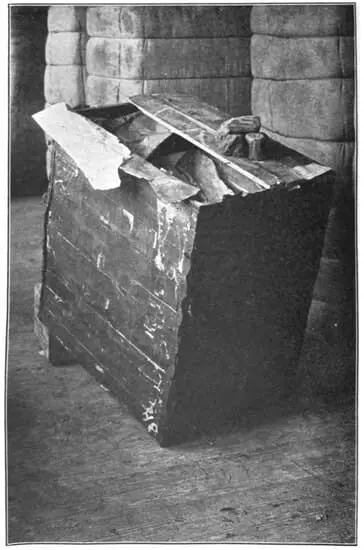
Rhubarb as exported 100 years ago. Wooden case with
yellow tissue paper lining a hermetically sealed inner tin.
Squibb’s Atlas of the Official Drugs, Mansfield, 1919
Click the above Tabs for more information on this medicine
The Chinese appear to have been acquainted with the properties of rhubarb from a period long anterior to the Christian era, for the drug is treated of in the herbal called Pen-king, which is attributed to the Emperor Shen-nung, the father of Chinese agriculture and medicine, who reigned about 2700 B.C. The drug is named there Huang-Hang, yellow excellent, and Ta-huang, the great yellow. The latter name also occurs in the great Geography of China, where it is stated that rhubarb was a tribute of the province Si-ning-fu, east ward of Lake Kuku Nor, from about the 7th to the 10th centuries of our era. previously unrestricted, was limited to the government caravans which passed the frontier only at Kiachta and at Zuruchaitu, south of Nerchinsk. The latter place always remained unimportant, while Kiachta and the opposite Chinese town of Maimatchin became the staple depots of rhubarb.
As regards Western Asia and Europe, we find a root called [?] or [?], mentioned by Dioscorides as brought from beyond the Bosphorus. The same drug is alluded to in the fourth century by Ammianus Marcellinus, who states that it takes its name from the river Rha (the modern Volga), on whose banks it grows. Pliny describes a root termed Bhacoma, which when pounded yielded a colour like that of wine but inclining to saffron, and was brought from beyond Pontus. The root was subjected to special control as early as 1687-1697 by the Russian Government, who finally monopolized the trade about 1704. Caravans fitted out by the Crown alone brought the drug to Moscow, until 1762, when the caravan-trade was for a while thrown open. It was not until this period that the export of rhubarb became consider able, although the stringent regulations, established in 1736, were still maintained. The surveillance of rhubarb was exercised at Kiachtaina special court or office called the Brake, under instructions from the Russian Minister of War, by an apothecary appointed for six years, the object being to remove from the rhubarb brought for inspection all interior or spurious pieces, and to improve the selected drug by trimming, paring and boring. It was then carefully dried, and packed in chests, which were sown up in linen, and rendered impervious to wet by being pitched and then covered with hide. The drug was dis patched, but only in quantities of 1000 puds (-10,000 lb.), once a year by way of Lake Baikal and Irkutsk to Moscow, whence it was transmitted to St. Petersburg, to be there delivered to the Crown apothecaries and in part to be sold to druggists.
The drug thus described is usually regarded as rhubarb, or at least as the root of some species of Rheum, but whether produced in the regions of the Euxine (Pontus), or merely received thence from remoter countries, is a question that cannot be solved. We are indebted for these accounts chiefly to Calau, an apothecary appointed to supervise the examination of rhubarb, and who resided a long time at Kiachta. An exact account of the remarkable policy of the Russian Government in relation to that drug was also given by Von Schrbders in 1864.
It is however certain that the name Radix pontica or Rhaponticum, used by Scribonius Largus and Celsus, was applied in allusion to the region whence the drug was received. Lassen has shown that trading caravans from Shensi in Northern China arrived at Bokhara as early as the year 114 B.C. Goods thus transported might reach Europe either by way of the Black Sea, or by conveyance down the Indus to the ancient port of Barbarike. Vincent suggests that the rha imported by the first route would naturally be termed rha-ponticum, while that brought by the second might be called rha-barbamm. So long as China kept all her ports closed to foreign commerce except Canton in the extreme south, a large supply of fine rhubarb found its way to Europe by way of Russia. But the unpleasant accompaniments of the Russian supervision, which was exercised with unsparing severity, and the extreme tediousness of the land-transport, made the Chinese very ready to accept an easier outlet for their goods. Accordingly we find that the opening of a number of ports in the north of China exerted a very depressing influence on the trade of Kiachta, which was augmented by the rebellion that raged in the interior of China for some years from 1852.
We are not prepared to accept this plausible hypothesis. It receives no support from the author of the Periplus of the Erythrean Sea (circa a.d. 64), whose list of the exports of Barbarike does not include rhubarb; nor is rhubarb named among the articles on which duty was levied at the Roman custom-house of Alexandria (A.D. 176-180). On these accounts Russia in 1855 removed certain restrictions on the trade, though without abandoning the Rhubarb Office. She with drew in 1860 the custom-house to Irkutsk, and declared Kiachta a free port, while by the treaty with China of November 1800, she insisted on that country abandoning all restrictions on trade. But the over-land rhubarb trade had already been destroyed: the Chinese, tempted by the increased demand occasioned by the new trading-ports, became less careful in the collection and curing of the root, while the Russians insisted with the greatest strictness on the drug being of the accustomed quality. Hence it happened that from 1860 hardly any rhubarb was delivered at Kiachta, either for the government use or to private traders; and in 1868 the Rhubarb Office was abolished.
The terms Rheum barbarum vel barbaricum or Reu barbarum occur in the writings of Alexander Trallianus about the middle of the 6th century, and in those of Benedictus Crispus, archbishop of Milan, and Isidore of Seville, who both flourished in the 7th century. Among the Arabian writers on medicine, the younger Mesue, in the early part of the 11th century, mentions the rhubarb of China as superior to the Barbaric or Turkish. Thus the so-called Russian or Muscovitic or Crown Rhubarb, familiarly known in England as Turkey Rhubarb, a drug which for its uniformly good quality long enjoyed the highest reputation, has become a thing of the past, which can only now be found in museum collections. It began to appear in English commerce at the commencement of the last century. Alston, who lectured on botany and materia medica at Edinburgh in 1720, speaks of rhubarb as brought from Turkey and the East Indies,— ” and of late, likewise from Muscovy.”
Constantinus Africanus about the same period speaks of Indian and Pontic Rheum, the former of which he declares to be preferable. In 1154 the celebrated Arabian geographer Edrisis It has been shown that rhubarb was shipped from Syria in the 12th century. Vasco da Gama mentions it in 1497 among the exports of Alexandria. In fact, the drug was carried from the far east to Persia, whence it was brought by caravans to Aleppo, Tripoli, Alexandria, and even to Smyrna. From these Levant ports it reached Europe, and was distributed as Turkey Rhubarb; while that which was shipped direct from China, or by way of India, became known as China, Canton, or East India Rhubarb. The latter was already the more common sort in England as early as 1640.
mentions rhubarb as a product of China, growing in the mountains of Buthink— probably the environs of north-eastern Tibet near Lake Tengri Nor (or Bathang in Western Szechuen ?). Rhubarb in the 12th century was probably imported from India, as we may infer from the tariff of duties levied at the port of Aeonin Syria, in which document it is enumerated along with many Indian drugs. A similar list of A.D. 1271, relating to Barcelona, mentions Ruibarbo. In a statute of the city of Pisa called the Breve Fundticariorum, dating 1305, rhubarb (ribarbari) is classified with commodities of the Levant and India. As the rhubarb of the Levant disappeared from trade, that of Russia took not only its place but likewise its name, until the term “Turkey Rhubarb” came to be the accepted designation of the drug imported from Russia. This strange confusion of terms was not however prevalent on the Continent, but was chiefly limited to British trade.
The first and almost the only European who has visited the rhubarb-yielding countries of China is the famous Venetian traveller, Marco Polo, who speaking of the province of Tangut says— ” … et par toutes les montagnes de ces provinces se treuve le reobarbe en grant habondance. Et illec l’achatent les marchans et le portent par le monde.” The risk and expense of the enormous land-transport over almost the whole breadth of Asia, caused rhubarb in ancient times to be one of the very costly drugs. Thus at Alexandria in 1497, it was valued at twelve times the price of benzoin. In France in 1542, it was worth ten times as much as cinnamon, or more than four times the price of saffron. At Ulm in 1596, it was more costly than opium. A German price-list of the magistrate of Schweinfurt, of 1614, shows Radix Rha Barbari to be six times as dear as fine myrrh, and more than twice the price of opium. An official English list giving the price of drugs in 1657, quotes opium as 6s. per lb., scammony 12s., and rhubarb 16s.’ (Pharmacographia, Fluckiger & Hanbury, 1879)
A sketch of the history of rhubarb would be incomplete without some reference to the various routes by which the drug has been conveyed to Europe from the western provinces of the Chinese Empire, and which have given rise to the familiar designations of Russian, Turkey and China Rhubarb.
The first route is that over the barren steppes of Central Asia by Yarkand, Kashgar, Turkestan, and the Caspian to Russia; the second by the Indus or the Persian Gulf to the Red Sea and Alexandria, or by Persia to Syria and Asia Minor; and the third by way of Canton, the only port of the Chinese Empire which, previous to the year 1842, held direct communication with Europe.
In 1653 China first permitted Russia to trade on her actual frontiers. The traffic in Chinese goods was thereupon diverted from the line of the Caspian and Black Sea further north, taking its way from Tangut across the steppes of the high Gobi, and through Siberia by Tobolsk to Moscow. Thus it is mentioned in 1719 that Urga on the north edge of the Gobi desert was the principal depot for rhubarb. From the earliest times, Bucharian merchants appear to have been agents on this traffic, the producers of the drug never concerning themselves about its export.
GENERAL / REVIEW:
–A Comprehensive and System Review for the Pharmacological Mechanism of Action of Rhein, an Active Anthraquinone Ingredient.
–Emodin: A Review of its Pharmacology, Toxicity and Pharmacokinetics.
–Emodin – A natural anthraquinone derivative with diverse pharmacological activities.
–Aloe-emodin: A review of its pharmacology, toxicity, and pharmacokinetics.
–Rhein: A Review of Pharmacological Activities.
–Quantification of mineral elements of Rheum emodi Wallr. (Polygonaceae)
–The Health Benefits of Emodin, a Natural Anthraquinone Derived from Rhubarb-A Summary Update.
–Pharmacokinetics and pharmacodynamics of rhubarb anthraquinones extract in normal and disease rats.
VARIANT SPECIES
–Rheum australe, an endangered high-value medicinal herb of North Western Himalayas: a review of its botany, ethnomedical uses, phytochemistry and pharmacology.
–Comparison of the Phytochemical Properties, Antioxidant Activity and Cytotoxic Effect on HepG2 Cells in Mongolian and Taiwanese Rhubarb Species.
–Phytochemical and Antioxidant Studies on a Rare Rheum cordatum Losinsk. Species from Kazakhstan.
–Pharmacological properties of Rheum turkestanicum Janisch.
PROCESSING
–[New method of processing on Rhei Radix Et Rhizoma and study on quality control of its processing products].
ANTI-BACTERIAL:
–[Research progress in anti-tumor effect of emodin].
–Antimicrobial activity of Sapindus mukorossi and Rheum emodi extracts against H pylori: In vitro and in vivo studies.
–Antimicrobial constituents from the rhizomes of Rheum emodi.
–The anthraquinone rhein exhibits synergistic antibacterial activity in association with metronidazole or natural compounds and attenuates virulence gene expression in Porphyromonas gingivalis.
ANTI-FUNGAL:
–Antifungal activity of anthraquinone derivatives from Rheum emodi.
ANTIOXIDANT:
–Antioxidant Activities of Stilbenoids from Rheum emodi Wall.
–Activity-guided isolation of antioxidants from the roots of Rheum emodi.
–Antioxidant and Anti-Cancer Potentials of Rheum emodi Rhizome Extracts.
ANTI-VIRAL:
–[Research progress in anti-tumor effect of emodin].
–Promising Role of Emodin as Therapeutics to Against Viral Infections.
–Anti-influenza A Virus Effects and Mechanisms of Emodin and Its Analogs via Regulating PPARα/γ-AMPK-SIRT1 Pathway and Fatty Acid Metabolism
–Rheum emodin inhibits enterovirus 71 viral replication and affects the host cell cycle environment.
–Antiviral effect of emodin from Rheum palmatum against coxsakievirus B5 and human respiratory syncytial virus in vitro.
–Antiviral activity of Rheum palmatum methanol extract and chrysophanol against Japanese encephalitis virus.
ANTI-ALLERGY
–Anti-allergic activity of emodin on IgE-mediated activation in RBL-2H3 cells.
PULMONARY PROTECTIVE
–Emodin Protects Against Lipopolysaccharide-Induced Acute Lung Injury via the JNK/Nur77/c-Jun Signaling Pathway.
ASTHMA
–Emodin alleviates alternatively activated macrophage and asthmatic airway inflammation in a murine asthma model.
HERPES LABIALIS:
–Combined herbal preparation for topical treatment of Herpes labialis.
NEUROPROTECTIVE:
–Active Compounds of Rhubarb Root and Rhizome in Animal Model Experiments of Focal Cerebral Ischemia.
–Exploring the journey of emodin as a potential neuroprotective agent: Novel therapeutic insights with molecular mechanism of action.
–Emodin ameliorates antioxidant capacity and exerts neuroprotective effect via PKM2-mediated Nrf2 transactivation.
PROTECTS MEMORY
–Protective effects of aloe-emodin on scopolamine-induced memory impairment in mice and H₂O₂-induced cytotoxicity in PC12 cells.
POST STROKE / CEREBRAL ISHCEMIA TREATMENT:
–Active Compounds of Rhubarb Root and Rhizome in Animal Model Experiments of Focal Cerebral Ischemia.
–Rhubarb root and rhizome-based Chinese herbal prescriptions for acute ischemic stroke: a systematic review and meta-analysis.
PANCREATITIS
–Emodin has a protective effect in cases of severe acute pancreatitis via inhibition of nuclear factor‑κB activation resulting in antioxidation.
–[Pharmacological study on free anthraquinones compounds in rhubarb in rats with experimental acute pancreatitis].
HEPATITIS B:
–Anti-HBV effect of individual traditional Chinese herbal medicine in vitro and in vivo: an analytic review.
–Traditional Chinese medicine and related active compounds against hepatitis B virus infection.
HEPATOPROTECTIVE:
–Rhein: A Review of Pharmacological Activities.
–Hepatoprotective activity of Sapindus mukorossi and Rheum emodi extracts: in vitro and in vivo studies.
LIVER FIBROSIS
–Emodin Alleviates Liver Fibrosis of Mice by Reducing Infiltration of Gr1hi Monocytes.
OSTEOARTHRITIS
–Emodin ameliorates cartilage degradation in osteoarthritis by inhibiting NF-κB and Wnt/β-catenin signaling in-vitro and in-vivo.
AUTOIMMUNE DISEASES
–[Research progress of effect of Rhei Radix et Rhizoma and its anthraquinone in treatment of autoimmune diseases].
CARDIOVASCULAR DISEASE
–Molecular Mechanisms of Action of Emodin: As an Anti-Cardiovascular Disease Drug.
NEPHROPROTECTIVE:
–Rhein: A Review of Pharmacological Activities.
–Effect of Rheum emodi (Revand Hindi) on renal functions in rats.
ANTI-NEPHROTOXIC:
–Botanical medicines for the urinary tract.
RENAL FAILURE / CHRONIC KIDNEY DISEASE:
–[Progress on research of mechanism of Rheum palmatum in delaying the chronic renal failure]. (NO ABSTRACT)
–Rheum officinale (a traditional Chinese medicine) for chronic kidney disease.
–Effect of Rheum emodi (Revand Hindi) on renal functions in rats.
ANTI-DIABETIC / HYPOGLYCEMIC:
–Evaluation of anti-diabetic and alpha glucosidase inhibitory action of anthraquinones from Rheum emodi.
–[Studies on hypoglycemic action of Rheum emodi].
ANTI-ANGIOGENIC:
–Antiangogenic effect of selected phytochemicals.
–Anti-angiogenic effects of rhubarb and its anthraquinone derivatives.
ANTI-TUMOR, ANTI-CANCER:
–[Research progress in anti-tumor effect of emodin].
–Anti-cancer properties of anthraquinones from rhubarb.
–Potential antineoplastic effects of Aloe-emodin: a comprehensive review.
–Cancer-specific chemoprevention and anti-metastatic potentials of Rheum emodi rhizome ethyl acetate extracts and identification of active principles through HPLC and GC-MS analysis.
–Antioxidant and Anti-Cancer Potentials of Rheum emodi Rhizome Extracts.
–Aloe emodin suppresses EGF‑induced neoplastic cell transformation by inhibiting the ERK/MSK1 and AKT/GSK3β signaling pathways.
–[Research progress in anti-tumor effect of emodin].
–Potential antineoplastic effects of Aloe-emodin: a comprehensive review.
–Anthraquinone emodin inhibits human cancer cell invasiveness by antagonizing P2X7 receptors.
–Anticancer potential of emodin.
BREAST CANCER:
–Acceleration of pro-caspase-3 maturation and cell migration inhibition in human breast cancer cells by phytoconstituents of Rheum emodi rhizome extracts.
–Apoptosis induction in MDA-MB-435S, Hep3B and PC-3 cell lines by Rheum emodi rhizome extracts.
–Rhein induces apoptosis in human breast cancer cells.
–Emodin Inhibits the Proliferation of MCF-7 Human Breast Cancer Cells Through Activation of Aryl Hydrocarbon Receptor (AhR).
–In Vitro Estrogenic and Breast Cancer Inhibitory Activities of Chemical Constituents Isolated from Rheum undulatum L.
–The anthraquinone derivative Emodin inhibits angiogenesis and metastasis through downregulating Runx2 activity in breast cancer.
–Synergistic effects of curcumin with emodin against the proliferation and invasion of breast cancer cells through upregulation of miR-34a.
CERVICAL
–Emodin Induces Death in Human Cervical Cancer Cells Through Mitotic Catastrophe.
–Emodin induces apoptosis of human cervical cancer hela cells via intrinsic mitochondrial and extrinsic death receptor pathway.
COLON CANCER:
–Antitumor effects of emodin in CACO-2 human colon carcinoma cells are mediated via apoptosis, cell cycle arrest and downregulation of PI3K/AKT signalling pathway.
–ACSL4 promotes colorectal cancer and is a potential therapeutic target of emodin.
–Antitumor effects of emodin in CACO-2 human colon carcinoma cells are mediated via apoptosis, cell cycle arrest and downregulation of PI3K/AKT signalling pathway.
LEUKEMIA
–Emodin enhances ATRA-induced differentiation and induces apoptosis in acute myeloid leukemia cells.
LIVER
–Emodin inhibits migration and invasion of MHCC-97H human hepatocellular carcinoma cells.
–Emodin induces hepatocellular carcinoma cell apoptosis through MAPK and PI3K/AKT signaling pathways in vitro and in vivo.
–Inhibitory effect of emodin on human hepatoma cell line SMMC-7721 and its mechanism.
LUNG
–Emodin induces apoptosis and suppresses non-small-cell lung cancer growth via downregulation of sPLA2-IIa.
MELANOMA
–Emodin Suppresses the Migration and Invasion of Melanoma Cells.
NASOPHARYNGEAL
–Emodin suppresses the nasopharyngeal carcinoma cells by targeting the chloride channels.
PANCREATIC
–Emodin and rhein decrease levels of hypoxia-inducible factor-1α in human pancreatic cancer cells and attenuate cancer cachexia in athymic mice carrying these cells.
–Effects of emodin on the demethylation of tumor-suppressor genes in pancreatic cancer PANC-1 cells.
PROSTATE CANCER:
–Apoptosis induction in MDA-MB-435S, Hep3B and PC-3 cell lines by Rheum emodi rhizome extracts.
LIVER CANCER:
–Apoptosis induction in MDA-MB-435S, Hep3B and PC-3 cell lines by Rheum emodi rhizome extracts.
CHEMOTHERAPY RESISTANCE
–Emodin reverses leukemia multidrug resistance by competitive inhibition and downregulation of P-glycoprotein.
SYNERGISTIC WITH CHEMOTHERAPY
–Aloe-Emodin Enhances Tamoxifen Cytotoxicity by Suppressing Ras/ERK and PI3K/mTOR in Breast Cancer Cells.
PSORIASIS
–A systematic comparison of the effect of topically applied anthraquinone aglycones to relieve psoriasiform lesion: The evaluation of percutaneous absorption and anti-inflammatory potency.
SCAR TISSUE
–[Active ingredients in rhubarb with anti-proliferative effects on scar fibroblasts].
DYSMENORRHEA:
–Effect of rhubarb (Rheum emodi) in primary dysmenorrhoea: a single-blind randomized controlled trial.
“Its greatest virtue is that it purifies the stomach, liver, and even blood in the body, and removes all obstruction of the internal organs, from which serious diseases, such as dropsy, jaundice, quarter fever, and affections of the spleen, more readily arise”. (Dorsetn, 1540)