Pulegium, Pennyroyal
Pulegium, Pennyroya
Futang (Unani)
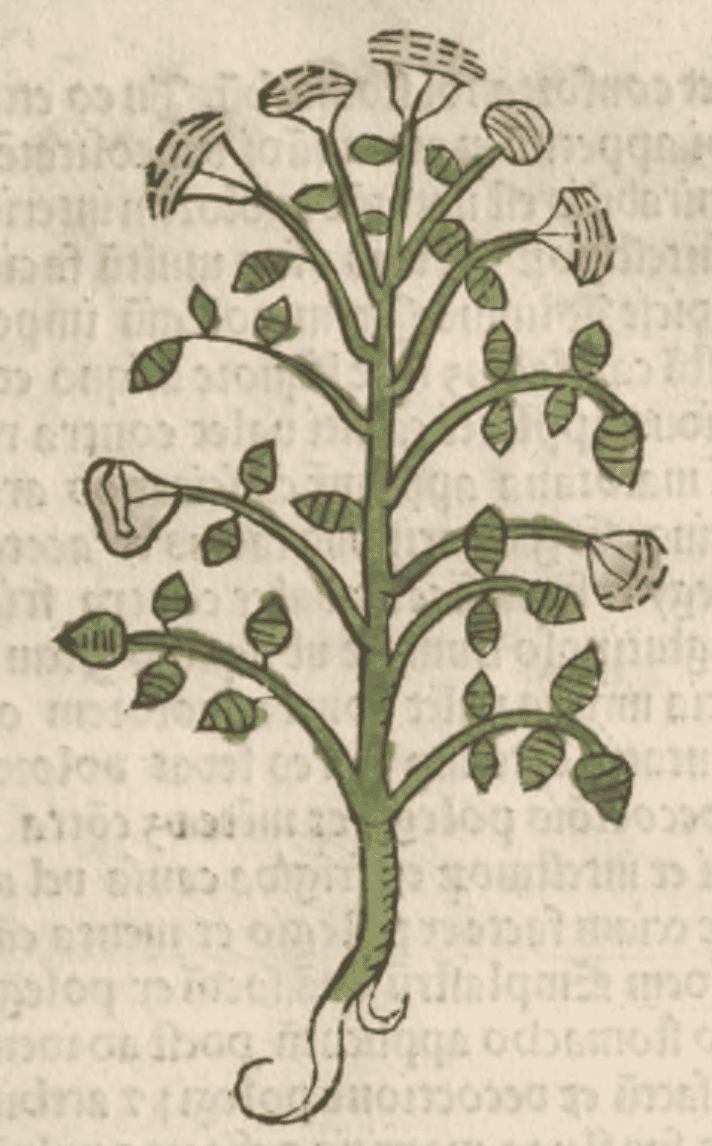
Herbarius latinus, Petri, 1485
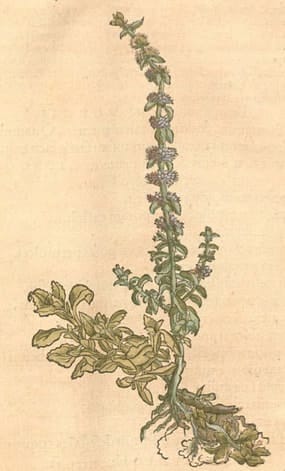
Herbarum Vivae Eicones, Otto Brunfels, 1530
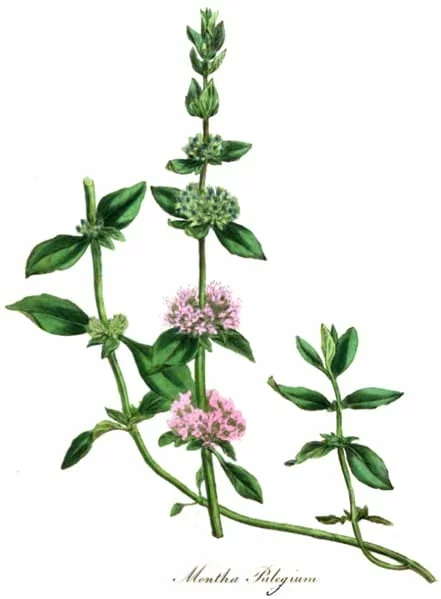
Medical Botany, Woodville, 1810
Botanical name:
Mentha pulegium
Parts used:
Herb
“When Pennyroyal bears flowers and is to be collected, then it lasts for two years”. (Dorsetn, 1540)
Temperature & Taste:
Slightly Warm, dry. Pungent, Bitter
Classifications:
2A APERIENT. 2B ATTENUATER. 2F. PURIFYING. 2H. CARMINATIVE. 2J. RAREFYING
3C. ALEXIPHARMIC. 3G. EMMENAGOGUE. 3H. LACTAGOGUE. 3K. EXPECTORANT. 3M. ARTHRITICS
4a. CEPHALIC. 4f. SPLENETIC. 4i. UTERINE. 4k. ARTHRITIC
Uses:
1. Warms the Womb, Moves Qi, Promotes Menstruation:
-Amenorrhea, Dysmenorrhea (since Hippocrates)
-promote Labor, clear the Afterbirth, and expel a Dead Child. “Taken in drink or with food, it expels the Afterbirth”. (Dorsetn, 1540)
-can be taken (in low doses) for 2–3 weeks before Childbirth to prepare the Uterus (Dr. Christopher)
-prevents and treats Postpartum disorders.
-Leukorrhea from Cold and Damp
-“A fomentation made from the decoction dries up the moisture of the uterus, and wonderfully tightens the vagina”. (Dorsetn, 1540)
2. Clears Phlegm, Stops Cough:
-‘cleanseth the Lungs, and cleareth the Breast from all Gross and thick humours’;
-‘being mingled with Honey and Salt, it voids phlegm out of the Lungs’ (Culpeper)
-Cough, Asthma, and Whooping Cough
-“Asthma is removed when mixed with honey and taken internally”. (Dorsetn, 1540)
3. Moves Qi, Settles Wind, Eases Pain:
-Bile disorders, Biliousness (Lonicerus)
-Headache, Dizziness, Vertigo, Spasms, Nervousness, Hysteria, and Lethargy‘
-“all pains of the head and sinews that come of a Cold cause… and applied to the Nostrils with Vinegar, revives those that are fainting and swooning” (Culpeper)
-“He who is constantly drowsy, let him take fresh Pennyroyal, and put it under his tongue, and keep it in his mouth, and if he takes it frequently, it will help him, and will prevent sleep”. (Dorsetn, 1540)
-“the seed of Pennyroyal if it be smelled unto, is singular good to recover their tongue again who be Speechless”. (Pliny)
-“If he is mute, let him take pulgium, and dissolve it in good wine or vinegar, and apply it to his tongue; this will quickly restore speech”. (Dorsetn, 1540)
-strengthens the Eyesight.
4. Resists Poison:
-“cures the bite of a Viper … Taken in wine, dispels the poison of snakes.”. (Dorsetn, 1540)
-“Drank with wine, it helps such as are bitten and Stung with Venomous beasts”, (Culpeper)
-in enemas for Worms
5. Moves Qi, Regulates the Stomach, Eases Pain:
-cold stomach pain, “gnawing of the Stomach” and “Pains of the Colic”.
-nausea, digestive weakness (Lonicerus)‘
-“taken with water and vinegar to asswageth the inordinate desire to vomit, and the pains of the stomach”.
-Taken with Honey and Salt it ‘purges Melancholy by Stool’.
6. Promotes Urine, Clears Damp, Clears Stones:
-Edema, Fluid retention (Hippocrates)
-“breaks and expels the Stone”; used for Gravel and Stones.
-Jaundice
7. Externally:
-applied with Salt to Liver or Spleen swelling.
-the fresh herb is bruised and infused in vinegar to cleanse foul Ulcers.
-boiled in wine, with honey and salt added, it is good for Toothache as well cold diseases of the Joints.
-“If the teeth are rubbed into a powder, it drives away all pain”. (Dorsetn, 1540)
-applied with Honey, Salt and Vinegar to Spasms and Cramps.
-“A decoction of this herb, used as a wash, soothes itching”. (Dorsetn, 1540)
-fresh herb stamped to a paste was applied to various aches and pains.
-“Mixed with honey and salt, it helps paralytics and broken limbs”. (Dorsetn, 1540)
-“Against itching of the body, decoct Pulegium in water, and wash the itching scab, and it is a good remedy.”. (Dorsetn, 1540)
-the decoction is applied with Barley Meal to burns.
-the ashes were used to strengthen the Gums.
Dose:
1. To move the Blood, promote Menstruation, calm the Liver and Resist Poison, the Decoction in Wine or the Tincture is preferred.
2. For the Lungs, the Honey sweetened Decoction, or the Honey Syrup is best.
3. Taken with Vinegar for the Liver and Epilepsy
4. It was also decocted in Milk.
Infusion or Brief Decoction: 2–5 grams (commonly 1 teaspoonful per cup);
Powder: 1–3 grams
Tincture (1:5): 2–4 mls, up to 5 mls. 2–3 times daily. 20 drop doses may be given in hot water every 3 hours to promote Menstruation;
Fluid Extract:: 1–2 mls.
Essence: 5–20 drops;
Essential Oil: ½–3 drops, taken on Sugar;
Juice: 1 spoonful.
Substitute:
1. Culpeper said of Dittany of Crete (Origanum dictamus) that it “possesses the virtues of Pennyroyal, but in a superior degree”.
2. “Nepeta, Pulegium, and Oregano possess the same strong powers, whence one is often taken for the other”. (Dorsetn, 1540)
Main Combinations:
1. Obstructed Menstruation:
i. Pennyroyal with Mugwort
ii. Pennyroyal with Motherwort
iii. Pennyroyal with Tansy, Southernwood
iv. Pennyroyal with Oregano, Balm, St. John’s wort
v. Pennyroyal with Motherwort, Mugwort, Balm, Vervain
vi. Pennyroyal with Mugwort, Feverfew, Balm, Mallow (as in Decoction to Promote Menstruation)
vii. Pennyroyal with Balm, Sage, Mugwort, Calendula, Zedoary
viii. Pennyroyal extract, Hiera Picra (a compound) (equal parts), form pills. Make 4 grain pills. Dose: 2 pills at bedtime. (Valuable Herbal Prescriptions)
ix. Pennyroyal with Cyperus, Angelica, Valerian, Madder, Mugwort, Carrot seed, Cinnamon, Saffron (as in Emmenagogue Decoction)
2. To strengthen the Womb and promote Menstruation, Pennyroyal with Balm, Sage, Mugwort, Calendula, Cardamon and Zedoary
3. To Promote Birth, Pennyroyal with Savin, Mugwort, Saffron, Cinnamon, Myrrh (as in Powder to Facilitate Birth)
4. Carminative, Pennyroyal with Thyme, Rosemary, Fennel seed, Cumin, Cinnamon (as in Carminative Decoction)
5. Stomach Pain, Pennyroyal, Siler, Celery seed, Camaomile, Thyme, Black Pepper (as in Electuary of Pennyroyal from Pharmacopoeia Persica)
6. ‘Dutch Blood Purifier‘: Pennyroyal with Sage, Sarsaparilla, Sassafras, Figs
7. Neuropathy, Nerve diseases, Pennyroyal with Valerian, Peppermint, Balm (Dinand)
8. To purge Melancholy, Pennyroyal with Black Myrobalan, Oregano (as in Infusion for Melancholy)
9. Cold, Pennyroyal with Elder flower and Yarrow (BHP)
10. Cold Coughs
i. “The wine decoction of it with dried Figs is effective against a cold Cough, from a sticky or watery humor.”. (Dorsetn, 1540)
ii. Pennyroyal with Horehound, Hyssop, Thyme, Fennel seed, Aniseed (as in Decoction for Cold Coughs of Nicholas)
11. Fainting, Pennyroyal and Peppermint with Vinegar (Pliny)
12. Apoplexy, Loss of Speech, Pennyroyal with Juniper, Sage, Saffron (as in Tincture of Juniper Compound)
.13. Enema for Uterine pain, Pennyroyal with Mugwort, Camomile, Fenugreek, Linseed
14. Ulcers: “Tempered with saffron [and applied], it dispels malignant ulcers of the body”. (Dorsetn, 1540)
15. Worms: “The juice taken in an enema kills worms”. (Dorsetn, 1540)
Major Formulas:
Infusion of Senna and Flower with Spices (Mesue)
Decoction to Promote Menstruation (Wirtzung)
Emmenagogue Decoction (Riverius)
Decoction for the Womb (Schroder)
Tincture Against Schirrus of the Spleen
Syrup of Mugwort (Augustana)
Powder to Warm the Head (Bononiense)
Powder to Facilitate Birth (Renodeus)
Powder of Calamint Compound (Nicholas)
Electuary of Calamint (Galen)
Electuary of Hyssop (Diahyssopus) (Nicholas)
Electuary of Orris Root (Diaireos Salomonis) (Nicholas)
Cautions:
1. Not used during Pregnancy (although it has been used in the weeks before birth to prepare for birth, and has been used to promote labor). “Pulegium is not suitable for pregnant women, because abortion is feared”. (Dorsetn, 1540)
Main Preparations used:
Conserve of the Tops, Distilled Water of the Herb, Distilled Oil
Click the above Tabs for more information on this medicine
‘Pennyroyal was in high repute among the ancients. Both Dioscorides and Pliny describe its numerous virtues. In Northern Europe it was also much esteemed, as may be inferred from the frequent reference to it in the Anglo-Saxon and Welsh works on medicine.
Gerarde considered the plant to be “so exceedingly well known to all our English nation” that it needed no description. In his time (circa 1590), it used to be collected on the commons round London, whence it was brought in plenty to the London markets. At the present day pennyroyal has fallen into neglect, and is not named in the British Pharmacopoeia of 1867. (Pharmacographia, Fluckiger & Hanbury, 1879)
GENERAL / REVIEW
–Mentha Pulegium: A Plant with Several Medicinal Properties
–Effect of Extraction Methods on Polyphenols, Flavonoids, Mineral Elements, and Biological Activities of Essential Oil and Extracts of Mentha pulegium L.
–Tunisian Native Mentha pulegium L. Extracts: Phytochemical Composition and Biological Activities
–Screening of the Potential Bioactivities of Pennyroyal (Mentha pulegium L.) Essential Oil
ANTI-BACTERIAL
–Phytochemical Composition and Antibacterial Activity of Hydroalcoholic Extracts of Pterospartum tridentatum and Mentha pulegium against Staphylococcus aureus Isolates
–Chemical Characterization and Antioxidant, Antimicrobial, and Insecticidal Properties of Essential Oil from Mentha pulegium L.
–Chemical Composition and Synergistic Potential of Mentha pulegium L. and Artemisia herba alba Asso. Essential Oils and Antibiotic against Multi-Drug Resistant Bacteria
–Evaluation of Antimicrobial Potential and Comparison of HPLC Composition, Secondary Metabolites Count, and Antioxidant Activity of Mentha rotundifolia and Mentha pulegium Extracts
–Screening of the Potential Bioactivities of Pennyroyal (Mentha pulegium L.) Essential Oil
–Antimicrobial Properties of Plant Essential Oils against Human Pathogens and Their Mode of Action: An Updated Review
–Commercial Essential Oils as Potential Antimicrobials to Treat Skin Diseases
ANTI-FUNGAL
–Essential Oils and Their Natural Active Compounds Presenting Antifungal Properties
–Antioxidant, Antifungal, Antibiofilm, and Cytotoxic Activities of Mentha spp. Essential Oils
–Essential Oils of Lamiaceae Family Plants as Antifungals
ANTI-VIRAL
–Antiviral effect of phytochemicals from medicinal plants: Applications and drug delivery strategies
ANTIOXIDANT
–Chemical Characterization and Antioxidant, Antimicrobial, and Insecticidal Properties of Essential Oil from Mentha pulegium L.
–Evaluation of Antimicrobial Potential and Comparison of HPLC Composition, Secondary Metabolites Count, and Antioxidant Activity of Mentha rotundifolia and Mentha pulegium Extracts
–Screening of the Potential Bioactivities of Pennyroyal (Mentha pulegium L.) Essential Oil
–Antioxidant, Antifungal, Antibiofilm, and Cytotoxic Activities of Mentha spp. Essential Oils
ANTI-INFLAMMATORY
–Screening of the Potential Bioactivities of Pennyroyal (Mentha pulegium L.) Essential Oil
ANTISPASMODIC
–Antispasmodic Potential of Medicinal Plants: A Comprehensive Review
INSECTICIDAL
–Chemical Characterization and Antioxidant, Antimicrobial, and Insecticidal Properties of Essential Oil from Mentha pulegium L.
–An Evidence-Based Review on Medicinal Plants Used as Insecticide and Insect Repellent in Traditional Iranian Medicine
CYTOTOXIC
–Antioxidant, Antifungal, Antibiofilm, and Cytotoxic Activities of Mentha spp. Essential Oils
CANCER
–Anticancer Activity of Essential Oils and Other Extracts from Aromatic Plants Grown in Greece
BURNS
–The Effect of Mentha Pulegium on Healing of Burn Wound Injuries in Rat
You must be logged in to view this content, please login. If you're not a member then Click this link to subscribe