Polipodium, Polypody
Bisfayaj (Unani)
Shui Long Gu, Duo Zu Jue Shu [lit. ‘Multi-Foot fern’=Polypodium] (TCM)
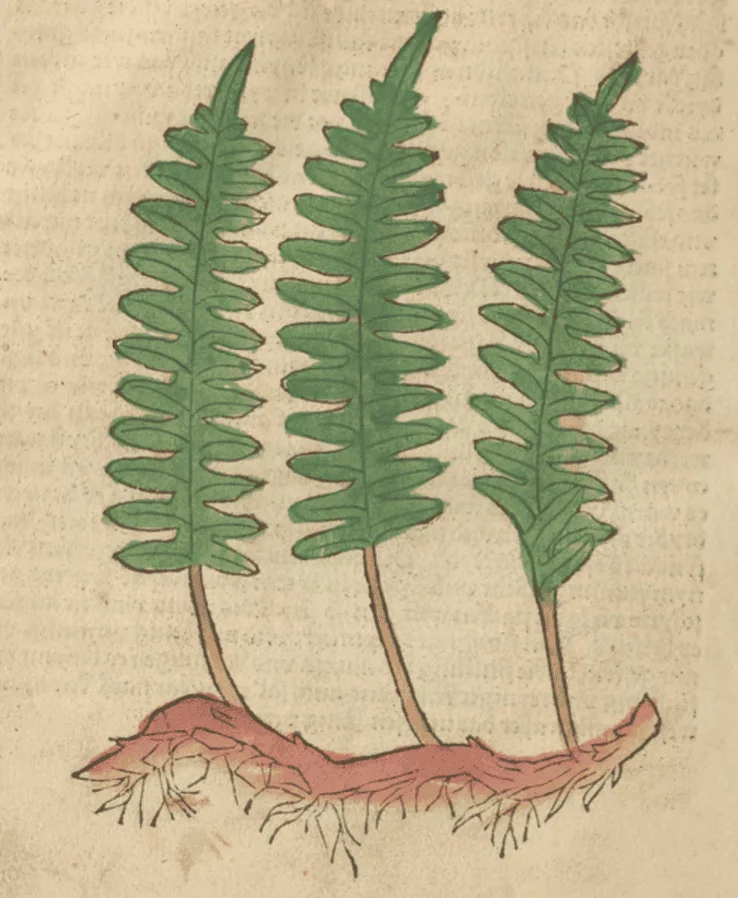
Gart der Gesundheit, Cuba, 1485
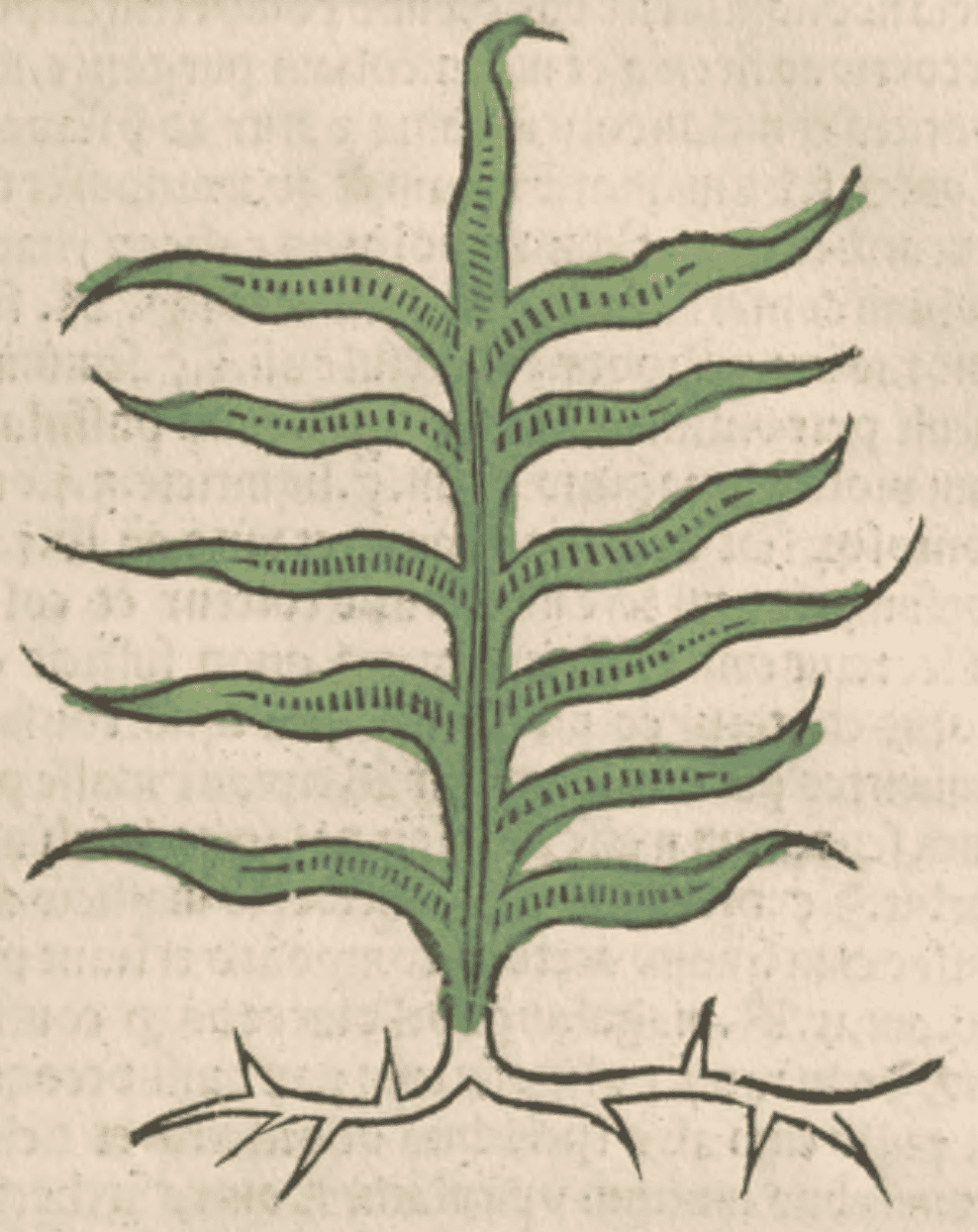
Herbarius latinus, Petri, 1485
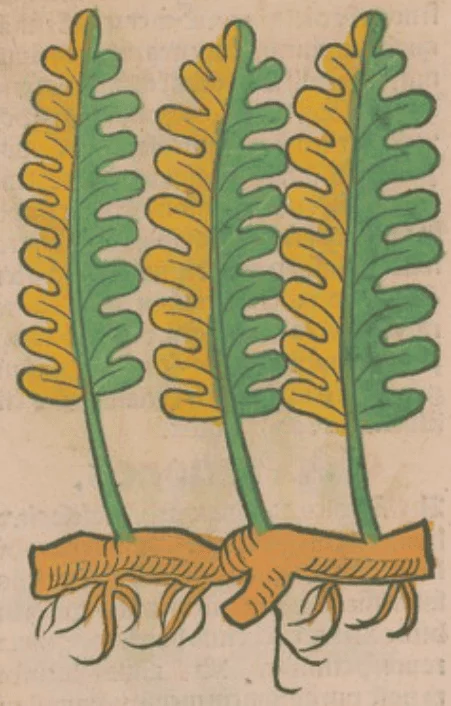
Ortus Sanitatis, Meydenbach, 1491
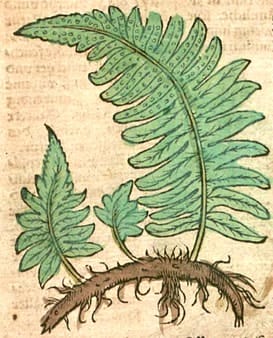
Kurtzes Handtbuchlein, Ryff, 1599
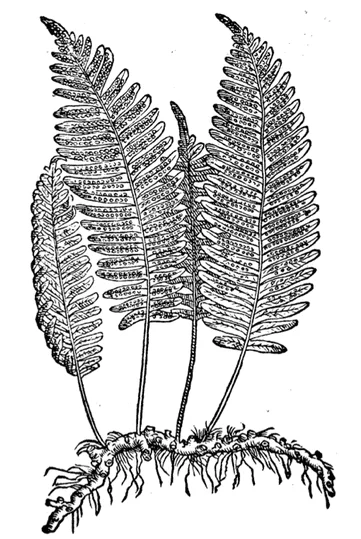
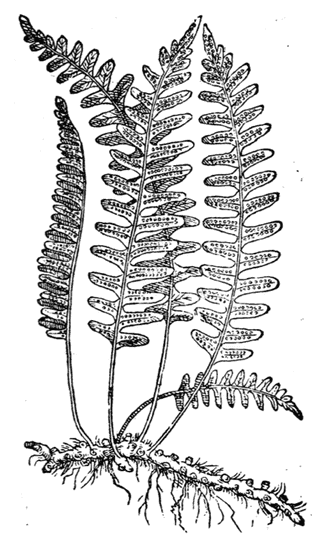
Official Polypody A second species used
Della Materia Medicinale Andrea Valuassori, 1562
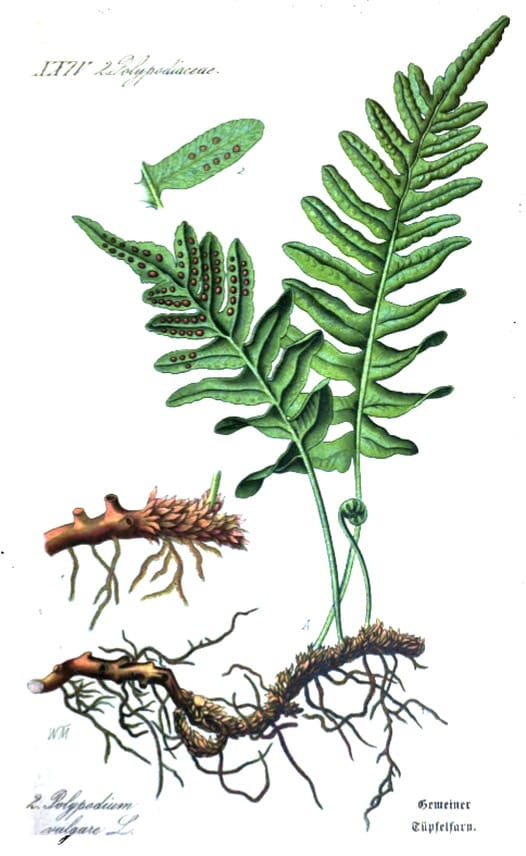
Flora von Deutschland, Kohler, 1886
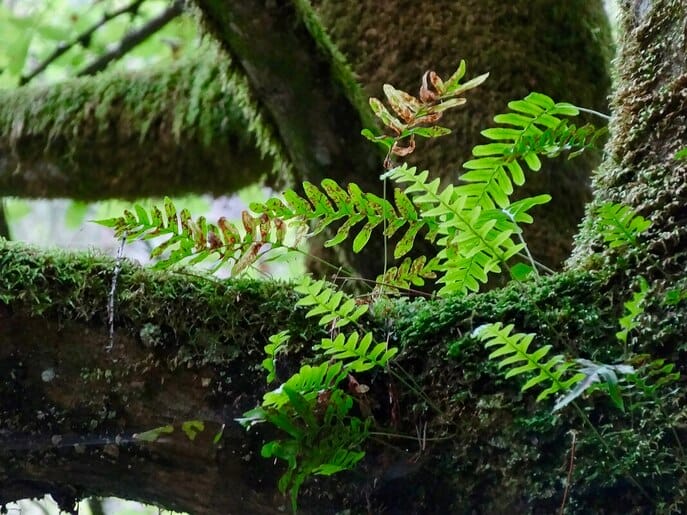
Polypodium vulgare
(Photo by Saxifraga mutata) (Wikimedia)
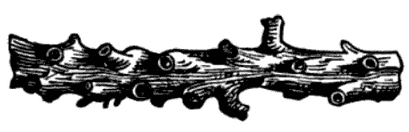
Polypody root
Notes on Pharmacognosy, Otto Augustus Wall, 1902
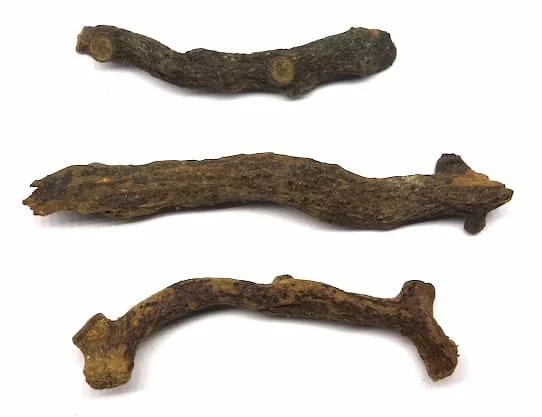
Polypody root
(Calcutta Unani College, Adam, 2019)
Botanical name:
Polypodium vulgare (TCM, West)
P. virginianum is also used in TCM.
A number of other species have reportedly been used similarly including P. decumanum, P. aureum, P. triseriale, P. lowery, P. loriceum.
Parts used:
Root; that growing on the Oak was regarded as best
“The best is that which is as thick as an index finger, somewhat green or yellow, compact, fresh, with a little Bitterness but Sweet (at the sametime) and Acrid, tasting somewhat like a Clove”. (Avicenna)
“The root is gathered in the summer, and should be dried in the sun for one day, it retains its potency for two years”. (Dorsetn, 1540)
Temperature & Taste:
Mildly Warm, very dry. Bitter, Sweet, Pungent
“It is Hot in the Second and Dry in the Third degree … It is Sweet”. (Avicenna)
Some sources claim it is Cold.
Classifications:
2A APERIENT. 2G. CLEANSING. 2H. CARMINATIVE
3K. EXPECTORANT
4f. SPLENETIC
Uses:
1. Clears Wind-Damp, Purges Melancholy:
-“a gallant though gentle purger of Melancholy” (Culpeper)
-opens obstructions of the Liver and Spleen; Hypochondriac Melancholy; Swelling of the Liver or Spleen.
-stubborn skin diseases, Fibroid Tumors, Cancer, Leprosy;
-mental disturbances, Madness, Schizophrenia, Depression, Nightmares;
-Dementia, Parkinsonism
-Hemorrhoids.
-keeps the Hair colored, prevents grey hairs.
-Exhilarant and Cardiac tonic.
-“It removes flatulence [Wind] and Moistness”. (Avicenna)
-“The root has the power of dissolving and purging cold humors, such as Phlegm and Melancholy”. (Dorsetn, 1540)
-“It preserves a man from diseases”. (Dorsetn, 1540)
2. Clears Damp and Heat, Promotes Urine:
-burning urine, Strangury, Gonorrhea (TCM, West)
-Jaundice, Hepatitis
-Diarrhea and Dysentery. (TCM, West)
3. Clears Phlegm, Stops Cough and Wheezing:
-Cough and Asthma with tough, hard-to-clear Phlegm.
-Difficulty Breathing (powdered root)
-Tuberculosis (TCM, West)
4. Clears Heat and Poison:
-Boils, Carbuncles, Toxic sores, Urticaria, Rubella, and for Febrile Convulsions in Children. (TCM)
-“With Honey water, it cures the Quartan Fever”. (Dorsetn, 1540)
5. Moves the Blood, Clears Stasis:
-Trauma and Bruising (TCM)
6. Clears Damp, Benefits the Bones and Joints:
–Mesue used it for superfluous humors, including Rheumatic swellings of the hands, feet, knees, and joints;
-Joint diseases including Arthritis and Rheumatism (Unani)
-Joint disease, Lumbago; promotes healing of Bones (TCM)
-Rickets (West)
7. Kills Worms:
-Powdered herb is used
8. Externally:
-“very good for chaps between the fingers’. (Dioscorides)
-“It works for the cracks in the fingers, if they are anointed with honey”. (Dorsetn, 1540)
-“It is also beneficial for sprains, applied as a plaster”. (Dorsetn, 1540)
-applied topically for Nasal Polyps (topically with Honey); or the powder is used as a Snuff (Pliny)
-The root beaten and applied, helps Sprains and Dislocations; Dioscorides used it for Sprains.
-bruised with Vinegar and applied to the Spleen and other places to relieve inflammation.
-topically to sores, boils, hives and toxic sores.
-beaten applied topically to Bruises, Inflammations and Swellings (TCM)
-Felon: beat the fresh root with alcohol, mix, and apply. (TCM)
-old TCM texts recommend the root topically for Ulcers
Dose:
1. Dioscorides said it was common to boil it with Chicken or Beef; Avicenna said boil with Chicken or Fish Soup.
2. Best taken with a liquid like Hydromel (Avicenna)
3. “The root is boiled in chicken broth and water with honey: this way, however, taken, it cleanses Phlegm and Black Bile”. (Dorsetn, 1540)
Decoction: 5–15 grams
Powder: 2–6 grams
Comment:
The Polypodium species are fairly similar in appearance and activity. In both the West and TCM; various species have supplied the market. While it is not a regularly used herb in TCM, it is a very important medicine for Melancholy in the Western Tradition.
Correctives:
1. Corrected with Licorice or Mastic
2. Fennel, Caraway, Aniseed, Clove, Ginger and Cinnamon correct it, and quicken its activity.
3. Unani considers Chebulic Myrobalan and Damask Rose as the best Correctives.
4. “corrected with Honey water, whey, chicken broth, decoction of Barley water, or Raisins”. (Dorsetn, 1540)
Substitutes:
1. Dodder herb (Avicenna)
2. Indian Salt in half its quantity (Avicenna)
3. Hiera Picra
4. Aloe
Main Combinations:
1. To purge all Humors:
i. Polypody with Senna, Dodder, Caper root-bark, Agaric, Hart’s Tongue, Balm, Betony, Aniseed (as in Syrup to Purge all Humors of Frankfurt)
ii. Polypody with Fennel seed, Aniseed, Senna, Rhubarb, Licorice, Cold seeds (as in Catholicum)
2. To Purge Melancholy Humor:
i. Polypody with Senna, Ginger, Raisin, Prune, Borage, Violet, Rose, Rosemary (as in Decoction of Senna)
ii. “Polypodium boiled with anise, fennel, cumin, equal weight in a pound of water, and taken in drink, purifies the intestines, bringing out many evil humors. It has the ability to dissolve Melancholy”. (Dorsetn, 1540)
3. Purge Melancholy and Phlegm/Damp:
i. Asthma, Leprosy, Epilepsy, Melancholy, Arthritic, Rheumatic complaints, Polypody with Fumitory and Triphala (Unani)
ii. Polypody with Elecampane. (Pomet)
iii. Fibroid Tumors, Cancer, Polypody with Black Myrobalan, Senna, Turbith, Dodder (as in Decoction of Dodder of Thyme)
4. To resolve Wind and Damp, Polypody, Aniseed, Fennel seed, Cumin (Herbarius latinus, Petri, 1485)
5. To Purge Phlegm Humor from the Chest:
i. prepare a decoction of Polypody and infuse Agaric in the strained decoction (Herbarium Horstianum, 1630)
ii. Polypody with Agaric, Turbith, Aniseed
6. ‘Evil color of the Face’ and Phthisis, take 3–4 ounces of distilled water of Polypody every morning (The Secrets of Alexis, 1615)
7. Couch, Bronchitis, Polypody root, Aniseed, Licorice
8. Spitting Blood, Polypody decocted in Goat milk whey (Herbarium Horstianum, 1630)
9. Obstruction of the Organs from Damp and Phlegm, Polypody, Senna, Galangal, Ginger (Herbarium Horstianum, 1630)
10. “Polypodium taken with whey, gently relieves the Stomach, and especially cures a swollen Spleen”. (Dorsetn, 1540)
10. Spleen obstruction, Jaundice and Edema, Polypody with Cream of Tartar.
11. Hardness of the Spleen, Polypody with Mallow
12. Cleanse the Blood, Polypody with Fumitory, Thyme, Chicory, Agrimony
13. Chronic Skin diseases, Eczema, Psoriasis, Polypody with Dodder, Oregano, Pennyroyal, Black Myrobalan, Yellow Myrobalan, Rhubarb (as in Electuary of Dodder and Fumitory)
14. Edema, and for obstructions:
i. Polypody, Dodder, Agaric, Celery seed, Fennel seed
ii. Polypody, Dodder, Pepper, Amomum, Clove, Cinnamon, Spikenard, Parsley seed, Aniseed
iii. Polypody, Rhubarb, Sagapen, Tithymalus (Spurge), Spikenard, Aloes (Syrian ‘Book of Medicine‘, Budge, 1913)
15. Arthritis, Rheumatism:
i. Polypody is taken in Chicken Soup (Unani)
ii. Polypody, Fennel seed, Colchicum (Herbarius latinus, Petri, 1485)
iii. Polypody with Guaiacum, Sarsaparilla, Cinnamon (as in Decoction of Guaiacum and Sarsaparilla)
16. Paralysis and Joint Pain: “Take Polypodium reduced to powder one ounce, a dram of quinquefolium, half a dram of Colchicum root, half an ounce of sugar, all of which are mixed together, with a little water of the Paralytic herb, or Salvia: this is taken for Paralysis and pain in the Joints”. (Dorsetn, 1540)
Major Formulas:
Powder of Polypody (Montagnana)
Electuary of Polypody
Decoction of Dodder of Thyme (Rhasis)
Decoction of Dodder of Thyme (Mesue)
Decoction of Fumitory Compound
Decoction of Senna
Decoction of Thyme (Mesue)
Decoction of Guaiacum and Sarsaparilla
Syrup to Purge all Humors of Frankfurt
Syrup of Fumitory Greater
Syrup of Dodder of Thyme (Mesue)
Syrup of Horehound (Fernelius)
Syrup of Betony (Pharmacopoeia Augustana)
Wine for Scrophula (Renodeus)
Powder for Epilepsy (Unani)
Powder Against Rabies
Hiera Logadii
Arabian Confect Purging Melancholy (Confectio Hamech) (Mesue)
Catholicum (Diacatholicum) (Nicholas)
Bishops Electuary (Electuarium Elescop) (Mesue)
Electuary of Dodder (Unani)
Electuary of Dodder and Fumitory (Mesue)
Electuary for Head and Stomach Pain (Galen)
Electuary for Melancholy and Fear (Filius Zacharia)
Triphala Electuary of Dodder (Unani)
Indian Pills (Mesue)
Pills for Melancholy (Unani)
Pills for Uterine Fibroids
Greater Polycrest Pills
Pills to Crumble Kidney Stones (Unani)
Cautions:
‘It works very safely’ (Culpeper)
1. Unani texts consider it harmful for the Lungs and Kidneys (ie. damages the Yin).
2. As it is very drying it is not suitable in Yin deficiency.
Main Preparations used:
Click the above Tabs for more information on this medicine
“The Radix Polypodii is one of those Roots that do not descend perpendicularly into the Earth, but creep under the Surface; this indeed very frequently in great Part upon the Surface, though sometimes bury’d an Inch or more in Depth. It is a very singularly shaped Root, and is easily known from all the other medicinal ones at Sight: It is of an oblong but irregular Figure, of the Thickness of a large Goose-Quill, sometimes of one’s little Finger: It is three, four, or more Inches in Length, and is sometimes single, but frequently branch’d, and is every where of the same, or nearly the same Thickness : Its Surface is extremely rough and irregular, usually crooked or contorted more or less, and has a number of irregular Dents and Protuberances in it. It is sometimes naked, but more usually it is cover’d with a rough fibrous Matter; from its lower Part it always sends out a great number of Fibres: Its Colour on the Surface is a dusky brown, within it is greenish; it has no very remarkable Smell, but is of a sweetish Taste when first taken into the Mouth, after wards somewhat austere, and upon the whole very nauseous.
The Plant which rises from it is one of the Cryptogamia of Linnæus, and one of the Herbe Epiphyllosperme of Ray. It is common with us on the Banks of Ditches where there are Stumps of old Trees, on Walls, and by the Sides of Woods; what grows on the Oak has been esteem’d like the Mistletoe of the same Tree, to have more Virtue than what is found in any other Place, but it is observable that very little of it is found on the Stump of that Tree; and it is somewhat strange, that the Oak, a Tree whose Juices are all of the astringent
Kind, and that in a very high Degree, should be suppos’d to add to the Virtue of a purging Root by its growing over it.
The Plant grows to six, eight, or ten Inches high; it consists only of a single Leaf, several of which arise from the different Parts of the Root, and each of which is a distinct and perfect Plant; this Leaf is form’d of a small but tough Stalk, which from the Middle upwards, or for more than the upper half, becomes a middle Rib, beset on each Side with oblong and narrow Pinna, divided nearly to the Base; on the back of these are found a number of round yellowish Spots, disposed in a regular Order, which are the Congeries of the Seed-Vessels of the Plant.
Polypody Root, chemically analysed, yields first a large Quantity of a colourless Phlegm, of a faint Smell, and of an insipid Taste, but with some obscure Acidity in it; after this rises a more acid Phlegm, then a colour’d Liquor of an empyreumatic Smell, and austere Taste; and after this a small Portion of a reddish Liquor, with a strongly empyreumatic Flavour, and with a Taste of a volatile Alkali in it; after this comes over a moderately large Quantity of an Oil, somewhat thick and of a brown Colour, and strongly empyreumatic Smell. The Remainder in the Retort is a light black Coal, which, alkin’d and lixiviated, yields a ſmall Quantity of a fix’d Salt, but that not of
the alkaline, but merely of the Sal Salsus Kind.
Polypody has been at all Times celebrated for Its Virtues in Medicine: It stands in the rank of purging Roots, but its cathartic Virtue is so small, that it is not to be given alone in this Intention, though join’d with other Purges it is not without its Use. It is attenuating and dissolvent, and has been found of great Service in Obstructions of the Viscera. It is given in purging Diet-drinks, in scorbutic, and in hypochondriac Cases with Success; it is alſo an Ingredient in the Lenitive Electuary, and in several other of the officinal Compositions”. (A History of the Materia Medica, Hill, 1751)
GENERAL / REVIEW
–Polypodium vulgare L. (Polypodiaceae) as a Source of Bioactive Compounds: Polyphenolic Profile, Cytotoxicity and Cytoprotective Properties in Different Cell Lines
–Polypodium vulgare Linn. a versatile herbal medicine: A review
–ETHNOPHARMACOLOGICAL STUDIES OF Polypodium vulgare Linn.: A COMPREHENSIVE REVIEW
–Bisfayej (Polypodium vulgare L.): A review on medicinal importance of rhizome with Unani prospective and modern pharmacology
–A review on phytopharmacological properties of Bisfaij
ANTI-BACTERIAL
–Polypodium vulgare Linn. a versatile herbal medicine: A review
–Differing antibacterial and antibiofilm properties of Polypodium vulgare L. Rhizome aqueous extract and one of its purified active ingredients–osladin
–Antioxidant and antimicrobial activities of methanolic extract of Polypodium vulgare L
ANTI-VIRAL
–Polypodium vulgare Linn. a versatile herbal medicine: A review
ANTIOXIDANT
–Evaluation of anti-tyrosinase and antioxidant properties of four fern species for potential cosmetic applications
–Antioxidant and antimicrobial activities of methanolic extract of Polypodium vulgare L
ANTI PYRETIC
–Polypodium vulgare Linn. a versatile herbal medicine: A review
ANALGESIC
–Polypodium vulgare Linn. a versatile herbal medicine: A review
HYPOTENSIVE:
–Polypodium vulgare Linn. a versatile herbal medicine: A review
ANTI-ATHEROSCLEROTIC
–Polypodium Vulgare L.: A valuable cardioactive medicinal plant.
ANT-ARRHYTHMIC
–Polypodium Vulgare L.: A valuable cardioactive medicinal plant.
EPILEPSY
–Polypodium vulgare Linn. a versatile herbal medicine: A review
ALZHEIMER’S DISEASE
–Regulating factors for microglial activation: implication for Alzheimer’s disease and brain damage
ANTI-TYROSINASE
–Evaluation of anti-tyrosinase and antioxidant properties of four fern species for potential cosmetic applications
WOUNDS
–An Alternative Approach Wound Healing Field with Polypodium Vulgare
You must be logged in to view this content, please login. If you're not a member then Click this link to subscribe