Peucedanum, Hog-fennel, Qian Hu 前胡
Sulphur-wort
Andrasiyun (Unani)
Qian Hu (Chinese local species)
Tang kun, lcha ba (Tibetan, local species)
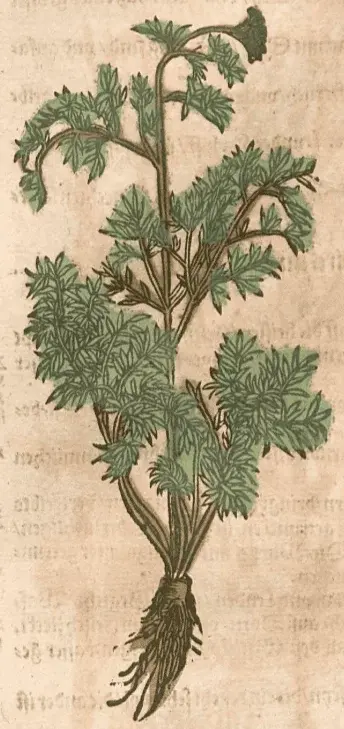
Krauterbuch, Lonitzer, 1578
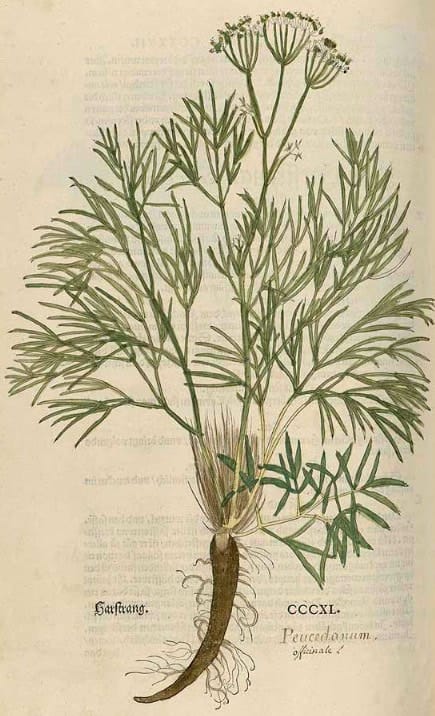
Peucedanum officinale
Fuchs, L., New Kreüterbuch, (1543)
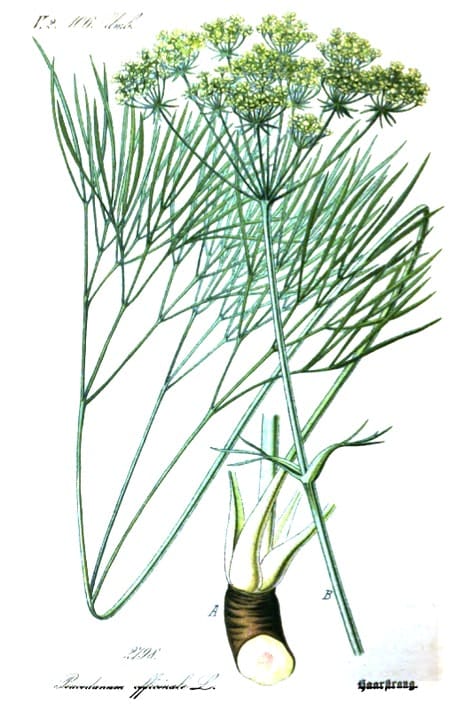
Flora von Deutschland (27), Kohler, 1886
Botanical name:
Peucedanum officinale (West)
TCM uses White and Purple flowered varieties including:
- P. decursivum (syn. Angelica decursiva)–official species
- P. praeruptorum–official species
- P. longshengens
- P. rubricaule
- P. terebinthaceum
- P. medicum
In Tibet, P. balcalense and others are used
Parts used:
Root; also the Juice
Temperature & Taste:
Warm, dry. Pungent (considered Slightly Cool in TCM)
“It is Hot and Dry in the 3d degree”.
attenuating, inciding, opening, cleansing
Classification:
Uses:
1. Clears Cold Phlegm: (TCM, West)
-Cough, Asthma, Shortness of Breath with thick, hard-to-clear Phlegm (Syrup)
-Cold Phlegm of the Lungs, Bowels, Uterus and Kidneys
-“good for a Cough or shortness of Breath” (decocted in Wine)
-in TCM for thick Phlegm obstructing the Chest (more often for Phlegm-Heat)
2. Warms the Stomach, Eases Pain:
-Colic, Flatulence, Meteorism and other digestive disorders
-the Chinese species has been shown to inhibit gastric ulcers and stop gastric spasms
-‘causes an Appetite’.
3. Clears Wind-Phlegm, Stops Spasms:
-Cramps, Epilepsy, Dizziness, Vertigo
-Apoplexy, Paralysis and Lethargy
–Qian Hu was listed for Wind-Phlegm diseases in older TCM texts
-“The Ancients say, it is proper for all Distempers that have their seat about the Nerves, such as Lethargy, Phrensy, Epilepsy, Megrim [migraine], and Palsy [paralysis]”. (Tournefort, 1730)
-Wind-Phlegm disorders (Tibet)
-Night-crying in babies (Ben Cao Gang Mu)
4. Clears Wind-Damp, Promotes Urine: (West, Tibet)
-Strangury, Dysuria, Edema (West0; Kidney disease in Tibet
-Kidney or lower back pain (West, Tibet)
-Gravel, Stones.
-Puffiness of the Eyes (Ben Cao Gang Mu)
5. Moves the Qi and Blood, Promotes Menstruation: (West)
-Amenorrhea and Dysmenorrhea
-cramps and pain of the Uterus; Hysteria.
-“gives ease to those Women that have hard Labour in Child-birth”. (Tournefort, 1730)
-Expels a Dead Fetus.
-Bruises, Trauma, and all cases with “Congealed and Clotted Blood”.
-the Chinese varieties have been shown to increase blood flow.
6. Resists Poison, Promotes Sweat: (West)
-acute Wind-Cold or Wind-Heat Colds and Flu
-TCM uses it for acute Wind-Heat; however, excess Phlegm is still a primary indication.
-all Cold Poisons; Fever due to poisoning in Tibet
-Bites of Venomous Beasts;
-Syphilis
-Quartan [Malarial] Fevers.
7. Externally:
-Numbness, Sciatica, Spasms, Convulsions,
-Hernias
-old Sores and Ulcers, Tumors
-“Powder of the Root put into foul Ulcers that are hard to be cured, cleanses them thoroughly”. (Tournefort, 1730)
-cold Headaches and all cold diseases
-juice dropped into the ears for Pain, Deafness and Tinnitus from Cold and Wind
Dose:
Decoction: 3–9 grams
Powder: 1–3 grams
Comment:
1. The European and Chinese species are very similar. This is seen in the fact that P. officinale (the European variety) is called Yao Yong Qian Hu, ie. a variety of ‘Qian Hu‘ (the Chinese name of Peucedanum).
2. In TCM, Qian Hu is accounted slightly Cool, and is primarily used for Phlegm obstructing the Lungs with Cough and Wheezing. It is believed to have a special function of promoting downward movement of Qi. This leads the Fire back to its source in the lower abdomen while simultaneously clearing Phlegm. in the West, Hog Fennel (also called Sulphurwort) is classed as Warm, and therefore more used for Cold Phlegm. We believe Peucedanum can be used for both Hot and Cold Phlegm disorders depending on the herbs its used with.
3. The primary function is to clear Phlegm obstructing the Chest. The Chinese Qian Hu is a suitable substitute for the rarely available Hog Fennel, used in the Western Tradition. It is also likely that the Chinese species can be used for the other functions listed above.
Main Combinations:
1. Phlegm obstructing the Lungs:
i. Peucedanum Qian Hu is often combined with Cynanchum Bai Qian in TCM for Cough that hasn’t cleared after an acute attack (Cold or Flu). (TCM)
ii. Peucedanum with Almonds
iii. with Lung Heat, Peucedanum Qian Hu with Mulberry root bark (Sang Bai Pi), Almond (Xing Ren), Fritillaria Bei Mu
2. Acute Wind-Heat (Common Cold or Flu), Peucedanum Qian Hu with Peppermint (Bo He), Platycodon Jie Geng, Burdock seed (Niu Bang Zi). (TCM)
3. Lower Back pain, Peucedanum with Asparagus root, Frankincense, Indian Spikenard, Cinnamon, Costus (as in Electuary for Back Pain of Galen)
4. Vertigo, Peucedanum with Thyme, Marjoram, Betony, Rosemary, Aniseed, Peony root, Aloeswood (as in Tincture for Vertigo)
5. Tuberculosis, Peucedanum Qian Hu with Pig Spine, Big Bile, Urine of an Boy (under 10), Soloman’s Seal (Yu Zhu), Picrorhiza Hu Huang Lian, Bupleurum Chai Hu (Ben Cao Gang Mu)
6. Puffiness of the Eyes, Peucedanum Qian Hu, Semiaquilegia Tian Kui Zi, Poria Fu Ling, Soloman’s Seal (Yu Zhu) (Ben Cao Gang Mu)
Major Formulas:
Electuary of Horehound Diaprassium
Electuary for Back Pain of Galen
Tincture for Vertigo
Jing Fang Bai Du San
Su Zi Jiang Qi Tang
Cautions:
1. Not used for Yin deficiency.
2. Caution during Pregnancy
Main Preparations used:
Distilled Water of the Herb and Root
Click the above Tabs for more information on this medicine
Dioscorides:
“Peukédanon is a plant with a thin stalk like that of the plant which is called págador (Márathon, Fennel). It has near its root an abundant thick tuft; its flower is yellow and its root black and of an offensive smell, thick and full of moisture (sappy ). It grows on mountains that are shaded by trees. The root is incised, while fresh, with a knife, its juice flows out and is put in the shade because its faculty grows weaker in the sunshine. He who collects this juice suffers from headache and dimness of sight if he does not (previously) anoint his nose with attar of roses and put some of it also on his head. The best of the sap of this plant comes from Sardonia (now Sardinia) and
Samothrake; it is of an offensive smell, red, and stings the tongue. If rubbed into the head with vinegar it is helpful to Lêthargos,, Phrenitis, obstructions, epileptic fits, chronic headache and plegia”.
Galen:
“The milk [juice] is more active than the root; the juice heats powerfuly and is useful for diseases of the chest and lungs, and for induration of the Spleen”.
You must be logged in to view this content, please login. If you're not a member then Click this link to subscribe