Paeonia officinalis, Western Peony
European Peony
Ood Saleeb, Ood Gharqi (Unani)
Yao Yong Shao Yao 藥用芍藥 (TCM)

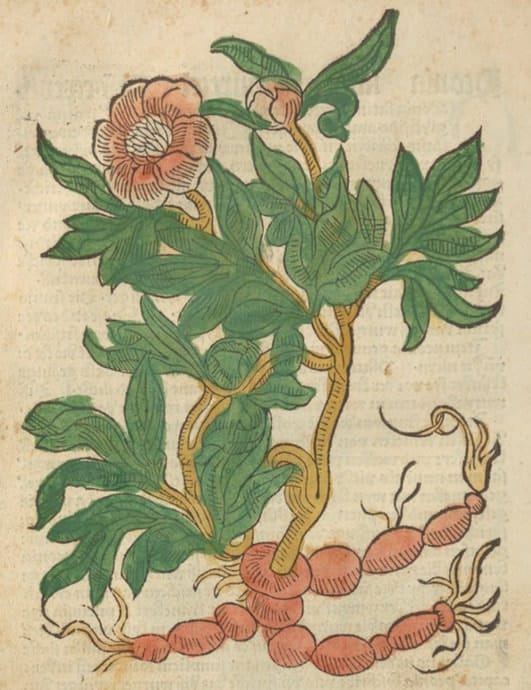
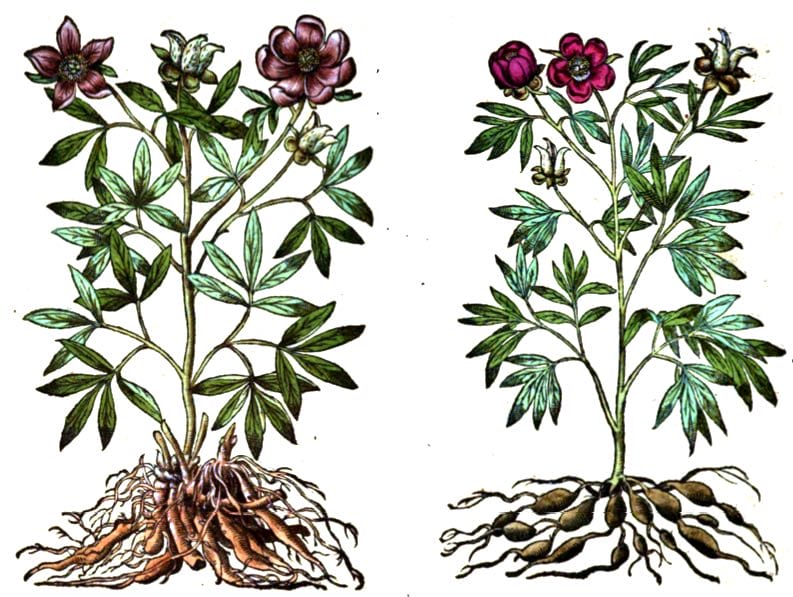
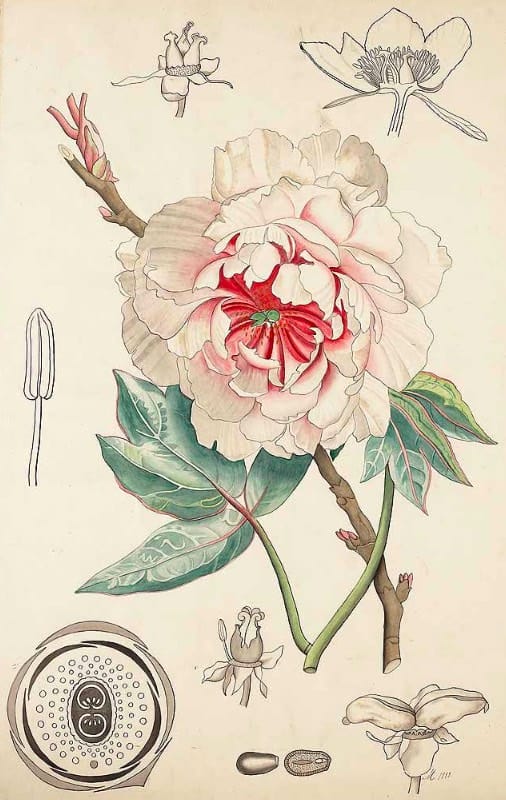
Gart der Gesundheit, Cuba, 1485
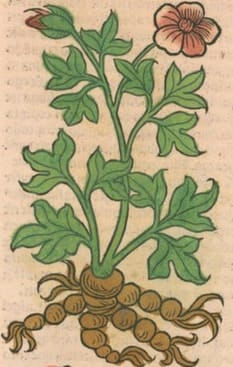
Ortus Sanitatis, Meydenbach, 1491
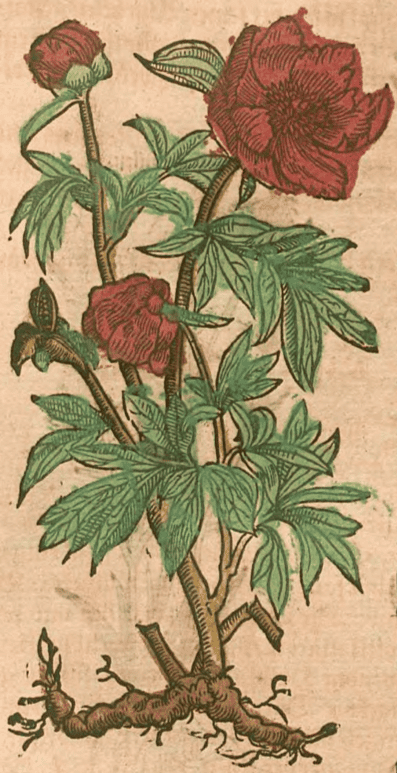
Krauterbuch, Lonitzer, 1578
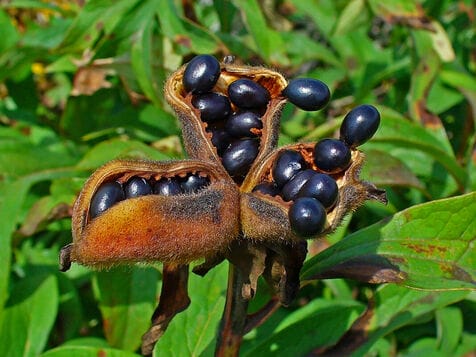
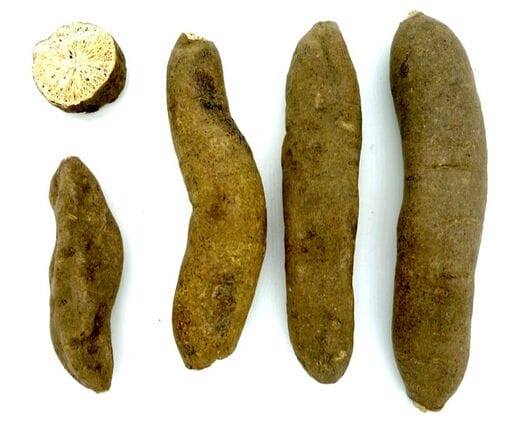
Peony from the Unani Market (Adam, 2021)
Botanical name:
Paeonia officinalis (syn. P. mollis) the ‘Female’ Peony
Others to supply the Peony of the West include:
- P. mascula (syn. P. corallina) the ‘Male’ Peony, found throughout Europe and Mid East
- P. clusii, P. parnassica (Greek Peony)
- P. emodii (Himalayan Peony)
- P. anomala (Russian Peony)
Parts used:
Root; Flower; Seed
“It lasts for ten years in its efficacy.” (Dorsetn, 1540)
Temperature & Taste:
Neutral (Warm in the West), dry. Sour, slightly Bitter)
Classifications:
2C INCIDERS. 2F. PURIFYING. 2G. CLEANSING. 2I. ANTISPASMODIC. 2K. RESOLVENT
3G. EMMENAGOGUE
4a. CEPHALIC. 4f. SPLENETIC. 4j. NERVINE
Uses:
1. Calms the Liver, Settles Wind:
-Epilepsy, Childhood convulsions, Apoplexy, Dizziness, Vertigo, Migraines
-nervous and spasmodic problems
-Nightmares, and traditionally for Lunacy
-“All diseases of the head”.
-“Peony is useful in cases of Nightmare specially when 5-10 of its seeds are taken with water mead or wine” (Avicenna)
-The red seed of the plant called paeonia arrests haemorrhage; the root also is possessed of similar properties’ (Pliny)
2. Tonifies the Blood, Promotes Menstruation:
-“One great remedy for all female diseases in common, is the black seed of the herbaceous plant paeonia, taken in hydromel: the root also is an effectual emmenagogue”. (Pliny)
-“it is good for women for diverse diseases” (Bankes)
-obstruction or deficiency of the Womb, and to promote menstruation
-Uterine pain, taken with wine (Avicenna)
-Pain and inflammation of the Uterus
-Root or seed have been used to promote Fertility and Conception, and to enhance Labor.
-cleanse Postpartum (Avicenna); “Female Paeonia boiled in wine cleanses women in childbirth”. (Dorsetn, 1540)
-“It has the power of strengthening and refreshing the body”. (Dorsetn, 1540)
3. Opens Obstructions of the Liver:
-Liver obstruction, congestion; Jaundice (Galen)
-Gall Stones (auxiliary)
-“Its roots are useful in Jaundice and for removing obstructions of the Liver” (Avicenna)
-“Peony clears the skin from black, spots” (Avicenna)
4. Clears Wind and Damp, Promotes Urine:
-Kidney and Bladder pain
-Urinary stones; Incontinence
-“beneficial for kidney and bladder pains”. (Dorsetn, 1540)
-“very useful in Gout [Arthritis]”. (Rhazes, Avicenna)
5. Stops Cough and Asthma
-Cough, Spasmodic Cough including Whooping Cough; Asthma
Dose:
Seed and Root can be used in similar doses
Powder: 1–3 grams
in Decoction: 3–6 grams
10–15 seeds was a common dose for Uterine pain, to promote Menstruation and Labor, and cleanse the Afterbirth.
Comment:
1. The European Peony and Chinese White Peony are almost analogous with the European being better to stop Wind and settles Spasms, the Chinese White Peony being more tonifying to the Blood and Yin. The Chinese Red Peony is Colder, less tonifying, and better to move the Blood and clear Heat from the Blood and Liver.
Correctives:
1. Sugar
2. Milk
3. Rose conserve
4. Tragacanth
Substitute:
1. Sebesten (Unani)
2. Peony seed and root can generally be substituted for one another.
3. Chinese White Peony (Bai Shao) can generally be used for the Western Peony, although the Western Peony is stronger to settle internal Wind.
Main Combinations:
Peony & Licorice
Calamus & Peony
Mistletoe & Peony
Wind and Brain Diseases
1. Peony is often combined with Mistletoe in the treatment of Wind, spasms, convulsions and nervous diseases.
2. Headache, Peony with Angelica, Valerian, Stoechas, Nutmeg, Sage, Betony, Balm, Sandalwood
3. Cold Rheumatic diseases of the Head and Nerves, Peony with Guaiacum, Sassafras, Sage, Betony
4. Epilepsy, Convulsions:
i. “Powder from Peony root taken in wine in which has been boiled Mugwort, is also beneficial against Epilepsy.” (Dorsetn, 1540)
ii. Decoction of Peony root with Syrup of Stoechas (Herbarium Horstianum, 1630)
iii. Peony, Valerian
iv. Peony with Mistletoe, Pearl, Amber (as in Powder for Childhood Convulsions)
v. Peony with Mistletoe, Valerian and White Dittany (as in Anti-Epileptic Powder)
vi. Peony with Amber, Mistletoe, Deer horn, Fraxinella root (Formulaire Magistral et Memorial Pharmaceutique, 1823)
vii. Peony root & seed, Conserve of Peony flowers, with Amber, Pearl and Red Coral
viii. Peony with Licorice, Cinnamon, Nutmeg, Clove, Long Pepper, Saffron, Red Coral and Pearl (as in Electuary of Peony)
ix. Peony with Fraxinella root, Mistletoe, Red Coral, Hyacinth (Zircon), Gold leaf (Pharmacopoeia Wirtembergica, 1798)
x. Peony with Amber, Mother of Pearl, Emerald, Aloeswood, Mistletoe, (Pulvis Cephalicus Albus from Pharmacopoeia Wirtembergica, 1798)
xi. Peony with Saffron, Senna, Rhubarb, Ammonium chloride, Black Hellebore, Amber, Cinnamon (Formulaire de Montpellier, 1822)
xii. Childhood Epilepsy, Peony seed, Nutmeg, Lavender, Amber (Lazarus Riverius)
xiii. Childhood Convulsions, Peony with Cinnabar and Nutmeg
5. Apoplexy:
i. Peony, Rosemary, Lavender, Costus, Siler Montane, Aniseed, Cinnamon, Clove, Amber (as in Powder Against Apoplexy of Zwelfer)
ii. Peony with Amber, Deer horn, Aloeswood, Lemon peel (as in Anti-Apoplectic Powder from Dispensatorium medico pharmaceuticum Palatinatus, 1764)
iii. Peony, Amber, Deer horn, Aloeswood, Citron peel, Pearl, Cinnamon (Powder for Apoplexy)
6. Epilepsy, Convulsions, Apoplexy, Peony with Siler Montane, Rosemary, Betony, Hyssop, Oregano, Rue, Aloeswood and Nutmeg (as inSyrup of Peony)
7. Vertigo:
i. Peony, Pearl, Red Coral, Amber (Electuary of Great Virtue for Vertigo)
ii. Peony seed, Mistletoe, Galangal, Calamus, Betony, Cubeb, Cumin
8. Paralysis, Peony, Licorice, Aniseed, Annis, Nutmeg, Elecampane (Electuary for Paralysis)
9. Lunatics, Peony root powder with Honey of Roses. (Avicenna)
Gynecology
10. Excess Menstruation: “Ten or twelve seeds, drunk in red and austere wine, relieve excessive female bleeding”. (Dorsetn, 1540)
11. Hysteria:
i. “ten Seeds with honey wine, proves to be useful in cases of Hysteria due to Uterine pain”. (Avicenna)
ii. Peony root, Mistletoe, Zedoary, Lovage root, Myrrh, Feverfew (Lazarus Riverius)
12. Uterine Pain:
i. 15 black seeds in powder were given in wine or mead for strangling Uterine pain
ii. Peony, Zedoary, Pennyroyal
iii. Peony, Cinnamon, Myrrh, Saffron
13. Female Infertility:
i. Peony, Seseli, Cinnamon, Cyperus, Mugwort, Frankincense, Mastic (as in Electuary Against Sterility of Nicholas)
ii. Peony, Agnus Castus, Coriander, Myrtle berry, Conserve of Rose (Electuary Against Sterility)
iii. Peony seed, Mandrake, Musk
14. To promote Labor:
i. “Peony seeds should be given in wine to the woman in Labor, they promote labor, and are very helpful” (Dorsetn, 1540)
ii. Peony, Cinnamon, Saffron
Other:
15. Catarrh, Children’s Coughs, Peony with Orris, Serpentaria, Saffron (Dispensatorium medico pharmaceuticum Palatinatus, 1764)
16. Consumption, Peony with Harts-tongue, Maidenhair, Hyssop, Balm, Licorice
17. To expel Poison: “Crushed Peony grains, and Zedoary, Galangal and sugar mixed in equal parts, are used as a remedy for indigestion, which, taken in the morning and evening, expels Poison”. (Dorsetn, 1540)
Major Formulas
Decoction to Strengthen the Head (Wirtzung)
Cephalic Decoction (Charras)
Electuary of Peony
Electuary Against Sterility (Nicholas)
Electuary Against Sterility (Renodeus)
Electuary of Currants
Electuary of Great Virtue for Vertigo (Hartman)
Electuary of Seseli (Nicholas)
Electuary for Paralysis
Powder of Mistletoe and Peony (Gabelhover)
Powder for Epilepsy (Quincy)
Powder for Apoplexy (Wirtenberg)
Powder for Childhood Convulsions
Powder of Marquis
Special Powder for Epilepsy (Wirtzung)
Special Powder for Memory (Wirtzung)
Tincture for Paralysis
Cautions:
1. Overdose (4 grams of the powder) can cause Headache, Tinnitus, Colic and Vomiting.
Main Preparations used:
Distilled Water of the Roots and Flowers, Syrup of the Infusion of the Flowers, Extract of the dried Flowers, Conserve of the Flowers, Salt of the Ashes
1. Conserve of Peony:
i. Peony petals (1 part), White Sugar (2 parts). Beat.
2. Distilled Water of Peony:
i. Peony flowers (1 part), Water (4 parts). Distil half. (Pharmacopoeia Sardoa, 1773)
Click the above Tabs for more information on this medicine
“Antiquity superstitiously believed that the Paeony could cure anything, and that it could cure not only bodily diseases but also mental affections, control storms, ward off hail”. (Dorsetn, 1540)
“It is useful in Epilepsy even when suspended around the neck. We have found it useful in epilepsy by personal observations; as long as the drug remained suspended there were no epileptic attack but when it was removed the disease reappeared”. (Avicenna)
“The root suspended around the neck removes the epileptic disease. It happened that this root was attached to the neck of a child, and the child did not feel the disease, but when the root was removed, he immediately suffered a convulsion again. This virtue is possessed by the male Paeonia, which has no seed, for it can be known from there”. (Dorsetn, 1540)
“I have often tried, and can prove the same by many Witnesses, that Peony gathered under its proper Constellation , viz. when the Moon is descendant in Aries, does remove the Falling Sickness only by external application. I caused a Virgin of eighteen years old, who had been troubled with this Disease from her Childhood, and daily fits, being in the Hospital to wear it about her Neck and Arms, after which she was perfectly cured. Hence it is apparent, of what consequence Astrology is, in the Practice of Physick”. (Collectanea medica, Salmon, 1703)
“For Lunatics, the Paeonia herb, applied to them lying down, never causes him any harm. The author is Apuleius“. (Dorsetn, 1540)
“This drug is the Female Peony of Dioscorides, and was esteemed by the ancients as a valuable remedy in uterine obstructions, colic, bilious obstructions, dropsy, epilepsy, convulsions and hysteria. Dioscorides describes two kinds of Peony, male, P. corallina, and female, P. officinalis, these are the two kinds of Fawania described by Arabic and Persian writers. The roots of the first are turnip-shaped and about as thick as the thumb; those of the second consist of oblong tubercles attached by a stout fibre to a rhizome … Ud-salap is used by the natives as a blood purifier for children. In the time of Galen a superstition prevailed that Peony root enclosed in a bag and hung round a child’s neck both prevented epileptic attacks and cured them, and this belief is not extinct among the peasantry of Europe even now; they also believe that wearing the seeds will prevent the dangers of dentition. The plant has been proved not to be inert; it produces headache, noise in the ears, confused vision, colic and vomiting if taken in full doses (60grs.)” (Vegetable Materia Medica of Western India, Dymock, 1885)
GENERAL / REVIEW
–Root Extracts of Two Cultivars of Paeonia Species: Lipid Composition and Biological Effects on Different Cell Lines: Preliminary Results.
–Pharmacological actions of Paeonia officinalis.
ANTIBACTERIAL
–Volatiles with antimicrobial activity from the roots of Greek Paeonia taxa.
ANTIOXIDANT
–Isolation of Strong Antioxidants from Paeonia Officinalis Roots and Leaves and Evaluation of Their Bioactivities.
ANTI-CHOLINESTERASE
–Efficient identification of Acetylcholinesterase and Hyaluronidase inhibitors from Paeonia parnassica extracts through a HeteroCovariance Approach.
EPILEPSY
–Efficacy and tolerability of hydroalcoholic extract of Paeonia officinalis in children with intractable epilepsy: An open-label pilot study.
ANTI-COAGULANT
–[Comparative study of anticoagulants obtained from various extracts of Paeonia anomala].
–[The nature of an anticoagulant isolated from peonies in the central zone of Russia].
–[An anticoagulant from extracts of peony roots: its isolation and properties].
THROMBOLYTIC
–[Thrombolytic and antithrombotic effect of Paeonia anomala extract at low concentrations].
ANTI-HEPATOTOXIC
–Preliminary phytochemical, acute oral toxicity and antihepatotoxic study of roots of Paeonia officinalis Linn.
REGENERATES LIVER
–Preliminary phytochemical, acute oral toxicity and antihepatotoxic study of roots of Paeonia officinalis Linn.
DIABETES
–[Effect of a peony root preparation on the status of the insulin and hemostatic system in animals during development of alloxan diabetes].
INHIBITS α-AMYLASE
–Isolation of Strong Antioxidants from Paeonia Officinalis Roots and Leaves and Evaluation of Their Bioactivities.
CANCER
–Root Extracts of Two Cultivars of Paeonia Species: Lipid Composition and Biological Effects on Different Cell Lines: Preliminary Results.
COSMETIC
–From bench to counter: Discovery and validation of a peony extract as tyrosinase inhibiting cosmeceutical.
You must be logged in to view this content, please login. If you're not a member then Click this link to subscribe