Nymphyae, Water Lilly
Nenufar (Latin)
Nilofar, Nasreen (Unani)
Utpala (White-flolwered, Ayurveda)
Nitopal (Blue-flowered, Ayurveda)
Neelothpalam (Blue-flowered, Siddha)
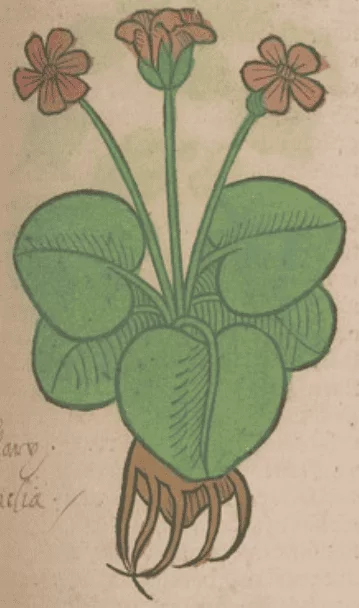
Ortus Sanitatis, Meydenbach, 1491
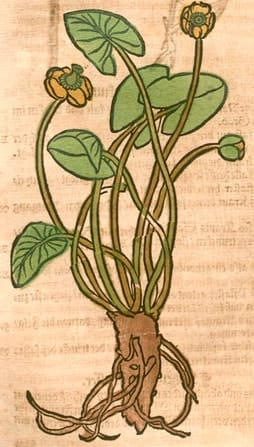
Krauterbuch, Lonitzer, 1578
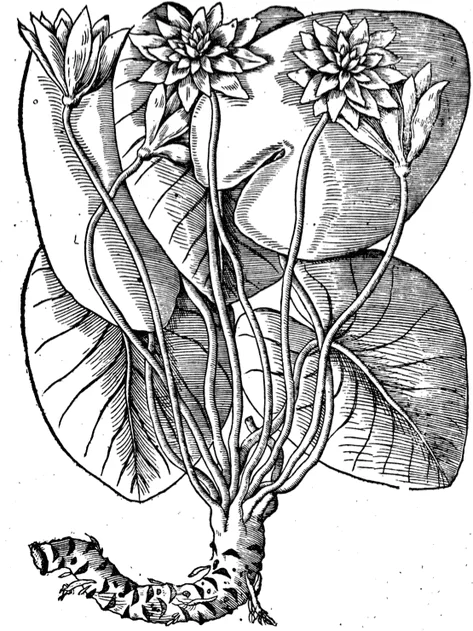
New Kreuterbuch, Matthiolus, 1563
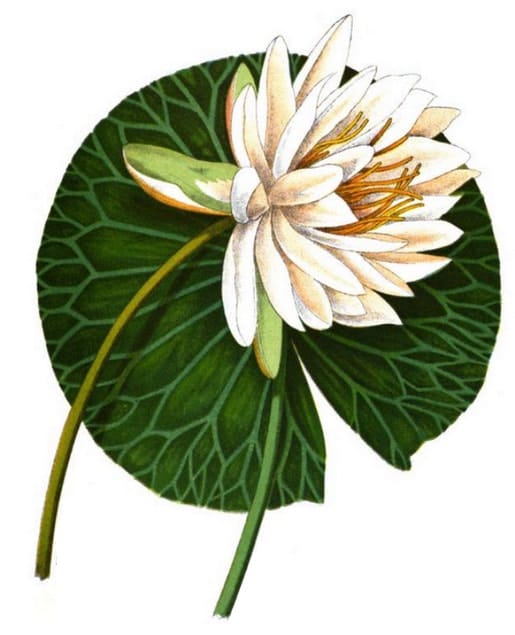
The Family Flora and Materia Medica Botanica, Good, 1847
Botanical name:
Nymphea alba.
Related species have been used. N. stellata (Indian Blue Water Lily) is used in Ayurveda, and both N. alba and N. stellata are used for Nilofar in Unani medicine.
Parts used:
Mainly Root and Seed; also Flower and Leaf
“the Seed … is more powerful in every Respect”. (Avicenna, out of Tournefort)
Temperature & Taste:
Root and Seed: Cool, dry.
Flower and leaf: Cool, moist
Lemery said “The Flower and Root are rnoistening, cooling”.
Classifications:
2Q. ANODYNE.
3B. FEBRIFUGE & ANTIPYRETIC. 3C. ALEXIPHARMIC. 3D. CORDIALS & CARDIACS. 3L. ANTI-TUSSIVE. 3M. ARTHRITIC
4a. CEPHALIC. 4c. CARDIAC. 4g. HEPATIC. 4h. NEPHRITIC. 4i. UTERINE. 4j. NERVINE
TCM:
B. Clears Deficient Heat
Uses:
1. Clears Heat and Toxin (leaf, flower):
-Heat, Fever, all types of Inflammation; ‘heat and thinness of Blood’
-Hectic Fever, Deficient Heat
-quenches Thirst
-Syrup is used for all types of Eruptive Fevers including Small Pox in Unani.
-Scrofula, Boils, Pimples, and Sore Throat
-“In Egypt, says Alpinus, they use the bruised Flowers and Leaves in all Cases where there is Heat”. (Tournefort, 1719)
2. Clears Heat, Calms the Mind and Spirit (mostly flower):
-Cools the Heart, calms the Mind and Nerves (flower)
-calms the mind annoyed by heat; Frenzy; Mental agitation, Madness (flower)
-Insomnia, Restlessness and Headaches
-in Unani, the flowers are used specifically for Migraines
-“And the Decodion of the Root, or the Extract is commended by some against Madness”. (Hoffman)
3. Clears Heat, Astringes the Kidneys: (Root)
-hot, sharp Urine
-Diarrhea, Dysentery,
-“Noctural Pollutions”, “sharpness of Seed”, Gonorrhea (chronic), Spermatorrhea, Leukorrhea
-Restrains Lust (root)
-Excessive Menstruation (from Heat) (Root, also the Seed)
-Prevents Miscarriage (root)
-“The use of it was very ancient in Dysenteries”. (Theophrastus)
4. Externally:
-Externally for Heat and Fever
-“In Fevers and Watchings they apply the bruised Leaves to the Head, and anoint the Forehead and Temples with its juice mixed with Oil and Vinegar”. (The Compleat Herbal, Tournefort, 1719)
-calms the mind, causes Sleep (washes, foot baths and other topical application of the Leaves and Flowers)
-douches for Leukorrhea and Vaginitis (root)
-applied topically to Quell Lust (Oil to the genitals, back and abdomen)
-green leaf applied to Wounds stops Bleeding. (Theophrastus)
-Freckles, Spots, Sunburn, Blemishes, apply the Distilled Water of White Water Lily.
-root is used in douches (and taken internally) for Uterine cancer, it is said to have been very useful (Grieves)
Dose:
Root, Seed or Flower in Decoction: 6–12 grams
Leaf in Decoction: 3–9 grams
Root or Seed in Powder: 2–4 grams
Syrup of the Root: ½–1 oz.
Comment:
“Two Things pretty remarkable may be observed concerning the Root: One is, That the Nymphea which bears a white Flower, has a black Root; and that which bears a yellow Flower, has a white Root: The other, That since both dry, bind, and cleanse, the white. has a more powerful Faculty of drying, that I mean which bears the yellow Flower; and the black, or that which bears the white Flower, has a greater Venue of cleansing, as we learn from Galen”. (The Compleat Herbal, Tournefort, 1719)
Substitutes:
Lotus and Water Lily are very similar in use. In general the corresponding part of each plant can be used as a substitute.
Main Combinations:
1. Calm the Mind and Spirit and clear Heat:
i. Water Lily flower, Violet, seeds of Lettuce, Purslane and Gourd (as a Syrup)
ii. Water Lily flowers, Willow leaf, Lettuce, Rose
iii. Syrup of Water Lily flower, Syrup of Poppy, Syrup of Violet
2. Promote Sleep:
i. Oil of Water Lily applied to the temples and forehead (Herbarium Horstianum, 1630)
ii. Syrup or Conserve of the White Flowers promotes sleep.
iii. Water Lily flower, Violet flower, Rose, Sandalwood, Pearl
3. Fever:
i. Syrup of Water Lily flower, Plantain Water
ii. Syrup of Water Lily flower, Syrup of Poppy, Syrup of Violet
4. Obstruction with Heat and Inflammation, Syrup of Water Lily Compound with Dialacca
5. Madness:
i. Water Lily flower with Coriander seed, Violet flower, Rose, Lettuce seed, Poppy seed, Red Coral (as in Powder for Madness)
ii. Water Lily flower with Violet, Rose, Camomile, White Poppy seed, Mandrake (as in Powder for Madness (2))
6. To Cool the Blood, Water Lily flower with Sorrel, Mallow, Plantain, Purslane, Endive, Aniseed, Lettuce, Borage, Violet (as in Decoction to Cool the Blood)
7. Excessive Menstruation: “The Root of white Water-Lilly boiled in black Wine and drunk, is a most effectual Remedy for stopping the immoderate flowing of the Terms, even when their Cure is despaired of by every Body. Seed has the same Effect”. (Tragus)
8. Prevent Miscarriage from Heat and Kidney weakness, Water Lily root, mature Deer horn, Distort, Dates
9. Gonorrhea or Spermatorrhea from Heat:
i. Water Lily flower, Violet, Plantain seed, Poppy seed
ii. Water Lily root with Tormentil, Lettuce seed, Rue, Agnus Castus, Frankincense
iii. Water Lily root with Purslane seed, Lettuce seed, Prepared Coriander seed, Dandelion, Nightshade, Rue, Camphor, Jujubes (Wirtzung)
iv, Water Lily root with Comfrey root, Pumpkin seed, Water Lily, Licorice juice, Gum Arabic, Red Coral (Wirtzung)
10. Pripism (continual erection): “Galen tells us, that he added a little Nymphea in case of a Priapism, and that he found by Experience that it produced a Cure by its natural Efficacy or Vertue”. (The Compleat Herbal, Tournefort, 1719)
11. To lessen Lust:
i. “Prosper Alpinus tells us, That the Hermits and others that lead a single Life, make use of this [the root] to keep them chaste”. (The Compleat Herbal, Tournefort, 1719)
ii. “they .who drink of it for twelve Days, are deprived of both the Desire and Power of Generation”. (Pliny)
iii. Water Lily root (1 dram) taken with Syrup of Poppy. (Avicenna)
iv. anointing the Genitals, or the Stomach and Back with the oil of Water Lily was said to do the same. (Pliny, Dioscorides)
Major Formulas:
Decoction of Water Lily Compound
Syrup Against Consumption
Syrup of Water Lily Flowers
Syrup of Agnus Castus Compound
Powder for Madness (2) (Rondeletius)
Powder of Montagnana for Kidney Ulcers (Nicholas)
Cooling Pearl Powder (Diamargariton Frigidum) (Nicholas)
Restorative Electuary (Antidotus Analeptica) (Nicholas)
Electuary to Restore Humidity (Arnold de Villa Nova)
Cautions:
1. Not used in Cold and weakness of the Kidneys (primarily the root).
“Frequent use extinguishes Venereous actions”. (Culpeper)
It “dries up the genital Seed, and takes away the Power of Generation, it must be used with great Caution”. (Tournefort)
Main Preparations used:
Distilled Water of the Flowers, Syrup of the Flowers made by Infusion, Compound Syrup, Conserve of the White Flowers, Infused Oil of the Flowers, Ointment of Water Lilies
1. Conserve of Water Lily Flowers
It is made of the White petals, as are other Conserves.
Used for all the purposes the flowers are used for; also good in hot burning fevers. It cools and strengthens much, being good for any who waste away due to extreme or long-lasting heat. It is good in Pleurisy, and for all dry Coughs, as well as dryness of the mouth and throat, and quenches Thirst. It cools the Liver, Kidneys and other principle parts. It is not for use by those who are cold. (Wirtzung)
2. Syrup of Water Lily Flowers.
Fresh, White Water Lily Flowers 1 lb.
Steep them in 3 lbs of warm water for 6 or 7 hours, then boil them a little, and strain them. Repeat this with fresh flowers 2 more times, then clarify, and add an equal weight of sugar, and form a Syrup in B.M.
A fine cooling syrup to clear heat and promote sleep. It ‘Cools and Moistens very much’, as well as clearing heat and easing pain of the Head, Heart, Liver, Kidneys, and Womb. It Cools inflammations, and abates the Heat of Fevers, both continual and intermittent, and Quenches Thirst. It settles the mind of frantic people, and Cools the Heat of Lust.
Dose: 1–1 ½, or 2 oz.
3. Distilled Water of Water Lily Flowers
Cools the Blood; also the Head, Heart, Liver, Kidneys, Bladder, Uterus and Bowels. Good for many heat conditions including Yellow Jaundice, hot Coughs and Pleurisy, and Headaches from heat. Also good for all fevers, including the Hectic (those coming from ‘Yin’ deficiency, or weak body moisture, as seen in consumption etc). It is commended when used externally for freckles, spots, sunburn, morphews.
4. Oil fo Water Lily Flowers
Made the same as the infused Oil of Rose Flowers (with the Yellow in the middle and the green being cast away).
Very Cooling; good for inflammations of the Head, Reins, Joints or other parts; it is used externally to cool hot tumors and swellings, and ease pain.
Gerard says it “doth Cool and Refrigerate, causing Sweat and quiet Sleep (applied to the temples, pulses and breast), and putteth away all Venereous dreams (applied to the genitals)”.
Salmon said “Annointed on the Forehead, Temples, and soles of the Feet it causes sleep and rest: annointed on the Back, it preserves from Miscarriage”. A little Camphor dissolved in Vinegar is mixed with it and applied to abate the heat of Lust, and is also good for pains of the Head. Also applied to sores
Click the above Tabs for more information on this medicine
-Water lilies have been used to protect from evil, witchcraft and demons. The flower was known as the Flower of Chastity, and was used by Monks and Nuns to suppress natural sexual urges.
-“Karrichterus writes of the white and yellow Water-Lillies, that if either of them be dried in the Northern Sun, and hung up either upon the Bed or the Wall of the Chamber where a convulsive Person lies, it will cure him in a moment”. (The Compleat Herbal, Tournefort, 1719)
-Interestingly, the Water Lily has been used quite similarly to TCM’s use of the Lotus. The plants are not unsimliar in appearance, are both water plants with beautiful flowers, all parts of each plant are used in their respective systems, and parts of both have strong effects on the kidneys. Compare with the Lotus.
You must be logged in to view this content, please login. If you're not a member then Click this link to subscribe