Lapis Phrygius
Phrygiun stone
Hajar Afroji (Unani)
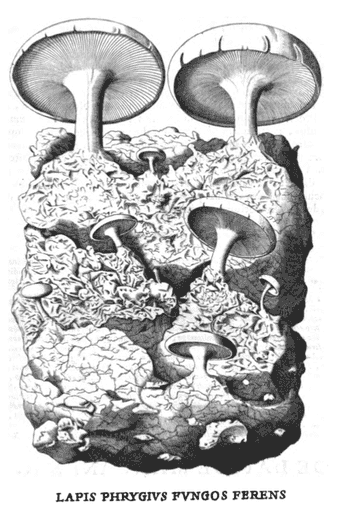
Metallotheca Vaticana, Mercati, 1719
“It thins, purifies, divides and dries; it is used for ulcers on the eyes and other parts of the body.” (Lemery, 1721)
Uses:
1. Ulcers of the Eyes; in Collyrium for the eyes.
2. Moist Wounds and Foul Ulcers
3. Burns
A Collyrium from Galen
Phrygian stone finely powdered is put in an earthen potnd heated until it glows, then quench in butter; next it ias heated again and quenched in Falerian Wine; It is heated a third time and quenched in Honey. Then it is dried.
Of this powder, take 1 pound, Pepper, Copper ore and Malabathrum 1 oz. each, and ½ oz. of Antimony. Powder all well and mix with Balsam oil and 1 oz. of fine Mica powder, and keep in a sealed jar. It is used only on the eyelids. It is applied several times per day when someone notices sensitivity in their eyes.
Dioscorides:
‘The Phrygian stone the dyers in Phrygia use (hence its name) is found in Cappadocia. The best is pale and mildly heavy, not firm from compaction, with partitions of white in-between like cadmia. The stone is burnt as follows. Moisten it with the best wine, cover it with live coals, and blow on it continuously. When it changes colour to a more deep yellow, take it out, quench it with the same wine, place it into the coals again, then do the same things and burn it a third time, taking care that it does not crumble and vanish into soot. Both raw and burnt it is effective with stiff ointment for binding, cleaning, forming scabs, and healing burns. It is washed like cadmia’.
Avicenna:
‘It is a desiccant drug with some astringent, irritant and dissolving properties’.
Salmon, Seplasium:
Called in Greek Lithos Phrygius; in Latin Phrygius, Lapis Phrygiae; in English, the Phrygian Stone. Found in Arabia and Phrygia, generated of a pumicose earth.
Dioscorides said its very astringent, yet purges. Applied with wax it helps burns according to Pliny and Isidore. Galen says it dries strongly and profits against putrid Ulcers and diseases of the eyes but it must be washed as Cadmia.
You must be logged in to view this content, please login. If you're not a member then Click this link to subscribe