
Lapis Crucifer, Lapis Cruciatus
Cross-stone, Andalusite, Chiastolite, Staurolite
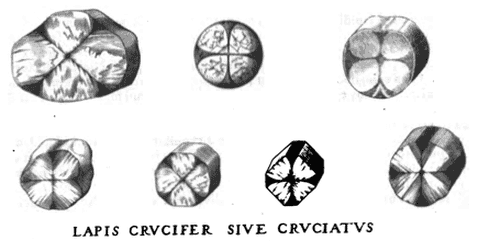
Metallotheca Vaticana, Mercati, 1719
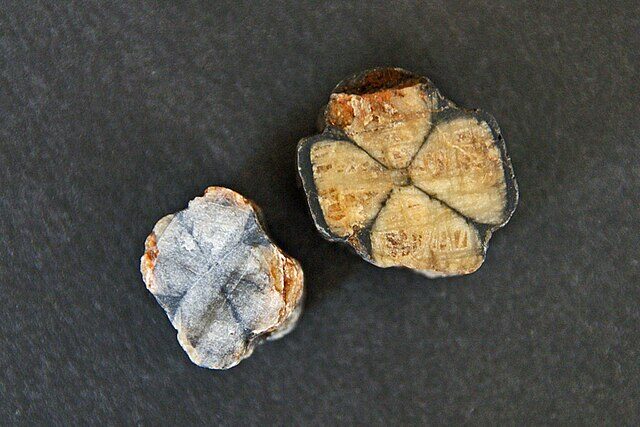
Chiastolite (Photo by Moha112100) (Wikimedia)
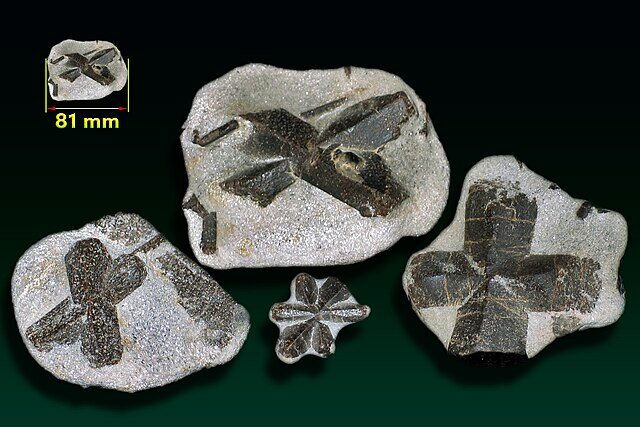
Staurolite (Photo by Lech Darski) (Wikimedia)
“When worn on bare skin, it is said to staunch blood, dispel fever, and increase milk production” (Materialien Lexicon, Lemery, 1721)
“The chiastolite, or macle, shows the representation of a cross on its surface, this effect being produced by the regular arrangement of carbonaceous impurities along the axes of the crystal. The name signifies a marking resembling the Greek letter X (chi). This marking is often very striking in appearance, and the crystal was naturally regarded as having a mystical and religious significance. It was said to stanch the flow of blood from any part of the body if worn so as to touch the skin, and it was also believed to increase the secretion of milk. All kinds of fevers were cured by this mineral if it were worn suspended from the neck, and the divine symbol it bore served to drive away evil spirits from the neighborhood of the wearer. This very interesting mineral occurs very frequently in mica schists. When found, it appears about the thickness of a small finger, tapering slightly at each edge. If broken near one end, it often shows a white cross with a veined outline of black, making a distinct cross with black markings. The crystals frequently measure from two to four inches in length, and are found in Massachusetts, California, and other places. If small segments are broken off, it will be found that the black outline will become stronger, and the white less marked, until finally a black cross will appear, with white markings. The white material is the result of two white wedges pushed point onward until the ends meet, the narrow end of one wedge being crossed by the broad end of the second wedge, and the black filling in the balance of the square. No two of these square crosses can thus ever be esactly alike, and, when polished, the crystals naturally form an interesting stone that was known as lapis crucifer, or cross-stone by the ancients”.
“The peculiar form of the mineral known as staurolite (from the Greek eraopdz cross) is due to the twinning of two crystals at right angles. In Cronstedt’s treatise on mineralogy, published in Stockholm in 1758, we are told that the staurolite was sometimes called Baseler Taufstein (baptismal-stone) or lapis crucifer, the former name being used in Basel, where the stone was employed as an amulet at baptisms. However, the lapis crucifer of De Bootappears from his description to have been the chiastolite. In Brittany these twin crystals were worn as charms, and local legends state that they had dropped from the heavens”. (Curious Lore of Precious Stones, Kunz, 1913)
You must be logged in to view this content, please login. If you're not a member then Click this link to subscribe

.jpg)
_-_Pestsovye_Keivy,_Keivy_Mountains,_Kola_Peninsula,_Murmanskaja_Oblast%27,_Northern_Region,.jpg)