Mentha, Mint, Bo He 薄荷
Bo He (TCM)
Pudina (Unani)
Gur tig གུར་ཏིག་ (Tibet)
Urnu (Akkadian)
Bur Da (Sumerian)

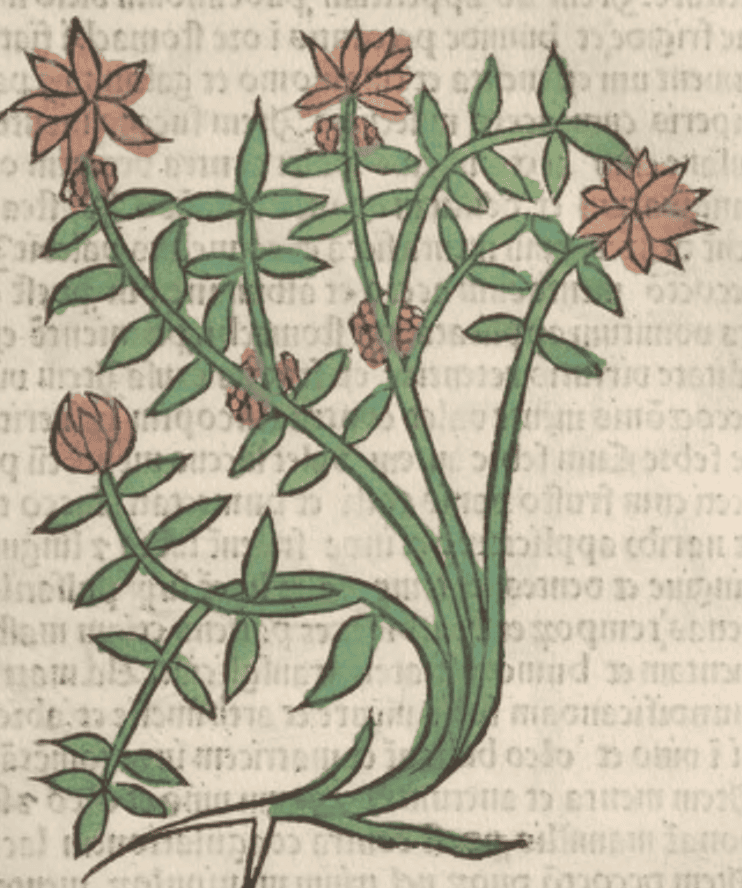
Herbarius latinus, Petri, 1485
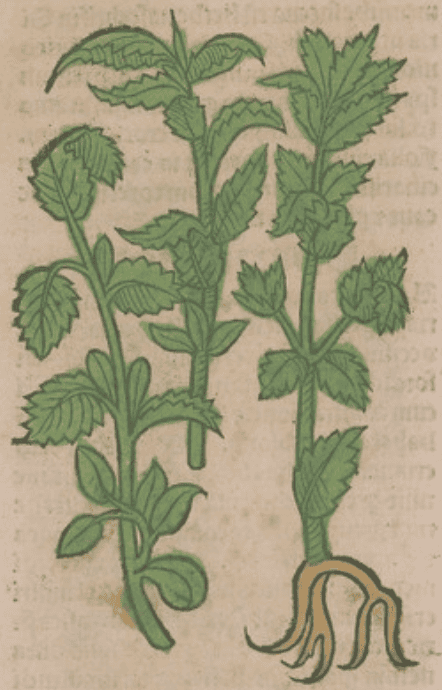
Ortus Sanitatis, Meydenbach, 1491
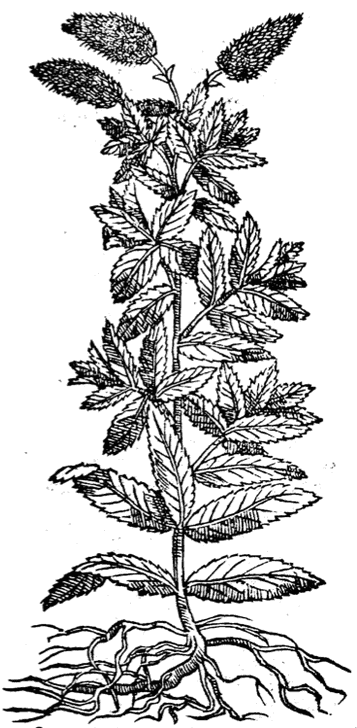
Left: ‘Greater’ and Right ‘Lesser’ Mints
Della Materia Medicinale, Andrea Valuassori, 1562
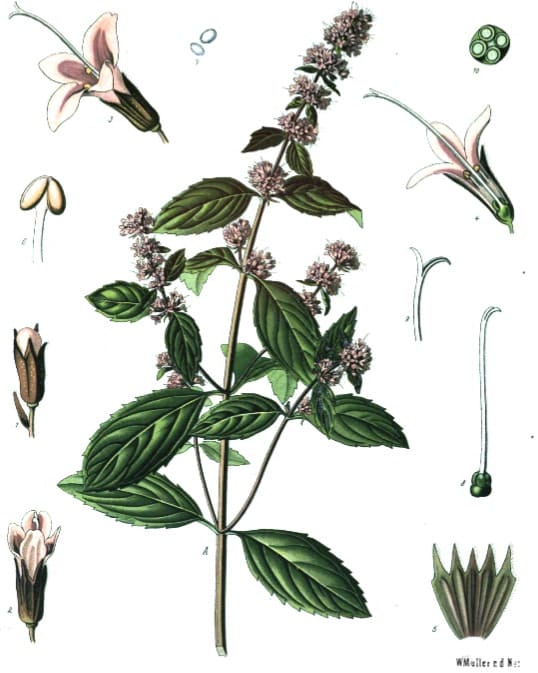
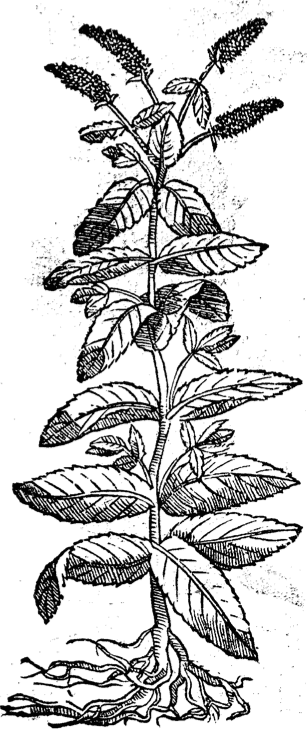
M. piperita
Koehler’s Medizinal Pflanzen, 1887
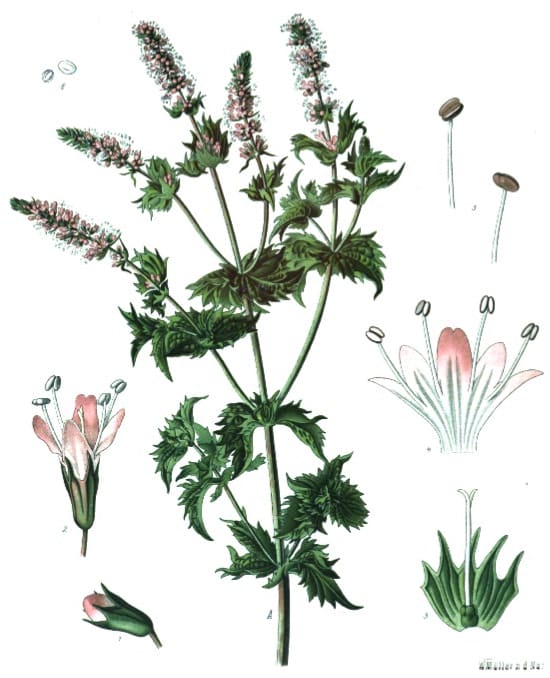
M. viridis
Koehler’s Medizinal Pflanzen, 1887
Botanical name:
Mentha spp.
Various types are used:
- Peppermint: M x piperita, M. arvensis var. piperacsens
- Crisp or Curled: M. crispa
- Cornmint, Field or Marsh Mint: M. arvensis, M. haplocalyx
- Saracen’s Mint; Wild Mint, Horsemint, ‘Mentastrum‘–M. sylvestris
- Water Mint ‘Sisymbrium‘: M. aquatica, M. hirsut
- Spearmint: M. viridis
Catmint (Nepeta) was regarded as a Mint variety and is also used similarly.
The Curled Mint with red stalks was accounted best by the Europeans.
TCM uses the Field Mint (M. haplocalyx), and Unani use Marsh Mint (M. arvensis) which are stronger than regular Peppermint.
Parts used:
Herb
Temperature & Taste:
Cool (Warm in the West), dry. Pungent, aromatic
“”Mint is hot and dry in the second degree with some superfluous moisture” (Avicenna)
Classifications:
2I. ANTISPASMODICS. 2K. RESOLVENT. 2Z. CICATRIZING
3A. SUDORIFICS & DIAPHORETICS. 3B. FEBRIFUGE & ANTIPYRETIC. 3D. CORDIALS & CARDIACS. 3H. LACTAGOGUE
4c. CARDIAC. 4e. STOMACHIC. 4f. SPLENETIC
TCM
A. Clear Exterior Wind-Heat
Uses:
1. Clears Wind-Heat, Promotes Sweat, Resists Poison:
-Fever, Fever with Chills
-beginning stages of Cold, Flu
-acute Wind-Heat conditions of the Head: loss of voice, mouth, teeth and throat problems
-“It elicits diaphoretic actions” (Avicenna)
-“Its intake with wine would remove the fatal effects of the Poisons”. (Avicenna)
-“The drug, specially its seeds, are useful in cases of bite by a Rabid Dog.” (Avicenna)
-also for Leprosy and Elephantiasis; “Oral use of mint is beneficial in Leprosy”. (Avicenna)
-“Pliny says, that in the Time of Pompey the Great, one found out by Experience, that by eating the Leaves of Mint he was cured of the Leprosy”. (The Compleat Herbal, Tournefort, 1719)
2. Promotes Expression of Rashes:
-Measles and other spotted Fevers to encourage full expression of Rash and facilitate quicker recovery.
3. Clears Liver Heat, Settles Wind:
-Liver Headache, Migraine, sore and red Eyes, Toothache
-“It is good against watering eyes and all manner of breakings out in the hea”‘. (Gerard)
-obstruction of the Liver: distention or pain of the Hypochondria
-Nervousness, insomnia, Hypertension, Tinnitus, Childhood Spasms
-“useful in cases of Jaundice” (Avicenna)
-“Oral intake of its extract with vinegar stops the internal bleeding.” (Avicenna)
4. Moves Qi, Clears Heat, Benefits the Stomach:
-chiefly for weak Stomachs, Crudities, Hiccups, Vomiting, Wind, burning Heat or pain of the Guts
-“It strengthens and warms the stomach, relieves hiccough and promotes digestion” (Avicenna)
-“The principal use of Mint is in the Weakness and Crudity of the Stomach, in a Hickup, Vomiting, Flatus’s, burning Heat”. (The Compleat Herbal, Tournefort, 1719)
-also helps remove Black Bile.
5. Externally:
-externally for weakness of the Stomach, pains of the Colic
-“applied externally, it takes away the Hardness of the Breasts, and the curdling of the Milk”, (The Compleat Herbal, Tournefort, 1719)
-curdling of Milk; poultice for Swollen Breasts in nursing mothers
-“Its plaster prevents the coagulation of blood in the Breast and relieves Mastitis” (Avicenna)
-Scald head (Tinea capitis), Itchiness and other skin diseases.
-Scurf and Dandruff of the head, apply Mint with Vinegar. (The Compleat Herbal, Tournefort, 1719)
-“plastered with roasted flour on Abscesses” (Avicenna)
-Neuralgia (Menthol or Peppermint oil)
-Mints are mixed with Parched Barley meal as an application to hard Tumors and swellings.
-“Mint, specially the fresh one, is decocted with wine and plastered to remove black spots of the body and the dark grey marks occurring round the eyes”. (Avicenna)
-‘And if a man have botches or other runnings or swellings in his head, take this herb and stamp it, and lay it to the sore, and it will heal it. Also if a mans tooth ache or stink: take this herb and seethe it in white wine and in Vinegar, and take that liquor and wash his mouth therewith’ (Wyer’s Herbal, 1535)
-Stings of Bees and Wasps.
Dose:
1. Smaller doses release constrained Qi and open Obstructions. Full doses clear Heat and promote Sweat.
Decoction: 3–6 grams, added towards the end
Infusion: 1–2 grams or a sprig of fresh mint may be infused.
Powder: 500mg–2 grams
Tincture (1:5 in 45% alcohol): 1–3 mls, 2–3 times daily
Spirit of Peppermint: 5–20 drops in water
Essential Oil: 1–2 drops, and up to 3 or 4 drop taken on sugar (or in milk) for an adult.
Comment:
“It is helpful in increasing the sexual desire.., It strengthens the seminal tract, but kills the Sperm. Its pre-coital use as a suppository prevents pregnancy.” (Avicenna)
Correctives:
1. Honey
2. Violet
3. Rose Conserve
4. Tragacanth (Unani)
Substitutes:
Various types of Mint have been used similarly.
Main Combinations:
Acute Diseases:
1. Cold and Flu:
i. Mint with Elder flower
ii. with Headache, Sore Throat, Mint with Chrysanthemum Ju Hua
iii. dry throat with cough, Mint with Burdock seed (Niu Bang Zi)
iv. Mint with fresh Ginger, Long Pepper (Ayurveda)
2. Promote the Expression of Measles and other Spotted Fevers, Mint with Burdock seed (Niu Bang Zi) (TCM)
3. Acute Sore Throat:
i. Mint with Sage and Licorice
ii. Mint with Platycodon Jie Geng, Licorice
4. To prevent infection during epidemics, Mint with Calamus, Cinnamon, Lavender, Rue, Sage, Wormwood, Rosemary, Clove, Nutmeg, Garlic, Camphor (as in Four Thieves Vinegar)
5. To protect from Rabies after being bitten, Mint with Rue, Vervain, Plantain, Sage, Polypody, Wormwood, Mugwort, Balm, Betony, Centaury, St. John’s Wort (as in Powder Against Rabies)
Clear Liver Heat
6. Cholecystitis, Mint with Camomile, Balm, Centaury, Caraway
7. Liver Heat:
i. Peppermint with Chrysanthemum
ii. Mint, Balm,. Camomile
iii. Liver Heat, Sore and Red Eyes, Scrofula, Mint with Self Heal (Xia Ku Cao) (TCM)
iv. Peppermint, Centaury, Agrimony
Liver Qi Stagnation:
8. Liver Qi Stagnation:
i. Mint with Paeonia Bai Shao, Bupleurum Chai Hu. (TCM)
ii. Sadness, Worry from Qi constraint Mint with Balm, St. Johns wort
iii. Mint with Basil seed, Bugloss, Pearl, Red Earth, Indian Spikenard, Chebulic Myrobalan, Dodder, Cinnamon, Frankincense (as in Electuary for Sadness and Worry)
iv. mental tension, Mint with Centella, Licorice (Ayurveda)
Calm the Liver, Settle Wind:
9. Childhood Spasms, Mint with Camomile, Red Poppy flower (Pharmacopoeia Generalis, 1783)
10. Hypertension, Mint with Camomile, Yarrow, Aniseed, Fennel seed
11. Tinnitus, Wild Mint with Marjoram, Rue, Stoechas, Camomile (as in Tincture for Tinnitus)
Stomach & Digestion:
12. Species Aromatica: Peppermint, Oregano, Thyme, Lavender, Cloves (Russian Pharmacopeia, 1910)
13 For the Stomach, Indigestion:
i. Mint with Fennel seed, Caraway, Wormwood
ii. Mint with Galangal, Nutmeg, Cinnamon (Pharmacopoeia Generalis, 1783)
iii. Mint with Wormwood, Sweet Basil, Pennyroyal, Rosemary, Lavender, Cinnamon, Clove, Coriander (distil a liquor). (Pharmacopoeia Generalis, 1783)
14. Loss of Appetite, Mint with Cinnamon, Aniseed, Celery, Cyperus, Calamint, Zedoary, Clove, Sesame (as in Powder for Loss of Appetite Greater of Nicholas)
15. Nausea and Vomiting:
i. “take two Ounces of Mint-water, repeat it once and again, and it will stop the most immoderate Vomitings”. (Hartman)
ii. Mint with Pomegranate seed (Avicenna)
iii. Mint with Wormwood, Rose, Galangal, Clove, Nutmeg, Quince (as in Decoction Against Vomiting)
16. Hiccups and Vomiting, Mint is taken with Pomegranate juice (Dioscorides)
Gynecology:
17. Amenorrhea, Dysmenorrhea:
i. Mint, Pennyroyal, Calamint
ii. Mint with Oregano, Mugwort, Camomile (as in Infusion for Painful Menstruation)
iii. Mint with Madder, Cyperus, Asparagus root, Balm, Valerian, Pennyroyal, Licorice (as in Emmenagogue Syrup)
18. Infertility:
i. “Borellus says, that it was revealed to him as a great Secret, that if Women who have even been reputed barren, will apply a Cake made of the Mentha sylvestris seu caballina to their Privy-parts, in the Form of a Crown, before they dally with their Husbands, they will readily conceive; and that this must be done immediately after their Courses are over”. (The Compleat Herbal, Tournefort, 1719)
ii. Mint with Madder, Mugwort, Wormwood, Fennel root, Marjoram, Balm, Cyperus, Mastic (as in Electuary to Promote Fertility)
Other:
19. “Oral intake of Mint followed by whey continuously for several days proves to be useful in cases of Elephantiasis and Varicose Veins” (Avicenna)
20. Thick and Viscid Humors of the Chest, decoct Mint with Figs (Avicenna)
21. Black Bile, Mint with Rose. (Avicenna)
Externally:
22. Abscesses, apply a plaster of Mint and Barley (Dioscorides)
23. Mint Juice in Hydromel for earache (Dioscorides)
Major Formulas:
West / Unani:
Infusion for Painful Menstruation
Decoction Against Vomiting
Powder of Aloeswood (Mesue)
Powder of Galangal Compound (Diagalanga) (Mesue)
Powder for Gonorrhea
Powder for Loss of Appetite Greater (Nicholas)
Powder for Paralysis and Vertigo (Nicholas)
Powder for Vomiting from Phlegm
Four Thieves Vinegar
Electuary to Promote Fertility (Wirtzung)
Electuary of Bayberries (Electuarium de Baccis Lauri)
Electuary for Sadness and Worry
Ointment for Congealed Blood
TCM:
Cang Er Zi San
Chuan Xiong Cha Tiao San
Di Huang Yin Zi
Fang Feng Tong Sheng San
Gua Lu Xiao Du Dan
Jia Wei Xiao Yao San
Liang Ge San
Pu Ji Xiao Du Yin
Ren Shen Bai Du San
Sang Ju Yin
Xiao Yao San
Yang Yin Qing Fei Tang
Yin Qian San
Cautions:
1. Not used for excess sweating
2. “It is an enemy to generation, by overthickening the seed” (Gerard)
3. Culpeper said of Wild Mint: “They are extream bad for wounded people and they say a wounded man that eats Mints his Wound will never be cured, and that’s a long day”.
Main Preparations used:
Distilled Water, Syrup of the Juice, Compound Syrup, Conserve of the Leaves, Distilled Oil, Infused Oil, Salt of the Ashes
1. Conserve of Mint:
i. Fresh leaves of Mint (1 part), White Sugar (2 parts). Beat together.
2. Syrup of Mint:
i. Fresh leaves of Mint (2 oz.), Water (2 pounds). Infuse, strain, add White Sugar (4 pounds). Make a syrup, strain.
ii. Dried Mint (½ pound), Water (5 pounds). Macerate 12 hours; distil four ounces, and dissolve in Sugar (8 ounces). To the expressed and strained residue add White Sugar (2 pounds, 4 ounces). Boil to the desired consistency and add the other Syrup. (Pharmacopoeia Amstelodamensis, 1792)
iii. Juice of Mint clarified by repose, White Sugar (of each 3 pounds). Boil together. (Dispensatorium medico pharmaceuticum Palatinatus, 1764)
iv. Spirit of Peppermint 1 part, Simple Syrup, enough to yield 8 parts
Mix well. Dose: 1–2 fluid drams. (3 ½–7 mls) (Squires)
3. Tincture of Peppermint:
i. Peppermint (1 part), Alcohol 20% (8 parts). Digest 3 days, filter. (Pharmacopoeia Manualis, Antwerp, 1812)
ii. Flowering tops of Peppermint (4 oz.), Rectified Spirit of Wine (2 pounds). Digest, express, and add more Peppermint (2 oz.). Digest again, express and filter. (Dispensatorium Pharmaceuticum, 1777)
iii. Oil of Peppermint (2 drams), Alcohol (1 pound). Mix. Dose: 1–2 drams.
4. Troches of Peppermint:
i. Mint Water, White Sugar (2 oz. each). Boil to the consistency of a soft electuary and add to it an oleosaccharum made of White Sugar (4 oz.) and Essential Oil of Mint (½ dram). Pour by drops onto a marble slab, and when solidified, expose them, placed on a sieve, to a moderate heat for several hours. (Pharmacopoeia Gallica, 1818)
5. Distilled Water of Mint:
i. Mint (1 ½ pounds), Water (sufficient to prevent burning. Distil one gallon. (London)
ii. Essential oil of Peppermint 1 part, Water 1500 parts. Distil off 1000 parts.
Dose: 1–2 fluid ounces (Squires)
6. Spirit of Mint:
i. Fresh Mint 6 lbs. Rectified Spirit of Wine 4 lbs.
Mix, digest 24 hours, then draw off 6 lbs. of Spirit in BM, or distil to dryness.
ii. Oil of Mint (6 ½ scruples), Proof Spirit (4 ½ pints), Water (sufficient to prevent burning). Mix the spirit with the oil, add the water, and slowly distil one gallon. (London)
iii. Fermented: Fresh Mint is covered with Warm Water, enough to cover, and to every 3 quarts of water is dissolved a pound of Sugar (or rather Manna), and left to ferment until it is vineous. Distil the first third off in BM and keep as the Spirit of Mint, the second third as Mint Water; the remainder is discarded.
“This Spirit is chiefly Stomatic, Cephalic, and Uterine, of thin parts, and subastringent. It is used mostly against vomiting, and debility of the Stomach, Crudities, hicket, nauseating Wind, faintings, Obstructions of the Liver, Pains of the Guts, and the belly ache in children, Migraine, Vertigo, Lethargy, Coagulation of Milk, Colic andc. It opens, attenuates, discusses, cures diseases of the Womb, provokes the Terms, strengthens the Liver, and resists Poison, and particularly the Narcotic quality of Opium; outwardly by bathing on the region of the abdomen it eases the Colic, and takes away the hardness of womens breasts from curdling of Milk, by bathing the part, and taking it also inwardly”. (Pharmacopoeia Bateana)
Dose of either Spirit: 2–6 drams
7. Essential Oil of Peppermint
“This warms and strengthens the Stomach, and dries up moist and superfluous humors gathered in the same, and causes good digestion, it stays Vomiting, being drunk and annointing the Stomach therewith, and Kills Round Worms being often used. It helps the griping pains of the Cholic, and stays the Menstrual flux, being either eaten or drunk with some convenient medicine. It eases women which are troubled with hard and perilous travel in child birth. It helps Deafness if it be dropped into the Ears; the only smell of this oil makes the Heart merry”. (A Brief Answer of Josephus Quercetanus Armeniacus, Doctor of Physick … By John Hester, London, 1591)
Click the above Tabs for more information on this medicine
-Known medicinally in Babylonia for the eyes, ears, foul breath, swellings, diseases of the anus, excessive salivation, heartburn, and cough.
-Peppermint has caused long running debate in regard to its temperature: the Chinese say it is cool, as did Aristotle; Galen maintained it was warm (in the 3rd degree), as did most European physicians up until the 17th Century. Holmes, in his ‘Energetics of Western Herbs’, postulates it to have both warming and cooling effects. Nevertheless, the nett effect of Peppermint is to clear heat and calm the Liver, both of which are heat clearing effects and therefore we may reason that it is Cool. Any warming effect it does have may be read as the superior quality of a Cold herb which has moderated itself to make it mildly Cool; also, any warming or stimulating effect it does possess is markedly weaker than that of a real warming medicine such as Ginger, Cinnamon or Cayenne. This is just one example of a medicine, which, when we can push our understanding of traditional medicine further, we will see many herbs with dual effects like this. Also, the Chinese will often judge a medicine by its nett effect on the body, while Galenists often judge a medicine by its activity: therefore Rhubarb is cool by clearing and purging heat from the body, but warm by stimulating the body to purge the heat. To summarise, Peppermint is a gentle herb that may be used for many conditions depending on the herbs it is combined with, but is best suited to: 1. Liver heat; 2. Liver stagnation (with Cold or Hot symptoms); 3. Acute heat conditions such as common cold or sore throat, as well as heat type rashes.
-The Greeks and Romans used Peppermint regularly on their tables in garlands, as sprays, and in their sauces, wines etc.
-First listed in the London Pharmacopoeia in 1721.
-Peppermint Essential oil is the most used essential oil, both in food, cosmetics, and commercial purposes. Essential oil from English Peppermint was regarded as superior to the French or American oils, and was more highly priced.
You must be logged in to view this content, please login. If you're not a member then Click this link to subscribe