
Luffa, Si Gua Luo 丝瓜络
Loofa, Loofah, Luffah, Vegetable Sponge
Dhamargava, Mahakoshtaki (Ayurveda)
Mozhukupeerankai, Pikku (Siddha)
Si Gua Luo (TCM)
Gser phud, Gser gyi phud bu (Tibet)
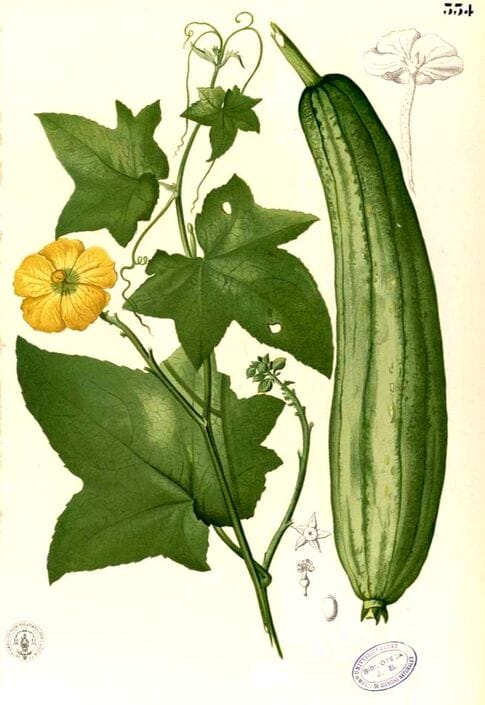
Luffa cylindrica
Blanco, M., Flora de Filipinas, ed. 3 (1877-1883)
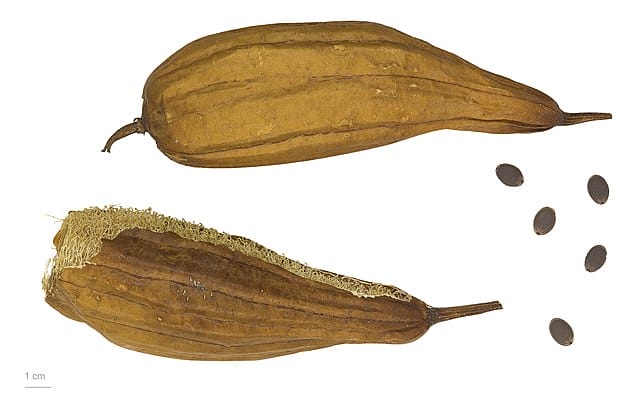
Luffa sponge showing exocapr
(Photo by Muséum de Toulouse) (Wikimedia)
Botanical name:
Luffa cylindrica (syn. L. petola, L. aegyptiaca, L. pentandra, Cucurbita luffa, Momordica cylindrica)
L. acutangula
Parts used:
Dried skeleton of fruit with seeds and exocarp removed
Temperature & Taste:
Neutral/Slightly Cool, Sweet
Classification:
Uses:
1. Clears Heat and Toxin, Reduces Swellings: (TCM, Tibet)
-Boils, Carbuncles, Abscess, Toxin Sores (internally and topically)
-Breast Abscess, acute Heat Breast Lumps (internally and topically)
-also traditionally used to clear Heat from the Blood
-“Cools the blood Heat and detoxifies Toxin”. (Li Shi Zhen)
2. Clears Wind, Opens the Channels, Resolves Obstruction:
-Wind-Damp pain of the muscles or joints (mild effect)
-Joint stiffness; Pain of the muscles and sinews
-distention in the chest and hypochondria
-Trauma, Bruising
-Uterine Bleeding (Charred)
-Amenorrhea (when dry-fried)
-“Metrorrhagia and Metrostaxis” (Li Shi Zhen)
-“dredges through the Channels and Collaterals, motivates the flow of Blood”. (Li Shi Zhen)
3. Clears Phlegm-Heat:
-Heat-type Cough with Fever, Chest pain and hard-to-clear sputum
-Catarrh, Sinusitis (Ayurveda)
-also used for Phlegm obstruction
-used for diseases caused by Phlegm and Bile in Tibetan Medicine
4. Promotes Milk:
-insufficient Breast Milk from Qi stagnation or Heat
5. Externally:
-ash is used topically for Small Pox, Abscesses and Carbuncles.
-the charred sponge can be decocted and used as a wash for Varicose veins
-“good for treating … Hemorrhoids and Fistula”. (Li Shi Zhen)
-topically for Toothache. (Li Shi Zhen)
WHOLE PLANT:
In India, the whole dried plant is used:
1. Obstinate skin diseases including Leprosy, Hemorrhoids
2. Edema, Jaundice, ‘Phantom Tumor’, Scrofula
3. Anemia
Dose: 5–10 grams
SEEDS:
In Unani, the seeds are used, primarily as a purgative.
In Tibetan Medicine, seeds are used as an Emetic, to detoxify, and especially for Jaundice.
Dose:
Ashed or Charred fruit skeleton is often used externally.
Decoction of Luffa: 6–15 grams
Charred Luffa in powder: 3–6 grams
Comment:
1. The fine network-like skeleton of the dried fruit resembles capillaries, and this is why it was traditionally noted to open the fine capillary circulation.
2. Like other members of the Cucurbitaceae, such as the Cold seeds, it is useful for clearing Phlegm-Heat conditions including those with stagnation. Its slightly moist, slippery nature means it doesn’t harm the Yin.
3. This medicine originated in India and was introduced into China in the Song Dynasty (960–1279 CE).
Preparation:
1. Dry-Fried Luffa (Chao Si Gua Luo)
Pieces of Luffa are dry fried in a wok until yellowed and slightly scorched. This is more warming, and is better to move the blood, open the channels and ease pain. This is better for amenorrhea, blood stasis, bruising, and obstruction causing insufficient lactation.
2. Charred Luffa (Si Gua Luo Tan)
Pieces of Luffa are dry fried until blackened. This is best to stop Bleeding such as Blood int he Stool and Uterine Bleeding, but is not commonly used in modern times. Also as a tea for Varicose veins.
Main Combinations:
1. Abscess, Toxic Sores:
i. Luffa with Violet (Zi Hua Di Ding) and Dandelion (Pu Gong Ying)
ii. Breast Abscess, Luffa with Liquidamber fruit (Lu Lu Tong), Vaccaria Wang Bu Liu Xing.
2. Breast Distention, Breast Lumps, Luffa with Citrus Qing Pi
3. Wind-Damp joint pain and swelling, Luffa with Clematis Wei Ling Xian
4. Pain from Qi and Blood stagnation, Luffa with Curcuma Yu Jin
5. Pain from Phlegm obstruction, Luffa with Pinellia Ban Xia, Allium macrostemum Xie Bai
6. Pain from Trauma, Luffa with Safflower (Hong Hua)
7. Pain of the Flank from Qi stagnation, Luffa with Bupleurum Chai Hu
8. Cough due to Phlegm-Heat:
i. Luffa with Scutellaria Huang Qin, Platycodon Jie Geng
ii. Luffa with Loquat leaf (Pi Pa Ye), Licorice
iii. Luffa with Mulberry bark (Sang Bai Pi), Peucedanum Qian Hu
9. Insufficient Lactation:
i. charred herb in powder is taken in doses of 3 grams with wine
ii. Luffa with Liquidamber fruit (Lu Lu Tong), Vaccaria Wang Bu Liu Xing.
10. Small Pox: “It is good for treating retarded vesticulation of Small Pox. Bum old Si Gua with its property retained, and blend in Cinnabar, grinding them into powder. Blend the powder with honey. It works very effectively.” (Zhu Zhen Heng)
Major Formulas:
Qing Luo Yin
Cautions:
Generally safe.
1. Excessive use can cause Diarrhea due to its mildly moistening nature.
2. Commercial Luffa, used as a sponge or to scrub the skin while showering should not be used medicinally as it has usually been bleached.
Main Preparations used:
You must be logged in to view this content, please login. If you're not a member then Click this link to subscribe

“In works before the Tang Dynasty (618-907) and Song Dynasty (960-1279) times, Luffa was not recorded at all”. (Li Shi Zhen)
“The old Si Gua has woven veins and fibers that connect with each other, which resemble the Channels and Collaterals. So it is used to dredge through these, as well as the Viscera and Bowels.” (Li Shi Zhen)