
Lilium candidum, White Lily
Rosa Junonis
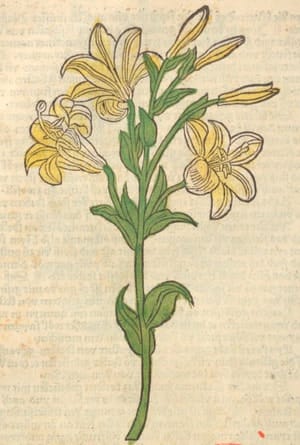
Gart der Gesundheit, Cuba, 1485
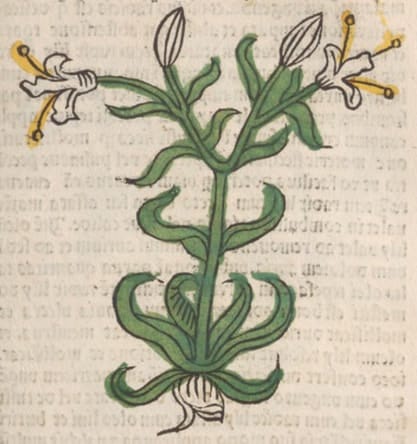
Herbarius latinus, Petri, 1485
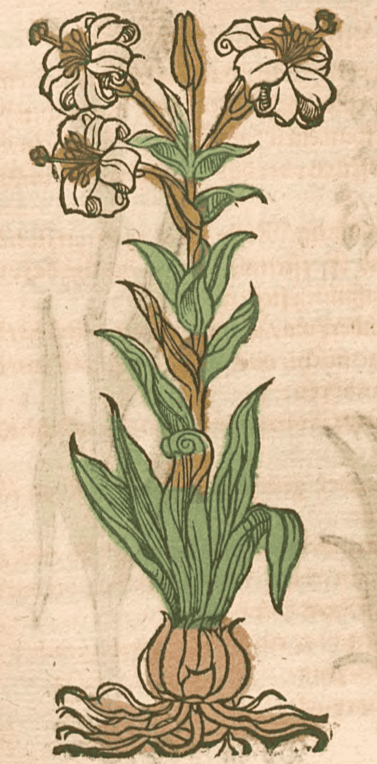
White Lily
Krauterbuch, Lonitzer, 1578
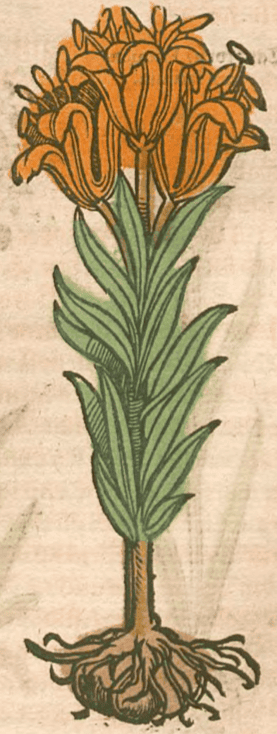
Yellow Lily
Krauterbuch, Lonitzer, 1578
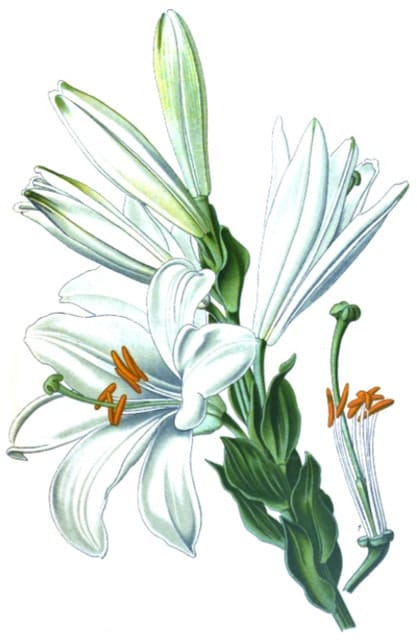
Atlas des plantes de jardins, Klincksieck, 1896
Botanical name:
Lilium candidum (syn. L. album)
A number of different types and species were listed in older texts.
Parts used:
Bulb (fresh and dried); Flower (fresh and dried)
Temperature & Taste:
Roots:
Neutral, slightly Dry. Digest, soften, ripen, cleanse
Flowers:
Warm, moist. Ripen, digest, cleanse, anodyne
“Warm and moist in the first degree” (Herbarius latinus, Petri, 1485)
Classifications:
Uses:
BULB
1. Clears Phlegm, Resolves Masses:
-hardness and Tumors, both topically and internally; especially of the Uterus and Testicles
-Cancers of Breast, Liver, Lung, Stomach, Colon, Testicle, Uterus (Duke)
-uterine bleeding and Uterine masses (internally and as a douche)
2. Promotes Urine:
-Edema, water retention (decoction)
-root juice mixed with Barley meal and baked were said to be effective (Gerard)
3. Clears Heat and Poison:
-fresh root, stamped with white wine, the strained and taken, was claimed to expel the Plague via little blisters on the skin. (Gerard)
4. Externally:
-softens and ripens Tumors;
-hardness of the Testicles and uterus
-heat and inflammation
-Burns and Scalds
-Ulcers
-Corns
-“Softens the Pudenda of Women in Labour”. (Tournefort, 1730)
FLOWER
1. Clears Heat, Stops Coughing and Wheezing:
-Cough, Wheezing, Shortness of Breath (primarily distilled Water)
-The distilled water is “of great use in distempers of the Lungs, such as Asthma, Cough and the like”. (Tournefort, 1730)
2. Moves Qi, Calms the Mind:
-The distilled water was said to be very effective in Hypochondriasis and Hysteria (Tournefort)
3. Externally:
-flower-infused oil is applied to clear Heat and inflammation, ease pain, and ripen Tumors
-burns, scalds
-an important cosmetic; applied to cleanse the skin, remove wrinkles and whiten (oil or distilled water)
HERB:
Externally in Cataplasms or poultices for Inflammations and Gout
Dose:
1. The roots are most used externally in oils, cataplasms, plasters etc. Internally they can be decocted in water or milk
2. The flowers were most used externally in oils and distilled waters, the distilled water of the flowers being the most common internal preparation of them.
Main Combinations:
1. The herb, made into a cataplasm with Henbane and Poppy leaf and Vinegar, applied to Gout. (Salmon)
2. Cough, Asthma, decoct the root with Marshmallow root in water and form a poultice with butter, apply to the chest. (Herbarius latinus, Petri, 1485)
3. Hardness of the Uterus, Uterine Fibroids, as a fomentation with Marshmallow, Violet, Mugwort, Linseed and Fenugreek.
4. Cataplasm for Heat and Inflammation of the Uterus, Marshmallow, Camomile, Mugwort, Barley meal and White Lily oil.
5. Burns, boil the root in vinegar and apply (Herbarius latinus, Petri, 1485)
6. Tinnitus and Ear pain, decoct the root in oil and drop in the ears.
7. To cleanse the skin, whiten and beautify the skin, the flowers the distilled water of the flowers mixed with Oil of Tartar and Camphor.
Cautions:
None noted
Main Preparations used:
Infused oil of Lily flowers (Oil of Lilies)
1. Conserve of Lily:
i. Lily petals (1 part), White Sugar (3 parts). Triturate together.
2. Distilled Water of Lily:
i. Fresh Lily flowers (1 part), Water (4 parts). Distil one-half. (Pharmacopoeia Gallica, 1818)
Some combined flower and root in making the distilled water.
This was primarily used externally as a cosmetic, but was also used for Hysteria, as well as to promote Birth and Afterbirth (mixed with Saffronn and Cinnamon or Cassis Wood).
3. Spirit of the Flowers:
i. Steep the fresh flowers in wine for several days, then distil.
This was said to be especially useful in Hysteria. The dose as a preservative or cure, is 1–2 spoonfuls. (Hoffman)
4. Pulp of Lily:
i. Lily bulbs (any quantity); cleanse them, then wrap in paper and place them in hot ashes until sufficiently soft to be bruised between the fingers; remove the exterior and scorched parts, pound the remainder in a stone mortar and pass through a sieve. (Pharmacopoeia Gallica, 1818)
5. Oil of Lily:
i. fresh Lily petals (1 part), Olive oil (2 parts). Digest for 2 days in a water-bath; express when cold and repeat the maceration with fresh flowers. (Pharmacopoeia Sardoa, 1773)
ii. fresh Lily petals (1 part), Olive oil (4 parts). Digest for 2 days in a water-bath; express when cold and repeat the maceration with fresh flowers. Repeat a third maceration leaving the flowers to infuse for 3 months. (Pharmacopoeia Gallica, 1818)
iii. Lily petals, Olive oil (equal parts). Boil gently to the consumption of the humidity. (Dispensatorium medico pharmaceuticum Palatinatus, 1764)
Click the above Tabs for more information on this medicine
You must be logged in to view this content, please login. If you're not a member then Click this link to subscribe

The Lily was always viewed as a symbol of fairness and purity.