Hyssopus, Hyssop
Zoofa (Unani)
Zupu Sar (Akkadian)

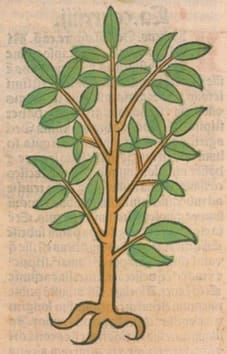
Ortus Sanitatis, Meydenbach, 1491
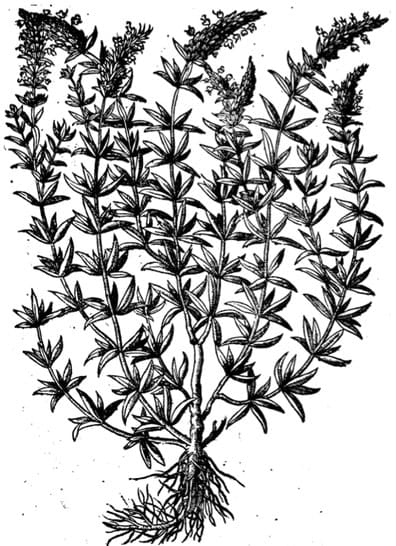 New Kreuterbuch, Matthiolus, 1563 | 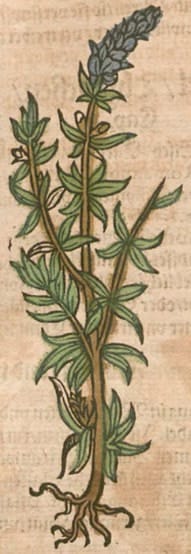 Krauterbuch, Lonitzer, 1578 |
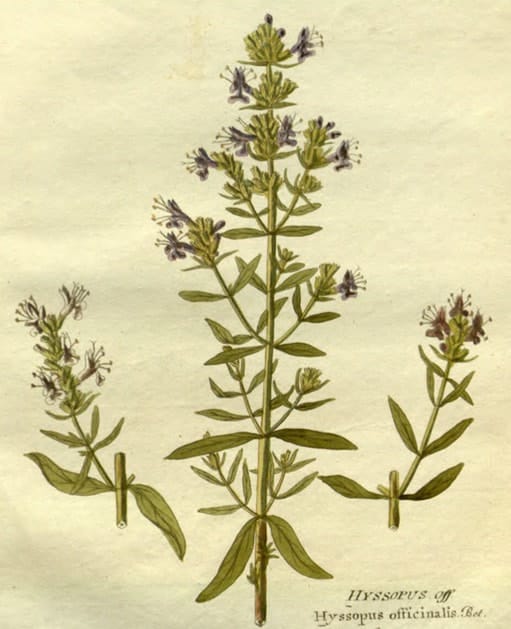
Icones Plantarum Medcio-oeconomico, Vietz, 1800
Botanical name:
Hyssopus officinalis
Five other European species have been used similarly: H. ambiguus, H. cuspidatus, H. latilabiatus, H. macranthus, and H. seravschanicus
Garden and Wild types were traditionally differentiated.
Parts used:
Herb, flower
Temperature & Taste:
Warm, dry. Pungent, Bitter
“Hot and Dry in the Third degree” (Avicenna)
Classifications:
2A APERIENT MEDICINES. 2B ATTENUATERS. 2F. PURIFYING. 2J. RAREFYING
3F. LITHONTRIPTIC. 3K. EXPECTORANT. 3L. ANTI-TUSSIVE. 3P. MASTICATORIES & STERNUTATORIES.
3Q. ANTHELMINTIC
4a. CEPHALIC. 4d. PECTORAL. 4j. NERVINE
Uses:
1. Clears Cold Phlegm, Stops Cough:
-Cleanses the Lungs of thick and cold Phlegm
-Cough, Bronchitis, Asthma, shortness of Breath, Pleurisy
-larger doses promote vomit.
-“The Syrup is of excellent use in the inveterate Distempers of the Breast of long continuance”. (The Compleat Herbal, Tournefort, 1719)
2. Clears Phlegm, Resolves Swellings:
-“It ripens and breaks tumors and impostumes [abscesses] in the Mouth, Throat, and Breast”. (Salmon)
-“helps inflammations of the Lungs”. (Salmon)
-Swellings, Abscesses and Tumors, especially of the Mouth, Throat, Chest and Lungs
3. Settles Wind, Calms the Nerves, Stops Spasms:
-Epilepsy, Convulsions, Tinnitus
-Anxiety, Depression, Hysteria
-Hypertension
-regarded as strengthening to the Brain and Memory (Haller, various)
4. Clears Wind and Cold, Promotes Sweat:
-Cold, Flu, Intermittent Fever, Allergic Rhinitis, acute Sore Throat
-helps to express rashes in Measles and other Spotted Fevers
-Eczema, Psoriasis
5. Moves the Blood, Clears Stasis:
-internal Blood Stagnation; Bruising; internal bruising and congealed blood of the Uterus, Abdomen, Liver, Lungs etc.
-congealed Blood or Bruising of the Eye (Unani)
-Amenorrhea, Dysmenorrhea
-classically to promote Abortion
-“If taken with wine, it dissolves the hard swellings”. (Avicenna)
-“Its oral intake improves the Complexion” (Avicenna)
6. Clears Damp, Opens Obstructions:
-Jaundice
-swelling or pain of the Liver or Spleen
-Stomach pain
-difficult Urination, Edema, Gravel and Stones
-“It provokes Urine, and is likewise good in the dripping of Urine, or Strangury”. (The Compleat Herbal, Tournefort, 1719)
7. Kills Worms:
-“expels intestinal Parasites”. (Galen)
-especially Round Worm (Unani)
-Powder is taken with Honey to expel Worms
8. Externally:
-the Oil is used to anoint the temples for Headaches, especially in Fevers; also good for shortness of breath, cough, and to procure sweat.
-the herb boiled in wine is used externally as a wash for inflammations, bruises, and muscular rheumatism etc.
-boiled in Vinegar to be used as a wash for Toothache.
-also for used as a gargle or mouth wash for mouth Sores or Abscesses.
-the vapors of the boiling decoction or the Oil was put into the ears for pain, inflammation and ringing of them.
-“Being bruised, and Salt, Honey and Cumin seed put to it, helps those that are stung by Serpents”. (Culpeper)
-Also applied to Herpes sores.
-the Oil was applied to the scalp for Lice. (Dioscorides)
-in baths for Nervous Exhaustion and Nervous complaints.
-as a wash for catarrhal Opthalmia
-Decoction as a wash for Black Eyes, Bruises of the Eyes and other Bruises
-hard swellings, boil in wine and apply (Pliny)
-to cleanse the Womb (in Douches)
-Tinnitus (the fumes taken into the Ear)
-Decoction as a Mouthwash for putrid or sore gums
Dose:
Pliny said “Hyssop mixed with Figs, purges; with Honey, vomits”.
Decoction: 3–6 grams, up to 9 grams
Powder: 1–3 grams
Tincture (1:5 in 45% alcohol): 2–5 mls, 2–3 times daily
Fluid Extract (1:1 in 25% alcohol): 30–60 drops, up to 5 mls.
Essential Oil: 1–2, or 3 drops on sugar.
Correctives:
1. Gum Arabic
2. Tragacanth
3. Pomegranate
Substitute:
1. Sage is similar to Hyssop, especially for conditions of the Lungs and Throat
2. Thyme, Licorice, Adhadota vasica (Unani)
3. “It is tenuous like common Thyme” (Avicenna)
Main Combinations:
Cough & Lungs
1. Cough:
i. Hyssop with Thyme
ii. Hyssop with Licorice, Maidenhair (as in Syrup of Licorice of Mesue)
2. Cough, shortness of Breath, Wheezing:
i. Hyssop with Figs and Rue (Dioscorides)
ii. Hyssop with Basil, Maidenhair, Horehound, Licorice (as in Decoction for Cough and Asthma of Galen)
3. Chronic and Persistent Cough:
i. Hyssop (1 handful), Figs (2 oz.), Sugar Candy (1 oz.), boil in 1 pint of Muscadine until reduced to half. Strain and take morning and evening. It stops cough and helps expel the tough Phlegm. (The Compleat Herbal, Tournefort, 1719)
ii. Hyssop with Rue and Fig
iii. Hyssop with Licorice, Currants, Fenugreek and Linseed (Wirtzung)
iv. Hyssop with Maidenhair, Vervain and Poppy capsules (or seed)
4. Cold Cough:
i. Hyssop with Thyme, Celery root, Fennel root, Aniseed, Raisin, Licorice (as in Decoction of Thyme of Andernacus)
ii. Hyssop with Orris, Thyme, Black Pepper, Pennyroyal, Rue, Cumin, Licorice, Raisins, Ginger, Aniseed (as in Electuary of Hyssop (Diahyssopus) of Nicholas)
5. Lung catarrh, Hyssop, Ivy leaf, Elecampane (Sobernheim, 1840)
6. For Cough from weakness, to strengthen the Lungs and enhance respiration:
i. Hyssop with Celery root, Fennel root, Licorice, Raisins, Figs, Dates, Maidenhair, Tragacanth (as in Syrup of Hyssop of Mesue)
ii. Hyssop with Coltsfoot, Fig, Raisin, Licorice (as in Decoction of Hyssop and Coltsfoot of Wirtzung)
iii. Hyssop with Sage, Elecampane, Licorice, Aniseed, Fennel seed, Rose (as in Decoction for Cough of Gabelhover)
iv. Hyssop with Maidenhair, Elecampane, Celery root (Pharmacopoeia Wirtembergica, 1798)
7. Chronic Bronchitis, Hyssop with Ground Ivy and Senega
8. Asthma, Shortness of Breath:
i. Hyssop with Agaric, Orris, Licorice, Peony (as in Decoction of Hyssop of Andrezeos)
ii. Hyssop with Gentian, Agaric, Mastic (as in Electuary for Asthma of Andrezeos)
iii. Hyssop with Squill, Orris, Horehound, Myrrh, Saffron (as in Lohoch Effective for Asthma of Serapion)
iv. Hyssop with Licorice juice, Maidenhair, Black Pepper, Bitter Almond, Orris, Radish seed (as in Electuary for Asthma)
v. Hyssop with Licorice and Adhatoda vasica (Unani, proven efficacy in Bronchial Asthma in clinical trials)
9. To clear Phlegm, Hyssop, Caraway, Orris (Avicenna)
10. Chronic Cough and Breathlessness with hard swellings, decoction of Hyssop and Figs with Honey (Avicenna)
11. Pneumonia, Hyssop, Thyme, Marshmallow root, Slippery Elm bark, Cayenne
Head, Brain and Nerves
12. Convulsions, Hyssop with Rue, Sage, Betony, Rosemary, Calamus, Peony, Asparagus root, Fennel seed, Nutmeg, Cinnamon (as in Tincture Against Convulsions)
13. Epilepsy, Hyssop, Horehound, Castoreum (½ dram ea.), Peony root (2 drams), Asafoetida (½ scruple), powder, mix with Hyssop juice and make 7 Pills. Take one each night before bed. (The Compleat Herbal, Tournefort, 1719)
14. Paralysis:
i. Hyssop with Sage and Rosemary
ii. Hyssop with Sage, Lavender, Mint, Clove, Nutmeg, Zedoary, Galangal, Calamus, Juniper berry, Peony (as in Powder for Paralysis and Vertigo of Nicholas)
iii. Hyssop with Asparagus root, Peony root, Betony, Cowslip, Four Cold Seeds, Calendula, Rosemary (as in Tincture for Paralysis)
15. To Improve Memory:
i. Hyssop with Calamus
ii. Tinctures of Hyssop and Cinnamon have been combined (equal parts)
16. Depression: “But if the Liver is sick because of the person’s sadness, the person should cook young chicken with Hyssop before the sickness increases. The person should often eat this Hyssop and Chicken, and should also eat fresh Hyssop laid in wine, and then drink the Wine”. (Hildegard von Bingen)
Other:
17. Measles, Hyssop, Sage, Calendula
18. Gall Bladder, Cholecystitis, Hyssop with Wormwood, Celandine, Ginger, Senna
19. Scrofula, Hyssop with Self Heal, Peppermint
20. To promote Menstruation, Hyssop with Mugwort, Betony, Elecampane (as in Decoction to Promote Menstruation of Turner)
21. To stop sweating, Hyssop with Sage and Walnut shells (Meyer)
22. To purge the body, take with Figs (Pliny)
23. Worms, take with Honey to purge worms.
Externally:
24. As a Gargle for Sore Throat and Tonsillitis, Hyssop with Sage and Alum
25. Tinnitus: “Vapours from a decoction using the drug along with its stalks specially with fig prove to be beneficial in tinnitus aurian. A funnel is used to enable the vapours reach the ear.” (Avicenna)
26. “Being bruised, and Salt, Honey and Cumin seed put to it, helps those that are stung by Serpents” (Culpeper)
Major Formulas
Decoction of Hyssop (Zacharia)
Decoction of Hyssop (Andrezeos)
Decoction of Hyssop and Coltsfoot (Wirtzung)
Decoction of Thyme (Mesue)
Decoction for Cough (Gabelhover)
Decoction for Cough and Asthma (Galen)
Syrup of Hyssop Compound (Mesue)
Syrup of Hyssop of Amaran
Syrup of Licorice (Mesue)
Tincture Against Schirrus of the Spleen
Powder to Clear Phlegm (Rhazes)
Electuary of Hyssop (Diahyssopus) (Nicholas)
Electuary for Asthma of Andrezeos
Antidote for Wind and Cold (Nicholas)
Cautions:
Avoid During Pregnancy
Main Preparations used:
Distilled Water, Distilled Oil, Conserve of the Flowers, Syrup of the Juice, Compound Syrup, Species Diahyssopi
1. Conserve of Hyssop:
i. Fresh Hyssop leaves, bruised (1 part), Powdered Sugar (2 parts). Mix well and keep.
Very good for the Breast and Lungs; also used for old Coughs, narrowness of the Breast and shortness of Breath; it consumes all cold Rheums; it strengthens the Stomach, Head and Brains; it removes the ascending vapours, and is good against all Poison, and also very meet against all coldness of the internal parts.
2. Syrup of Hyssop:
i. Hyssop dried (2 oz.), Water (2 pounds); Infuse, add to the strained liquor White Sugar (4 pounds). Strain. (Pharmacopoeia Hispana, 1798)
ii. Hyssop tops dried (1 oz.), Distilled Water of Hyssop (2 pounds); digest in a water bath for 2 hours in a covered vessel; strain, filter and add White Sugar (double the quantity). Melt in a water bath. (Pharmacopoeia Gallica, 1818)
3. Hyssop Wine
It is good for all Cold diseases, and especially for all old persons. It eases a Cold and Moist Cough, is good against Falling Sickness “for that when the same is used often and long, then does it take away the same, and that especially in young folks’. It is also good for the Lungs and Breast, clearing all slimy matter from them. It opens the Lungs, gives a clear voice, removes the shortness of breath, and is especially good for Dropsy”. (Wirtzung)
4. Distilled Water of Hyssop.
For Coughs and others conditions of the Lungs, disorders of the Stomach and Breast; as the Spirit, but not as strong.
5. Spirit of Hyssop.
Take fresh Hyssop in Flower, bruise well, and put into an Oak Vessel adding sufficient Fountain Water to cover, and a little Ale-yeast; leave to ferment for 10 or 12 days, then add more water and Distil by an Alembic; afterwards rectify often in BM according to Art. (When distilled in an Alembic it must not be distilled to dryness; two-thirds may be distilled off, or it may be distilled in BM)
“It is an admirable Pectoral”; used for coughs, colds, various obstructions of the Breast and Lungs, Wheezing, Hoarseness, Shortness of Breath, and difficulty breathing. Dose: 1 oz. (Pharmacopoeia Bateana)
6. Oil of Hyssop:
i. Hyssop (25 parts), Water (75 parts), Salt (3 parts). Digest for 3 days, then distil. (Pharmacopoeia Wirtembergica, 1798)
Click the above Tabs for more information on this medicine
-Hyssop was used for cleaning Sacred places, hence its name which is derived from the Hebrew ‘Azob’, meaning a Holy herb. It is said to be a Biblical herb; David said “Purge me with Hyssop, and I shall be clean” (Psalms 51:7), although some sources say another herb is being referred to. It is also mentioned in Exodus 12:22, Leviticus XIV: 4, 6, 49, 51, 52, Kings: 4:33, and John 19: 29.
-Hyssop was known to the ancient Greeks. Hippocrates used Hyssop for bronchitis and pleurisy. Galen promoted the inhalation of the fumes of burning Hyssop, Sulphur and other herbs for sore throat and tonsilitis. The famous School of Salerno recommended a decoction of Hyssop with Honey added to cleanse the Lungs of phlegm and help various Lung diseases. It was known in Britain by the middle of the 13th century.
-From the School of Salerno (taken from the English version by Sir John Harington):
Clean Hyssop is an herb to purge and cleanse
Raw phlegms, and hurtful humors from the Breast,
The same unto the Lung great comfort lends,
With Honey boiled: but far above the rest,
It gives good color, and complexion mends,
And is therefore with women in request.
-An important flavouring herb for liquors such as Chartreuse. Also added to perfumes such as Eau de Cologne.
-Traditionally said to “Strengthen all parts under Cancer and Jupiter”.
GENERAL / REVIEW:
–The Genus Hyssopus: Traditional Use, Phytochemicals and Pharmacological Properties
–Hyssopus Essential Oil: An Update of Its Phytochemistry, Biological Activities, and Safety Profile
–Wild Italian Hyssopus officinalis subsp. aristatus (Godr.) Nyman: From Morphological and Phytochemical Evidences to Biological Activities
ANTI-BACTERIAL:
–Chemical and Biological Properties of Different Romanian Populations of Hyssopus officinalis Correlated via Molecular Docking.
–Evaluation of Antioxidant and Antimicrobial Activities and Phenolic Profile for Hyssopus officinalis, Ocimum basilicum and Teucrium chamaedrys
ANTI-VIRAL:
COVID:
–Critical role of Hyssop plant in the possible transmission of SARS-CoV-2 in contaminated human Feces and its implications for the prevention of the virus spread in sewage
–Effects of Iranian herbal Zofa® syrup for the management of clinical symptoms in patients with COVID-19: A randomized clinical trial
HERPES:
–Susceptibility of Drug-Resistant Clinical Herpes Simplex Virus Type 1 Strains to Essential Oils of Ginger, Thyme, Hyssop, and Sandalwood
ANTIOXIDANT:
–Effects of dietary Hyssop, Hyssopus officinalis, extract on physiological and antioxidant responses of rainbow trout, Oncorhynchus mykiss, juveniles to thermal stress
–Antioxidant, Antigenotoxic and Cytotoxic Activity of Essential Oils and Methanol Extracts of Hyssopus officinalis L. Subsp. aristatus (Godr.) Nyman (Lamiaceae)
–Wild Italian Hyssopus officinalis subsp. aristatus (Godr.) Nyman: From Morphological and Phytochemical Evidences to Biological Activities
–Evaluation of Antioxidant and Antimicrobial Activities and Phenolic Profile for Hyssopus officinalis, Ocimum basilicum and Teucrium chamaedrys
–Phytochemical analysis and antioxidant activity of Hyssopus officinalis L. from Iran
ANTI-INFLAMMATORY:
–Discovery of Phenolic Glycoside from Hyssopus cuspidatus Attenuates LPS-Induced Inflammatory Responses by Inhibition of iNOS and COX-2 Expression through Suppression of NF-κB Activation
–Effect of Hyssopus officinalis L. on inhibiting airway inflammation and immune regulation in a chronic asthmatic mouse model
ANTICONVULSANT:
–Effects of aqueous extract of Hyssopus officinalis on seizures induced by pentylenetetrazole and hippocampus mRNA level of iNOS in rats
IMMUNOMODULATORY:
–Effect of Hyssopus officinalis L. on inhibiting airway inflammation and immune regulation in a chronic asthmatic mouse model
ASTHMA:
–Network Pharmacology-Based Analysis of the Underlying Mechanism of Hyssopus cuspidatus Boriss. for Antiasthma: A Characteristic Medicinal Material in Xinjiang
–The Effects of Uygur Herb Hyssopus officinalis L. on the Process of Airway Remodeling in Asthmatic Mice
–Effect of Hyssopus officinalis L. on inhibiting airway inflammation and immune regulation in a chronic asthmatic mouse model
HYPOGLYCEMIC:
–Hyssopus officinalis exerts hypoglycemic effects on streptozotocin-induced diabetic rats via modulating GSK-3β, C-fos, NF-κB, ABCA1 and ABGA1 gene expression
CYTOTOXIC:
–Hyssopus Essential Oil: An Update of Its Phytochemistry, Biological Activities, and Safety Profile
–Antioxidant, Antigenotoxic and Cytotoxic Activity of Essential Oils and Methanol Extracts of Hyssopus officinalis L. Subsp. aristatus (Godr.) Nyman (Lamiaceae)
ANTI-CANCER:
–Wild Italian Hyssopus officinalis subsp. aristatus (Godr.) Nyman: From Morphological and Phytochemical Evidences to Biological Activities
You must be logged in to view this content, please login. If you're not a member then Click this link to subscribe