Herb Groups
of Tibetan Medicine
As with other Traditions, Tibetan Medicine has a number of standard combinations regularly used in their formulas. While some of these are derived from Ayurveda, such as Triphala (Myrobalans) and Trikatu (Three Pungents), others are unique to Tibetan Medicine.
Six Excellent Drugs
One Tibetan group of herbs of particular interest is the Six Excellent Drugs. This combination is composed of one medicine for each of the 5 Main Organs (5 Yin Organs of TCM), Heart, Lungs, Liver, Spleen and Kidney, as well as the ‘Life Channel’ (Du Mai of TCM), the primary channel for Yang Qi. In addition each of the Dosas (Humors–Phlegm, Bile and Wind) are affected by 2 medicines. It is regarded as fairly Neutral in nature. For these reasons, it is commonly added to large formulas for complex diseases. When combined with Triphala, which also balances and regulates the Dosas (Humors), it becomes a powerful compound for regulating the Humors and balancing the Organs.
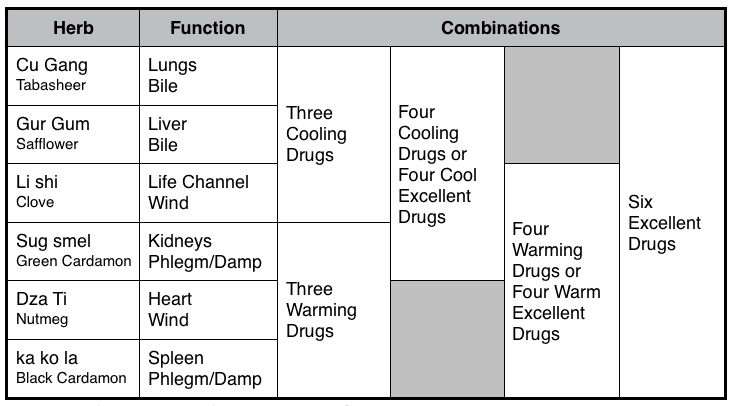
Table taken from Essentials of Tibetan Medicine, Gyatso & Hakin
Within this group of Six Drugs are several other groups, as demonstrated in the table above. Three and Four Warming and Cooling Drugs, used for Cold and Heat diseases respectively.
Pomegranate Formulas
Another important group of combinations is that based on Pomegranate seeds. The Pomegranate Formulas are all used to warm and strengthen Digestion, and increase Digestive Heat.
Pomegranate 4
There are a number of variations of Pomegranate Four, all having similar effects, but slightly different emphasis. They warm and strengthen the Stomach, promote Digestion and enhance the formation of Chyle suitable to make good blood and Humors (1st Digestion). When Safflower is added, it enhances the effect in the Liver of producing good Blood from the Chyle (2nd Digestion).
- Pomegranate, Cinnamon, Green Cardamon, Long Pepper
- Pomegranate, Cinnamon, Green Cardamon, Galangal
- Pomegranate, Cinnamon, Safflower, Long Pepper
- Pomegranate, Green Cardamon, Safflower, Galangal
Pomegranate 5
Pomegranate 5 combines Pomegranate, Cinnamon, Green Cardamon, Long Pepper and Galangal. Its effects are generally as for Pomegranate 4.
Pomegranate Sanctuary
This is the same as Pomegranate 5, but substitutes Safflower for Galangal. It is a stand-alone formula but may also be found as a component of larger formulas. The warming spices and Pomegranate help the Stomach produce good Chyle (1st Digestion). When Safflower is added it aids the Liver in producing good blood from the Chyle (2nd Digestion). It is also used for obstruction of the channels.
Primary Tibetan Combinations
Two Gums
Gu gul gnyis
Myrrh
Frankincense
Combined for Lymph disorders, and to move the Blood and clear stasis.
Two Cumins
Cumin
Nigella
They warm and strengthen the Stomach, clear Wind and Damp and increase Digestive Heat.
In some sources, Caraway or related seed is listed in place of Nigella. Fennel may also be used. It is similar to the 4 Warm Seeds of the Western Tradition.
Two Sandalwoods
Tsan dan gnyis
White Sandalwood
Red Sandalwood
Combined for Heat diseases and Fever.
Three Fruits (Triphala)
A bar skyur gsum
Chebulic Myrobalan
Emblic Myrobalan
Belleric Myrobalan
Used as for Triphala in Ayurveda.
Three Seeds
‘Bras sna gsum.
Mango kernel – a ’bras
Java plum (Eugenia jambolana) – sra ‘bras
Fever nut (Caesalpinia) – ‘jam ‘bras
This combination warms and strengthen the Kidneys.
Three Supplementary Medicines
Saffron/Safflower
Lesser Cardamon
Long Pepper
Added to enhance certain formulas.
Three for Lymph disorders
Frankincense
Cassia tora seed
Abelmoschus moschatus seed
Combined for Lymph disorders.
Three Bitters
Indian Chiretta (Swertia spp)
Tibetan Chiretta (Swertia spp)
Nepalese Chiretta (Swertia app)
Clears Heat of Blood and Bile, stops Fever, clears Heat of the Liver and Gall Bladder. Commonly, Indian Chiretta (Swertia) is substituted for all 3 as the others are often not available. Gentian may also be used.
Three Salts
Ammonium chloride
Rock Salt
Black Salt
Treats Wind and Phlegm diseases, strengthens Digestion
Minister Three
Blon po gsum
Tabasheer,
Safflower
Bezoar
Used to clear Heat.
Three Flowers
Ge sar gsum
Gesar (from Sanskrit Kesara), means stamen or flower.
Na ga ge sar: stamen of the flower of Bombax ceiba
Padma ge sar: petal of Bombax ceiba
Utpal ge sar: calyx of Bombax ceiba
Some sources have suggested one flower is Bombax ceiba, one is Mesua ferrea, and the third is Lotus pistil.
Three Woods
Shing mcho gsum
White Sandalwood
Red Sandalwood
Aloeswood
Three Horns
Gwa dor gsum
Deer horn
Rhinoceros Horn
Tibetan Elk horn
Used to dry pus and excess Lymph fluid.
Four Red Medicines
Dmar po bzhi
Madder
Lacca
Tibetan Gromwell (Onosma hookeri)
Sapphireberry (Symplocos)
Combined for Blood diseases.
Balancing Four
Rock Salt
Fresh Ginger
Chebula
Long Pepper
Together, these medicines are a foundation for formulas used to treat Cold-Phlegm.
Inula Four
Inula
Raspberry (kan ta ka ri)
Tinospora
Galangal
This forms the Decoction of Elecampane Four, but is also a component of other formulas.
Used for acute Fever, Cold, Influenza; Deficient Fever, Fever with Wind, and to bring out ‘Hidden Fever’.
Five Principal Medicines
Rtsa ba lnga
Angelica glauca root
Mirabilis himalaica root
Soloman’s Seal root
Tribulus seed
Asparagus root
This combination is rejuvenating and strengthening, nourishing Yin and Blood and warms Kidney Yang. Increases strength and vigor, good for the Elderly, debilitated and to nourish the 7 Body Constituents.
Note that in the compound, Dang Gui can be used for the Tibetan Angelica and Withania can replace Mirabilis.
Six Excellent Medicines
Bzang drug
Tabasheer
Safflower
Clove
Nutmeg
Lesser Cardamon
Greater Cardamon
An important combination used to help balance and harmonise the Organs of the body. See Six Excellent Medicines. See also other Excellent Medicine combinations below.
Other Tibetan Groups
A byag gnyis (A byag pair)
A byag gzer ‘joms (Pyrethrum tatsienense) and A byag tsher sngon (Meconopsis horridula)
A gar gsum (Aloeswood 3)
Ar skya, Ar nag and Ar dmar
Bzang bzhi (Excellent Four)
Dza ti (Nutmeg), Li shi (Clove), Ka ko la (Greater Cardamon) and Sug smel (Lesser Cardamon)
Bzang gsum (Excellent Three)
Dza ti (Nutmeg), Ka ko la (Greater Cardamon) and Sug smel (Lesser Cardamon)
Bong nga bzhi (Four Aconites)
Bong nga dkar, Bong nga ser, Bong nga nag and Bong nga dmar
Bsil bzhi (Cool Four)
Cu gang (Tabasheer), Gur gum (Safflower), Li shi (Clove), and Sug smel (Lesser Cardamon)
Bsil gsum (Cool Three)
Cu gang (Tabasheer), Gur gum (Safflower), and Li shi (Clove), for the upper body or Sug smel (Lesser Cardamon) for the lower body.
Bcud bzh (Four Essences)
meat, butter, molasses and wine
Gu gul gnyis (Two Resins)
usually this is Gu gul (Bdellium) and Spos dkar (Frankincense). Sometimes appears to be Bdellium and Myrrh.
Drod gsum (Heating Three)
Dza ti (Nutmeg), Ka ko la (Greater Cardamon) and Sug smel (Lesser Cardamon)
Mngar gsum (Sweet Three)
Ka ra (Sugar), Bu ram (Molasses) and Sbrang rtsi (Honey)
See also:
Herb Groups of the Western Tradition
Herb Groups of Ayurveda
Herb Combinations
Temperature of Medicines
Hot or Cold? The Temperature of Medicines
Directing Medicines
Tastes of Medicines
Doctrine of Signatures
Humoral Medicine
Medicines used in the Various Systems
Illustrations of Tibetan Materia Medica, Wellcome Collection
You must be logged in to view this content, please login. If you're not a member then Click this link to subscribe