Gmelina, Gambhari
White Teak, Malay Bushbeech, Kashmir Tree
Gambhari, Kashmiri (Ayurveda)
Kattanam, Kumizham (Siddha)
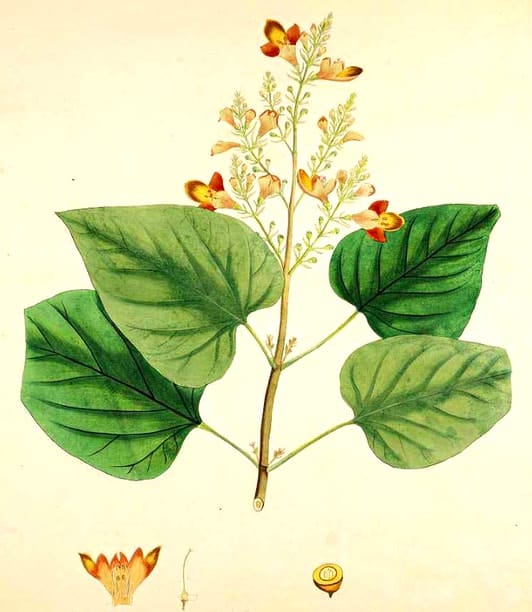
Gmelina
W. Roxburgh, Plants of the coast of Coromandel, (1819)
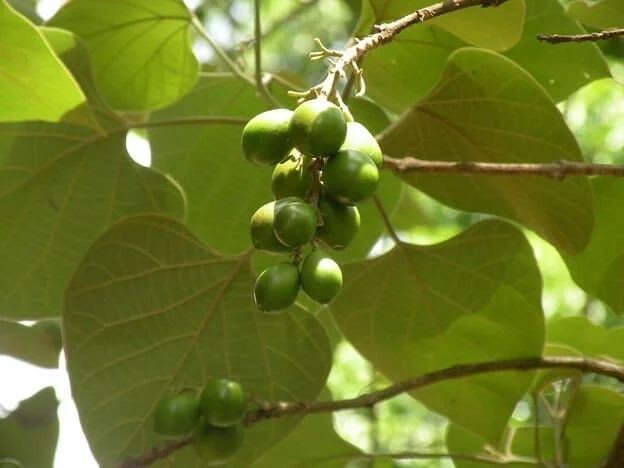
Gmelina arborea
(Photo by Ajtjohnsingh) (Wikimedia)
Botanical name:
Gmelina arborea (syn. Premna arborea)
Gmelina asiatica is often used due to the increasing rarity of G. arborea.
Parts used:
Root, Fruit
Because the tree is increasingly rarer and in high demand, the Stem-Bark is more commonly used in place of the root as it is sustainable.
Temperature & Taste:
FRUIT: Cool, dry. Sweet, Sour, astringent
ROOT / STEM-BARK: Cool, dry. Sweet, Bitter
Uses:
ROOT / STEM BARK:
1. Clears Wind-Heat:
-Fever, Cold, Flu, Chronic Fever
-excess Bile Humor
-Burning Syndrome; Thirst
-also for Dizziness
2. Clears Damp-Heat, Promotes Urine:
-Edema, Obesity
-Dysuria, Auria, Anasarca
-urinary tract infections
-Gonorrhea
3. Promotes Digestion:
-indigestion, digestive weakness, poor appetite
-Abdominal pain, Diarrhea, Malabsorption
-balances all 3 Dosas (Humors)
-Piles
4. Promotes Milk:
-increases Breast Milk
5. Nourishes Yin:
-increases intelligence
-fatigue, emaciation
-promotes Fertility
-Diabetes
FRUIT:
1. Clears Heat, Stops Leakage:
-Bilious Fever; Burning syndrome; Urticaria
-Bleeding from Heat; Heavy Menstrual Bleeding
-Diarrhea, Leukorrhea
2. Nourishes Yin:
-Weakness, loss of strength
-Wasting; Phthisis; Thirst
-Rasayana; Longevity tonic; improves Intelligence
-nourishes and promotes Sperm
-Diabetes
-strengthens and promotes Hair growth
3. Benefits the Heart:
-strengthens the Heart; Heart disease
FLOWERS:
1. Clears Heat, Stops Bleeding:
-bleeding disorders
-excessive Menstruation
LEAF:
1. Externally:
-leaf paste applied to Boils and Abscesses
-leaf paste with ghee applied to stiffness and paralysis
-leaf paste applied to the head in fevers
Dose:
Root bark in Decoction: 20–30 grams (API)
Stem in Decoction: 5–10 grams (API)
Stem-Bark: 3–5 grams (API)
Fruit in Powder: 1–3 grams (API)
Leaf Infusion (1 in 10): 1–2 fluid ounces
Substitutes:
1. The fruits are used as a substitute for Raisins; hence, Raisins may be used in their place in most instances.
Main Combinations:
Dashmula (the 10 Roots of Ayurveda)
Used along with Solanum xanthocarpum, Solanum indicum, Desmodium, Uraria, Tribulus, Aegle, Oroxylum, Stereospermum. Clerodendron, all in equal parts.
1. Obesity, Gmelina root with Aegle. Adhatoda. Stereospermum suaveolens
2. Fever, Gmelina stem-bark, Tinospora, Solanum surattense
3. Malabsorption, Diarrhea, Dysentery, Gmelina stem-bark, Madhuca, Holarrhena, Woodfordia flowers, Raisins (as in Kutajarista)
4. To promote Milk, Gmelina root with Licorice, Honey, Sugar
5. Cough, Cold, Gmelina stem-bark with Andrographis
6. To promote Fertility, Gmelina bark with Licorice
7. Bilious Fever, Gmelina fruit, Grewia, Licorice, Red Sandalwood, Vetiveria zizanioides (equal parts, decocted to half)
8. Fever and Burning Sensation of the body, Gmelina fruit, Grewia, Red Sandalwood, Licorice, Vetiveria
9. Strengthening tonic in weakness, Gmelina fruit, Triphala, Raisins, Licorice
10. Arthritis, Gmelina friut, Gmelina stem-bark, Licorice
11. Children tonic, Gmelina fruit, Licorice, Chebula,
Major Formulas:
Chyavanprash
Dashmula Ghirta
Kutajarista
Cautions:
None noted
Toxicity:
None noted
–Toxicological Evaluation of the Methanol Extract of Gmelina arborea Roxb. Bark in Mice and Rats.
–Toxicological studies on aqueous extract of Gmelina arborea in rodents.
Main Preparations used:
Click the above Tabs for more information on this medicine
GENERAL / REVIEW:
–Gmelina arborea- an indigenous timber species of India with high medicinal value: A review on its pharmacology, pharmacognosy and phytochemistry.
ANTIBACTERIAL–MULTI-DRUG RESISTANT:
–In Vitro antibacterial efficacy of 21 Indian timber-yielding plants against multidrug-resistant bacteria causing urinary tract infection.
–Evaluation of antimicrobial activity of Cleome viscosa and Gmelina asiatica.
ANTIPYRETIC:
–Antipyretic studies on some indigenous Pakistani medicinal plants: II.
ANTI-INFLAMMATORY:
–Anti-inflammatory effect of methanolic extract of Gmelina arborea bark and its fractions against carrageenan induced paw oedema in rats.
–Effect of Gmelina arborea Roxb in experimentally induced inflammation and nociception.
ANTIOXIDANT:
–In vivo antioxidant and vasodilating activities of Gmelina arborea (Verberaceae) leaves hexane extract.
IMMUNOMODULATORY:
–Modulating effect of Gmelina arborea Linn. on immunosuppressed albino rats.
GASTROPROTECTIVE:
–Radical scavenging and gastroprotective activity of methanolic extract of Gmelina arborea stem bark.
HEPATOPROTECTIVE:
–Phytochemical screening, and assessment of ameliorating effect of aqueous and ethanolic extracts of Gmelina arborea on drug induced hepatic and renal insufficiency in rats.
RENOPROTECTIVE:
–Phytochemical screening, and assessment of ameliorating effect of aqueous and ethanolic extracts of Gmelina arborea on drug induced hepatic and renal insufficiency in rats.
NEUROTROPIC:
–Prenylated-coumarins from Gmelina arborea and evaluation for neurotrophic activity.
EFFECT ON LEARNING & MEMORY:
–Effect of Gmelina arborea on learning and memory in amnesia-induced and non-amnesia groups of albino Wistar rats.
DIABETES:
–β-cell Regenerative Potential of Selected Herbal Extracts in Alloxan Induced Diabetic Rats.
–Gmelina arborea Roxb. (Family: Verbenaceae) Extract Upregulates the beta-Cell Regeneration in STZ Induced Diabetic Rats.
–Effects of Gmelina arborea extract on experimentally induced diabetes.
–Study of antihyperglycaemic activity of medicinal plant extracts in alloxan induced diabetic rats.
–Hypoglycemic and antihyperglycemic effect of Gmelina asiatica LINN. in normal and in alloxan induced diabetic rats.
CANCER:
–Inhibition of Dimethylbenz(a)anthracene (DMBA) – Croton Oil-Induced Mouse Skin Tumorigenesis by Gmelina arborea with Potential Anti-Inflammatory Activity.
–Phytoconstituents of Gmelina Arborea as Potential Breast Cancer Inhibitors: LC-MS/MS, Docking, MD Simulations, and In Vitro Evaluation.
–Evaluation of anticancer activity of Gmelina asiatica leaves, in-vitro and in-silico studies.
WOUND HEALING:
–Influence of traditionally used Nepalese plants on wound healing and immunological properties using primary human cells in vitro.
FRACTURES:
–Ethnomedicinal plants used to treat bone fracture from North-Central Western Ghats of India.
You must be logged in to view this content, please login. If you're not a member then Click this link to subscribe