Glechoma, Ground Ivy
Alehoof; Hedera terrestris, Corona Terra, Turnhoof, Gill-go-over-the-Ground
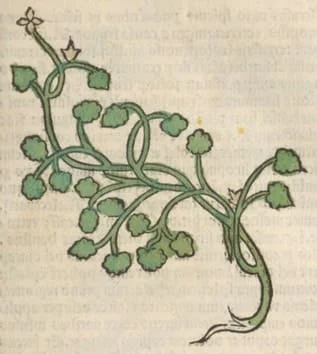
Herbarius latinus, Petri, 1485
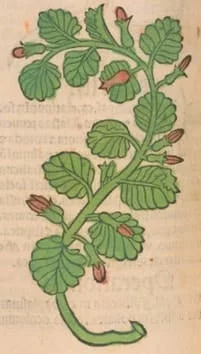
Ortus Sanitatis, Meydenbach, 1491
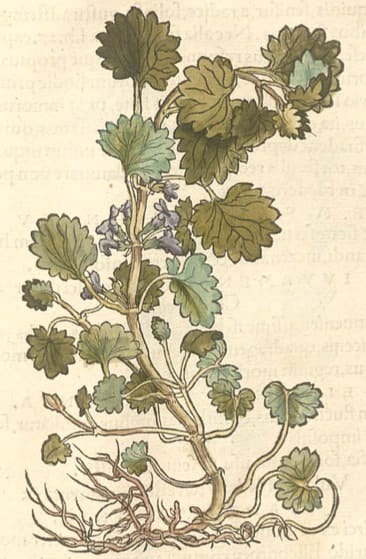
Herbarum Vivae Eicones, Otto Brunfels, 1530
Botanical name:
Glechoma hederacea (syn. Hedera terrestris)
Salmon listed 4 kinds:
- Common Ground Ivy (Alehoof)
- Lesser Ground Ivy
- Mountain Ground Ivy
- Stone Ground Ivy
The related G. longituba is used in TCM as one form of Jin Qian Cao., and is likewise used for Urinary Stones.
There are 6 species in the genus
Parts used:
Herb in flower
Temperature & Taste:
Cool, dry. Bitter
Classifications:
Uses:
1. Clears Heat and Damp, Promotes Urine:
-opens Obstructions of the Kidneys and Bladder; Dysuria, Strangury
-Jaundice
-Stones of the Kidneys (int. and in baths and fomentation)
2. Clears Wind and Damp, Benefits the Kidney and Bones:
-Lower Back Pain and weakness associated with Kidney weakness.
-Arthritis, Arthralgia, Rheumatism, Rheumatoid Arthritis, Sciatica, “Gout of the hands, knees, or feet”.
-“boiled in Mutton broth it helps weak and aching backs” (Gerard)
-used for Diabetes also
3. Clears Heat, Resists Poison, Reduces Swelling:
-clears Venom and Poison, including the Plague, Spotted Fevers
-Applied topically and taken internally for Scabs, Itches, Scabies, Erysipelas, spreading Ulcers and Cancers, Swollen Abscesses, Scrofula, Sores, Malignant Lesions and Tumors.
-“Running Ulcers” (usually Basal Cell Carcinoma), Fistulas
-juice or fresh herb is taken internally for various Cancers.
-Dysentery and Influenza (TCM)
4. Moves the Blood, Promotes Healing:
-internal Bruising, Trauma, Wounds and Fractures.
-expels the Afterbirth.
-Ulcers including Lung Ulcers
5. Clears Phlegm and Heat, Stops Coughs:
-Coughs, Asthma, Bronchitis, Consumption (West, TCM)
-Chronic Bronchitis and chronic Cough with excess Phlegm;
-some preferred it before all other vegetable medicines in the cure of Consumption.
6. Externally:
-ointment for all Burns and Scalds.
-juice has been applied to Fistulas, Spreading Ulcers, Tumors and Cancers
-juice is applied with Honey for Sores and Ulcers, including poor healing Ulcers and Wounds.
-Eye drops for sore, red, inflamed Eyes; also opacity and films of the eyes.
-juice was used for Ulcers of the Mouth, Throat and Genitals.
-Poor hearing, Deafness and Tinnitus, being applied topically (either the steam or juice dropped in)
-Applied fresh to Abscesses and Boils.
-juice or powdered leaves has been credited with curing chronic, obstinate Headaches when used as a snuff
-given in enemas for Colic pains
Dose:
Decoction: 5–15 grams (up to 30 grams for Stones); 20–50 grams of the fresh
Powder: 500mg–3 grams
Tincture (1:5): 2–5 mls, three times daily.
Fluid Extract (1:1 in 45% alcohol): 1–3 mls. (up to 1 dram has been used)
Juice: 5–25mls. in water, 3 times daily
Substitute:
The Chinese herb Lysmachia Jin Qian Cao is used synonymously with the local Chinese Ground Ivy, G. longituba. The main indications for both these herbs in TCM are for Stones. Lysmachia is better for Gall Stones, while Glechoma is best for Urinary Stones. Lysmachia Jin Qian Cao can be used as a substitute, especially when used for Stones and urinary disorders.
Main Combinations:
1. Cough, Bronchitis, Consumption:
i. Ground Ivy with Licorice
ii. Ground Ivy with Plantain
iii. Ground Ivy with Juniper berry
iv. Ground Ivy with Plantain, Comfrey, Licorice
v. Ground Ivy, Elecampane, Horehound, Licorice
vi. Ground Ivy with Coltsfoot, Licorice (Pectoral Infusion from Pharmacopoeia medici practici universalis, Bruxelles, 1817)
vii. Ground Ivy with Maidenhair, Speedwell, Hyssop (equal parts) (Pharmacopoeia Gallica, 1818)
viii. Ground Ivy with Speedwell, Coltsfoot, Licorice, Bittersweet (Pharmacopoeia Rossica, 1803)
ix. Ground Ivy with Pearl Barley, Licorice, Coltsfoot, Speedwell, Red Poppy flower, Mullein flower, Aniseed, Figs (Pharmacopoeia regni Poloniae, 1817)
2. Whooping Cough: Give Ground Ivy in milk and water every morning and evening. ‘It will cure him’. (The Physicians of Myddvai, translated by John Pughe esq., 1861)
3. Chronic Cough, Bronchitis, Asthma, Consumption as well as Backache, Diabetes and Arthritis, Ground Ivy with Licorice (as in Gill’s Tea)
4. Chronic Cough, Consumtpion: “Take the reddish tops of Ground Ivy what suffices, being bruised let them be made into a cake, and presently dried in the Sun, then reduce it into a fine powder, and keep it in a glass; this Plant retains its virtue, with its smell and color excellently well for a long time, beyond all Conserves and Syrups, and is of wonderful efficacy in a great and obstinate cough: Give from 0.5-1 dram twice a day, with a distilled water, or decoction”. (The London Practice of Physic; Dr. Willis, 1689)
5. Asthma, Ground Ivy with Horehound, Arum, Orris, Gum ammoniac
6. Chronic Lung diseases, Ground Ivy with Elecampane, Comfrey, Horehound, Ginger
7. Scarlet Fever, Ground Ivy with Red Sage, Centaury, Pleurisy root and Vervain (½ oz. ea.). Simmer in 2 pints of water down to 1 pint; it may be sweetened with Honey if needed. Dose: 1 tablespoonful, 3 times daily; the bowels must be kept open. (The Medical Herbalist)
8. Breast Cancer”
i. Ground Ivy, Cleavers
ii. Ground Ivy and Wintergreen, boiled in Wine (‘Highly Commended’) (Platerus Golden Practice of Physick, Plater, 1664)
9. Fistulas, Running Ulcers and Cancers, Ground Ivy juice is mixed with Honey and Verdigris (Culpeper)
10. As a wash for Sores and Ulcers of the Mouth or Genitals, add Burnt Alum and Honey to a strong decoction of Ground Ivy and use as a wash. (Culpeper)
11. Eyedrops: The Juice of Celandine, Field Daisies, and Ground Ivy is clarified, and has a little sugar dissolved in it, and Rose Water is added. This is dropped into the eyes for heat, redness, itchiness, watering and pain of them. It is also good for all skins and films of the eyes. “It is proved the best medicine in the world”. (Gerard, Culpeper)
12. Opcaity of the Eye: “Let some Ground Ivy juice be put therein, and the opacity will be removed, the eye becoming spotless and clear”. (The Physicians of Myddvai, translated by John Pughe esq., 1861)
Cautions:
Avoid overdose
Fatal poisoning in horses has been noted when large quantities have been eaten. Likewise Mice fed solely on the herb died after 3 to 4 days. Despite this toxicity has not been reported in humans.
Main Preparations used:
Distilled Water, Conserve, Syrup of the Juice, Compound Syrup and the Juice
1. Conserve of Ground Ivy:
Dose: 1 scruple–1 dram
i. fresh Ground Ivy in flower (1 part), White Sugar (2 parts); beat together, then heat in a water-bath until the sugar is melted. (Pharmacopee Usuelle, Louvain, 1821)
ii. Powder of Ground Ivy (½ oz.), Distilled Water of Ground Ivy (sufficient), White Sugar powder (1 oz.). Mix.
2. Syrup of Ground Ivy:
Dose: 1–2 oz.
i. Fresh Ground Ivy (half pound), Boiling Water (3 pounds). Infuse 12 hours, strain and add twice its weight of White Sugar and form a Syrup. (Pharmacopoeia Gallica, 1818)
ii. Depurated Juice of Ground Ivy, Syrup (equal parts), heat to make a syrup. (Pharmacopoeia Sardoa, 1773)
iii. fresh Ground Ivy, beat and express the juice, coagulate it with gentle heat, then to 5 parts of this add 9 parts of Sugar and form a Syrup. (Pharmacopee Usuelle, Louvain, 1821)
3. Extract of Ground Ivy:
i. Ground Ivy (1 pound), Spring Water (6 pounds). Digest for 4 hours, then boil. Express, evaporate to an extract. (Pharmacopoeia Sardoa, 1773)
4. Quiddonia of Ground Ivy:
Juice of Ground Ivy, depurated 8 lbs.
White Sugar 1 lb.
Very good for Coughs, as well as other diseases of the Breast and Lungs, including Lung Ulcers. It opens obstructions of the Liver, Spleen, and Gall, and is good for Jaundice; also promotes Urine. It is dropped into the eyes for Pin and Web, Films, watering and redness of the eyes, as well as dimness of Sight. Mixed with Honey and Vinegar, it is good for Mouth and Throat Ulcers as well as Ulcers of the genitals. It is also a good Vulnerary and Traumatic.
Dose: 3 oz. (Pharmacopoeia Bateana)
Click the above Tabs for more information on this medicine
-“Proved to be the best medicine in the world” (Gerard).
-Some claimed it to prevent premature aging.
-The leaves were used to weave chaplets for the dead. being used similarly to real Ivy.
-The Saxons used it to clarify their beer ebfore the use of Hops. This is the source of its old name Ale-hoof.
You must be logged in to view this content, please login. If you're not a member then Click this link to subscribe