Geranium, Herb Robert
Cranesbill is the common name of the Geraniums
Gratia Dei (used for a number of Geranium species)
Rostrum Ciconiae
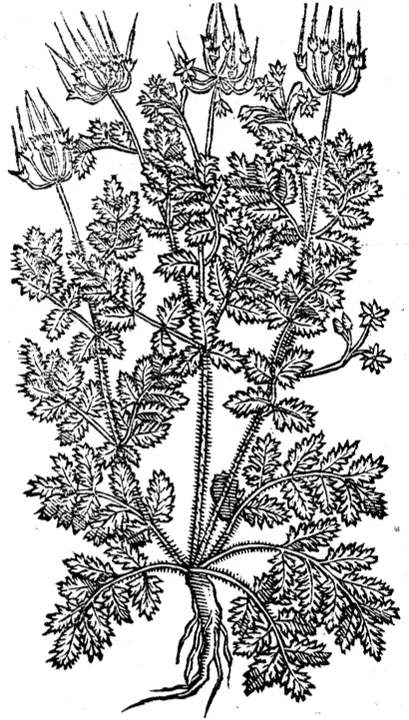
Dioscorides Materia Medica, Mathias, 1563
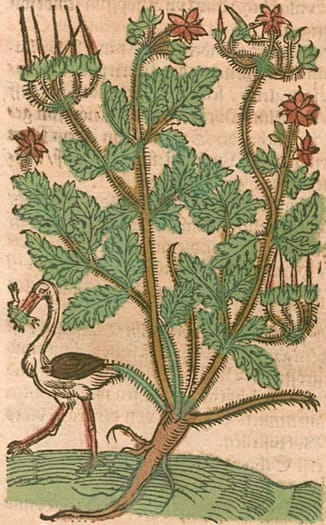
Krauterbuch, Lonitzer, 1578
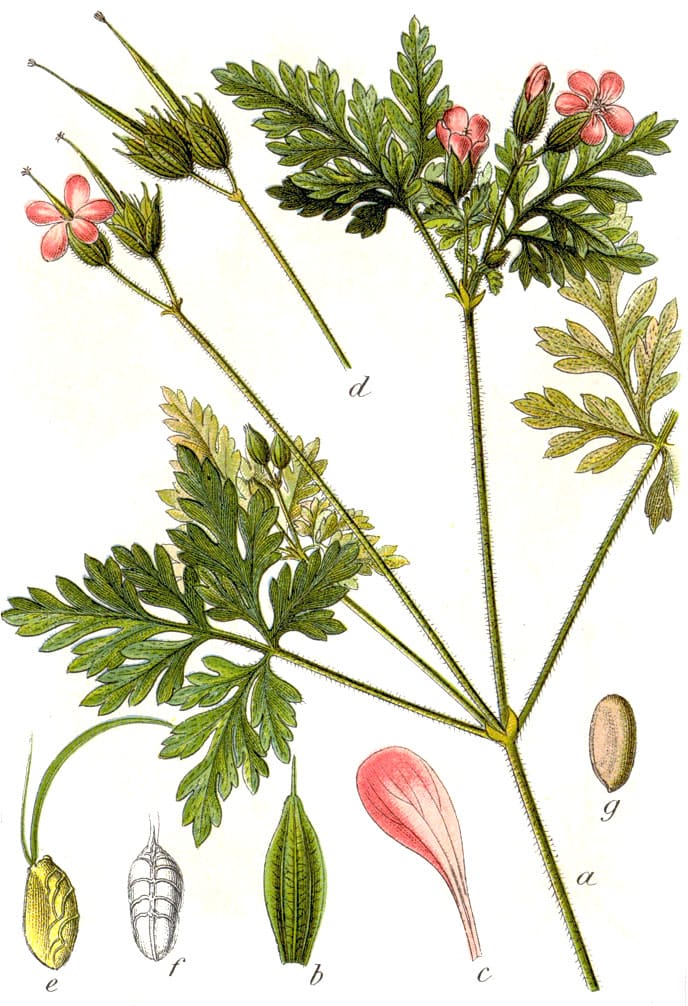
Geranium robertum
Deutschlands Flora in Abbildungen, Sturn, 1796
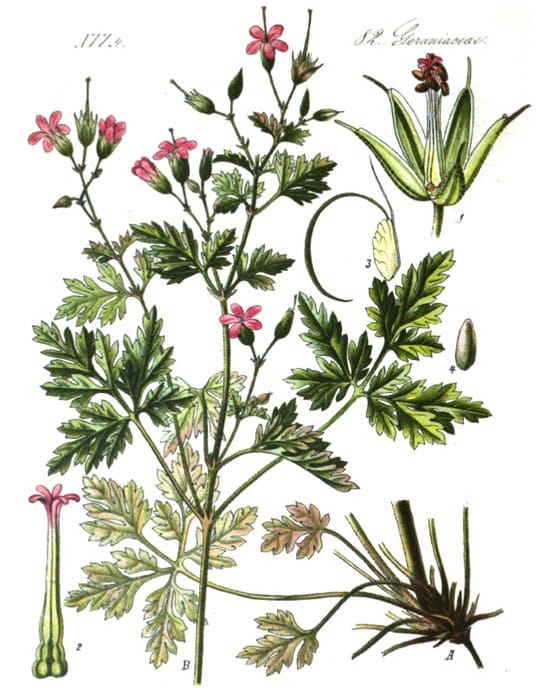
Geranium robertum
Flora von Deutschland (21), Kohler, 1885
Botanical name:
Geranium robertum (syn. G. robertianum)
A number of Geranium species are used similarly:
i. G. sanguinarum (syn. G. haematodes); Bloody Cranesbill
ii. G. rotundifolium (syn. G. columbinum); Dovesfoot, Pes columbinus
iii. G. pratense (syn. G. batrachioides); Crowfoot Cranesbill, Meadow Cransebill Batrachium
iv. G. moschatum; Musk Cranesbill; Acus moschata
The above-named species of Geranium generally share similar properties and were often collected and used indiscriminately.
Parts used:
Herb
Temperature & Taste:
Cool, dry. (Schroder said ‘temperately Hot and dry, and Cold’). Bitter, Salty
Classification:
Uses:
1. Clears Heat and Toxin, Moves the Blood, Resolves Masses:
–dissolves Congealed Blood, and Stops Blood; used for Bruising and Trauma
–good to cleanse and heal Wounds
–in compounds for Scrofula, Tumors and Cancers
–also to promote Menstruation
2. Clears Heat and Damp, Promotes Urine, Clears Stones:
–suppressed or burning Urine, Jaundice
–especially for Gravel and Stones (West, Ayurveda)
–related species used in Asian medicine clear Wind and damp and are used for Rheumatism, Arthralgia and Stroke.
3. Clears Wind-Heat:
–Fevers (internally, and with salt and vinegar applied to the soles and pulses).
–various skin conditions coming from heat.
4. Clears Heat, Stops Bleeding:
–commended to stop bleeding from the Nose, Mouth, Throat or Gastrointestinal Tract;
–especially Bleeding of Wounds.
5. Clears Heat, Settles Wind, Calms the Mind:
–Large doses (2 drams of the powder) were given to Lunatics. (Fioravanti)
-Melancholy and Sadness
6. Externally:
–applied to fresh Wounds, Tumors and Ulcers, including old Ulcers of the Genitals.
–concentrated decoction or ointment can be applied to chronic non-healing sores and cancers
–decocted in lye as a wash to chronic and putrid ulcers
–poultice for Rheumatism.
–the decoction made with lye is used as a wash for putrid Ulcers.
–all Cranesbills are used externally to allay the heat of Fever (applied to the Soles with Salt and Vinegar)
–also to ‘discuss’ Milk, and for ‘Clefts’ of the Breasts
Dose:
It was commonly infused or decocted in wine.
1–2 teaspoonfuls in infusion
Decoction: 5–15 grams
Main Combinations:
1. Scrofula:
i. Herb Robert with Horehound, Celery, Agrimony, Dill seed (as in Decoction Against Scrofula)
ii. Gratia Dei(1 oz.), Cinnamon (1 dram), Clove (1 scruple), Wheat flower (1 pound), Confected Orange (1 oz.), Powder, mix with honey to a paste and bake in an oven. Dose is 1 ounce. Also for Scabs, Eczema and similar skin diseases.
2. Tumors and Cancer, Herb Robert with Guaiacum, Sassafras, Sarsaparilla, Dock, Filipendula and Walnut tree rind (as in Cancer Ale)
3. Cancer:
i. Herb Robert with Black Nightshade, Agrimony, Dodder, Yarrow
ii. Herb Robert with Figwort, Mullein root, Filipendula, Agrimony, Tormentil, Elder flower, Rosemary and Nettle seed (as in Decoction Against Cancer)
4. Trauma, Wounds, Herb Robert with Tormentil, Comfrey, Shilajit, Wintergreen, Vervain, Mullein, St. Johns wort
5. Inflammations, Ulcers and Tumors, Linseed with Fenugreek and Herb Robert as a Cataplasm
6. Stones: “Take this herb and Saxifrage in equal quantities, and decoct in water, filter, then with a sweat-making pot prepared, take oat straw, and let it boil in water, then sprinkle the hot stones [with this water]: and when you begin to sweat, drink a decoction of this herb, this shall be done three times in succession, then the stone is gently broken”. (Dorsetn, 1540)
7. Melancholy aand Sadness: “Whoever is full of heavy blood, and is always sad, should use this herb with equal quantities of Pennyroyal and Rue, reduce to powder and eat them with bread, they strengthen the Heart, and generate Joy”. Dorsetn, 1540)
Major Formulas:
Decoction Against Scrofula (Fuller)
Decoction for Cancer (Fuller)
Universal Vulnerary Decoction (Joseph Du Chesne)
Water for Cancer
Cautions:
1. Not for Cold and weakness of the digestive system.
2. Some people may be allergic:
–Contact dermatitis caused by Geranium robertianum with erythema multiforme-like reaction.
Main Preparations used:
Distilled Water of the Herb
Click the above Tabs for more information on this medicine
ANTI-BACTERIAL:
–A comprehensive study on Geranium robertianum L. antibacterial potential.
–Herb Robert’s Gift against Human Diseases: Anticancer and Antimicrobial Activity of Geranium robertianum L.
–CHEMICAL COMPOSITION AND ANTIMICROBIAL ACTIVITY OF GERANIUM ROBERTIANUM L. ESSENTIAL OIL.
ANTI-VIRAL:
–Herb Robert’s Gift against Human Diseases: Anticancer and Antimicrobial Activity of Geranium robertianum L.
ANTI-FUNGAL:
–Herb Robert’s Gift against Human Diseases: Anticancer and Antimicrobial Activity of Geranium robertianum L.
ANTIOXIDANT:
–Antioxidant and anti-inflammatory activities of Geranium robertianum L. decoctions.
–Chemical characterization and bioactive properties of aqueous and organic extracts of Geranium robertianum
–Antioxidant activity of Tunisian Geranium robertianum L. (Geraniaceae).
ANTI-INFLAMMATORY:
–Promising effect of Geranium robertianum L. leaves and Aloe vera gel powder on Aspirin()-induced gastric ulcers in Wistar rats: anxiolytic behavioural effect, antioxidant activity, and protective pathways.
–Antioxidant and anti-inflammatory activities of Geranium robertianum L. decoctions.
NEUROPROTECTIVE:
–Neuroprotective effects of Geranium Robertianum L. Aqueous extract on the cellular Parkinson’s disease model.
DIABETES:
–“MitoTea”: Geranium robertianum L. decoctions decrease blood glucose levels and improve liver mitochondrial oxidative phosphorylation in diabetic Goto-Kakizaki rats.
GASTRIC ULCERS:
–Promising effect of Geranium robertianum L. leaves and Aloe vera gel powder on Aspirin()-induced gastric ulcers in Wistar rats: anxiolytic behavioural effect, antioxidant activity, and protective pathways.
CANCER:
–Herb Robert’s Gift against Human Diseases: Anticancer and Antimicrobial Activity of Geranium robertianum L.
–Chemical characterization and bioactive properties of aqueous and organic extracts of Geranium robertianum L.
You must be logged in to view this content, please login. If you're not a member then Click this link to subscribe