
Gentiana, Gentian, Long Dan Cao 龙胆草
Ghaafis, Jantiana (Unani)
related species:
–In TCM G. gabra (Long Dan Cao)
–In Ayurveda, G. kurroo (Trayamana)
–In Tibet G. robusta (Kyi lce)

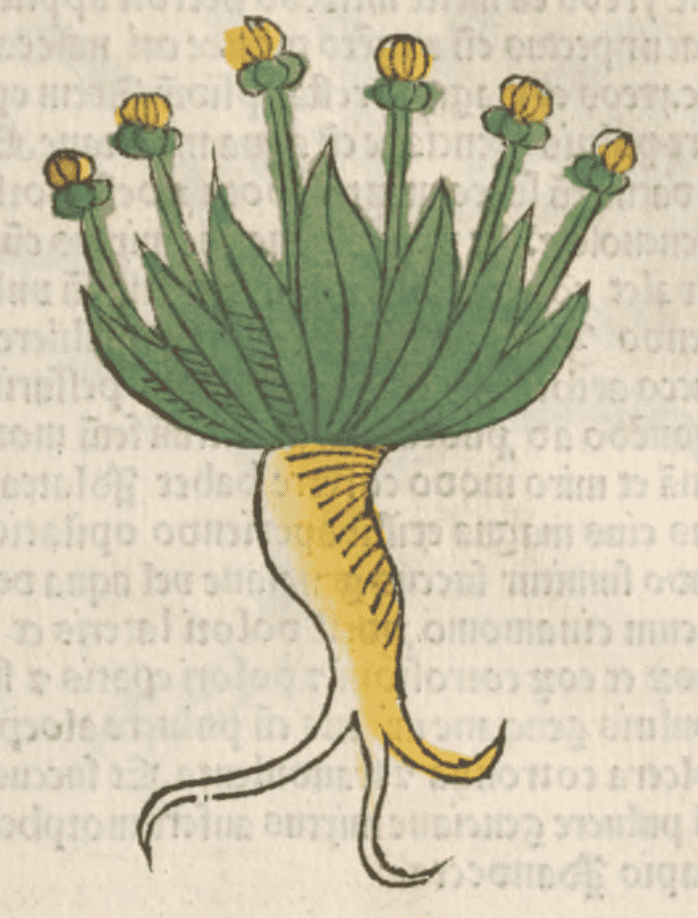
Herbarius latinus, Petri, 1485
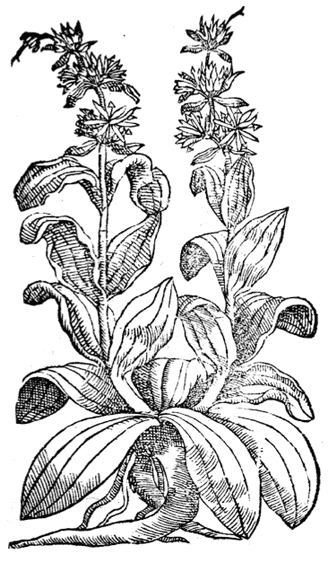
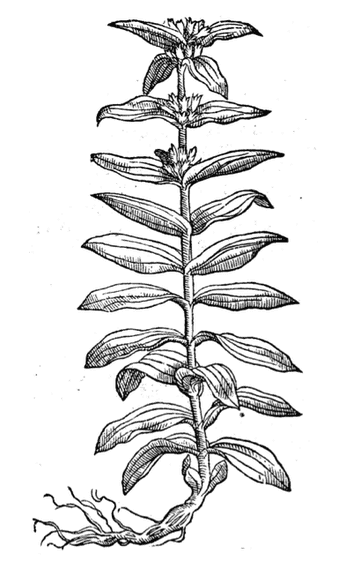
Greater and Lesser Gentians
Della Materia Medicinale, Andrea Valuassori, 1562
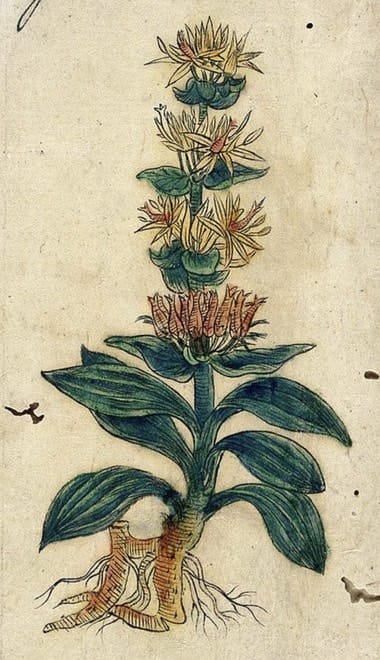
Japanese Herbal, 17th century (Welcome)
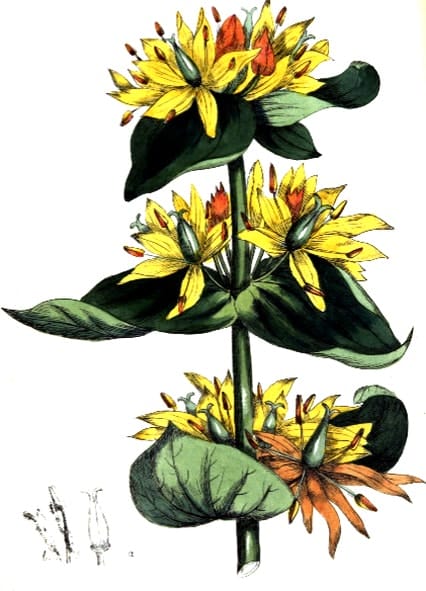
Gentiana lutea
Flora Medica, Royal College of Physicians, 1829
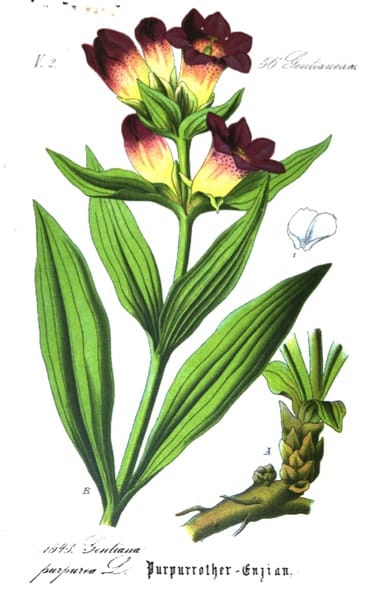
Gentiana purpurea
Flora von Deutschland (16), Kohler, 1884
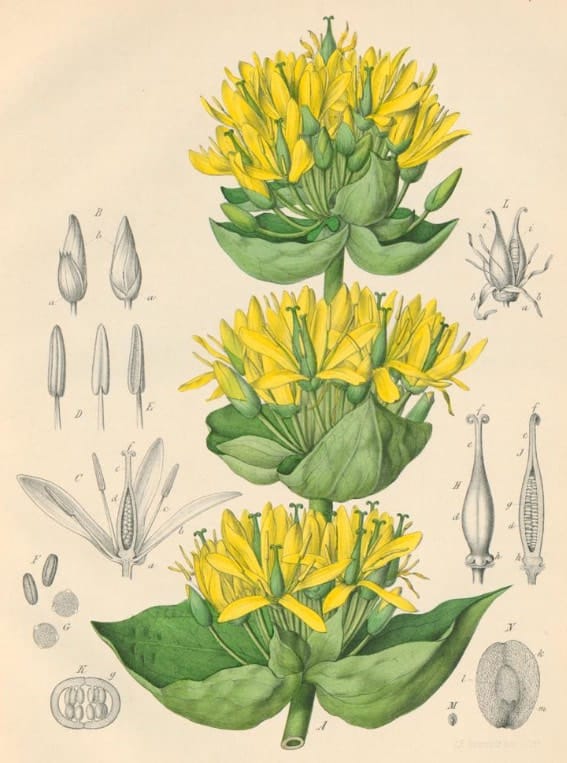
Gentiana lutea
Atlas der Officinellen Pflanzen, Berg & Schmidt, Leipzig, 1893
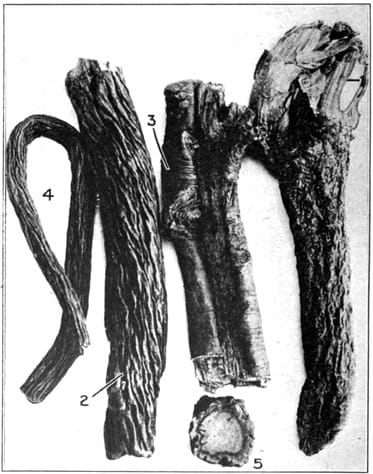
YELLOW GENTIAN ROOT
1. Root with numerous leaf bases. 2. Deep wrinkles. 3, Annulate rhizome portion.
4. Curved and twisted root. 5, Cross-section of root showing dark cambium zone.
Squibb’s Atlas of the Official Drugs, Mansfield, 1919
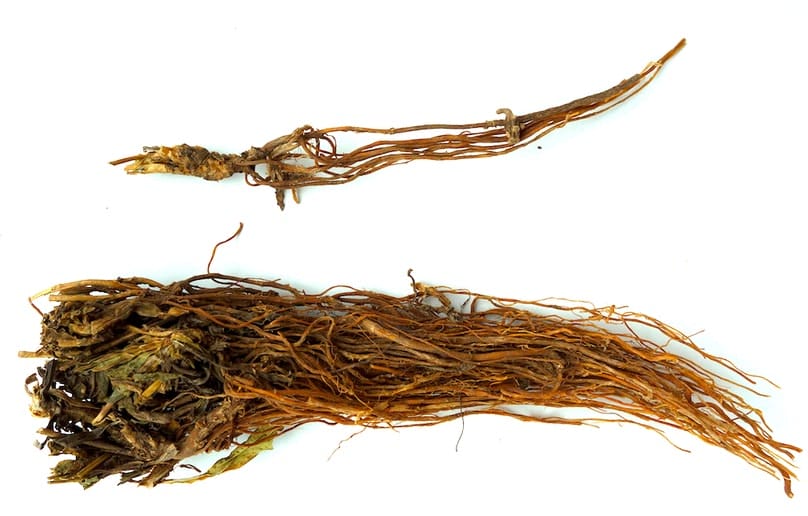
Wild Sichuan Gentian root (Adam, 2016)
Botanical name:
Gentiana spp.
In the Western tradition, the following species are most commonly used.
- G. lutea (Great Yellow Gentian, official European species)
- G. purpurea (Purple Gentian, used in Northern Europe synonymously, regarded as equally strong)
- G. punctata (Spotted Gentian, used in parts of Europe)
- G. pannonica (Hungarian or Brown Gentian, used in parts of Europe)
Other species used in the West include: G. acaulis (Lesser Gentian), G. pneumonanthe (Marsh Gentian, also called Calathian Violet) and G. cruciata (Cross Leaved Gentian), G. amarella (Autumn Gentian), G. verna (Spring Gentian), G. asclepiadea (Willow Gentian or Milkweed).
Many Gentian species have been used similarly in the various systems:
- TCM: G. scabra, G. triflora, G. manshurica, G. rhodanta, G. rigescens (Long Dan Cao) and others are used similarly. When G. rhodanta (Hong Hua Long Dan) is used, the whole plant is used.
- Ayurveda: G. kurroo (Trayamana)
- In Tibet, a white (Kyi lce dkar po) and a black (Kyi lce nag po) type are recognised:
- White: G. robusta, G. crassicaulis, G. macrophylla, G. tibetica
- Black: G. tianschanica, G. hexaphylla, G. straminea, G. triflora, G. oliveri
- Unani: G. olivierii (Ghaafis) and apparently some species used in Europe.
It should be noted that G. olivierii is used in both Unani and Tibetan Medicine; G. olivierii is synonymous with species used in Europe; G. triflora is used in both TCM and Tibetan Medicine, thereby showing similar use of the Gentian species in various systems.
Parts used:
Root
“The best Gentian is its Roman variety which is dark red in colour and very hard. It is a wood and the root is thick like a finger. It may be big or small (in size). It is dark yellow in colour and its broken piece resembles rhubarb.” (Avicenna)
Temperature & Taste:
Cold (Warm in the West), dry. Very Bitter
“Hot in the Third degree and Dry in the Second degree”. (Avicenna)
Classifications:
2A APERIENT MEDICINES. 2B ATTENUATERS. 2F. PURIFYING. 2M. DRAWING. 2T. GLUTINATE
3B. FEBRIFUGE & ANTIPYRETIC. 3C. ALEXIPHARMIC
4e. STOMACHIC. 4f. SPLENETIC. 4g. HEPATIC. 4i. UTERINE
TCM:
B. Clears Heat & Damp
Uses:
1. Clears Heat and Damp, Opens Obstructions (West, TCM, Ayurveda, Tibet):
-clears Bile (Choler)
-Jaundice, Scrofula, Cholecystitis, and Hepatitis
-itching of the Genitals
-Eczema, Dermatitis, Itching, Scabs, fretting Sores and Ulcers
-Leprosy, malignant Ulcers (Ayurveda, Sushruta)
-Liver Headache; red, sore, and itchy Eyes
-Cramps, Convulsions, Epilepsy, Vertigo
-Infantile Seizures due to Fright (Ben Cao Gang Mu)
-“useful for cold hepatic and splenic swellings particularly when a dose of two dirham (7 gm) is taken with wine”. (Avicenna)
-“Sense of depression referred to epigastric region, and associated with sense of physical and mental weariness”. (Scudder)
2. Clears Heat, Resists Poison (West, TCM, Ayurveda, Tibet):
-Alexipharmic
-Fevers (esp Intermittent); Epidemic disease; Plague (West, Ayurveda)
-“a more sure remedy cannot be found to prevent the Pestilence” (Culpeper)
-bites of Rabid Dogs and other venomous creatures
-“a good drug to be used in Scorpion Bite. Two dirham (7 gm) of Gentian with wine is useful in cases of the stings by all kinds of Insects, bites by Rabid Dogs and other beasts. (Avicenna)
-“Hectic Fever and chills due to Yin deficiency”. (Shen Nong Ben Cao)
-“pain in the throat and stopping night sweating due to attack of pathogenic Wind and Heat”. (Li Shi Zhen)
3. Benefits the Stomach, Stimulates Digestion:
-benefits a weak Stomach
-“rectifies the stomach ailments attributed to Coldness”. (Avicenna)
-“Strengthens the Stomach exceedingly, helps digestion… restores the appetite” (Culpeper)
-“for such as have evil Livers and bad Stomachs”. (Gerard)
-Malnutrition (Da Ming)
-small doses and short-term use for this function; mostly in powders
4. Clears Heat and Damp, Promotes Urine:
-Edema
-difficult, painful or burning Urination; Gravel
5. Clears Heat and Damp, Eases Pain:
-chronic Joint pain with Heat and Inflammation; Pain and numbness of the Joints
-Arthritis, Rheumatism
-Numbness, Lameness, Aches and Pains
-“weariness and cold lodgings in the Joints”. (Culpeper)
6. Moves the Blood, Promotes Menstruation:
-“dissolves and scatters Congealed Blood” (Gerard); usually taken in wine
-Amenorrhea; suffocation of the Womb
-Promotes Birth, expels Afterbirth
-“suffocation of the Womb … and expels both Birth and Afterbirth”. (Salmon)
-root made into a pessary expels After birth or a Dead Child (Dioscorides; Avicenna)
-tincture, decoction in wine, or the wine-prepared root is best for this function
-“also useful for the person who has fallen down from a high place”. (Avicenna)
7. Kills Worms (West, Ayurveda, TCM)
-“an admirable remedy to Kill the Worms”. (Gerard, Salmon)
-“effective for treating Gu Du (diseases from Parasites)” (Shen Nong Ben Cao)
-“Kills Parasites in the Intestine” (Ming Yi Bie Lu)
8. Clears Heat, Stops Cough and Wheezing:
-regarded by some older sources as effective for chronic Asthma
-“useful in Pleurisy”. (Avicenna)
9. Externally:
-Wounds
-Ulcers, knots, kernels in the Neck (Pemell, 1652)
-root or especially the juice for Ulcers (Dioscorides)
-“Heals the corrosive Wounds and Ulcers”. (Avicenna)
-powder is good for foul, putrid, rotten ulcers, even Running, Fistulous and Cancerous Ulcers (Pemell, 1652)
-“It is applied to Spreading Ulcers, the root is crushed and boiled in water to the consistency of thick honey and applied”. (Dorsetn, 1540)
-Bruises, mix the powder with oil and apply
-Arthritis and Neuralgia, root is steeped in alcohol and applied topically
-applied with Theriac to Rabid Bites
-root is chewed to help stop Smoking
-root powder or infusion has been applied to infants thumbs to stop thumb-sucking
-eye preparations for red and inflamed eyes, conjunctivitis (Avicenna)
Dose:
1. Small doses stimulate digestion and work as a warming, stimulating digestive tonic in the short term.
2. Large doses have a draining and purging effect, and can reduce heat
3. In Cold conditions, and to move the Blood, it is taken with wine
4. In Heat conditions, take with Water, or use the Decoction
Powder: 1–3 grams (traditionally 1 scruple–1 dram). Large doses of up to 7 grams are used for Hepatic swelling, Venomous Bites, Pleurisy etc.
Decoction: 3–9 grams (TCM and West; 1–3 drams was used in the West)
Correctives:
1. Licorice
2. Orange peel
3. Cardamon
4. Coriander seed
5. Rose corrects the harmful effects on the Testes (Unani)
Substitutes:
1. Swertia
2. Centaury
3. One and a half times Asarum, half the amount of Caper root bark, equal part of Birthwort (Unani)
4. “Indian Valerain one and a half time of its weight and the root-bark of Caper and Celery by half of its weight act as its substitute”. (Avicenna)
5. In Lung disease, Asplenium scolopendrium can be used in place of Gentian. (Gentian has a detrimental effect on the Lung in Unani medicine)
Preparations:
1. Dry-Fried Gentian:
Pieces of Gentian root are dry-fried in a wok until scorched but not charred, then sprayed with water to stop the burning. The pieces are then dried and kept for use.
This preparation is less cooling and the bitter nature is reduced. It is used to help Gentian enter the blood to cool the blood and stop bleeding. But is also less harsh on the Stomach and Spleen and so is better suited to those with digestive weakness.
2. Wine-fried Gentian:
Pieces of Gentian root are sprayed with alcohol (Rice spirit), then dried in an oven or by dry-frying in a wok.
This preparation is less cold, and better to open obstructions. So for example, it is used for Liver heat conditions with Qi or Blood stagnation. It also has the effect of raising the effect of the herb to treat heat and inflammation in the head.
3. Licorice-prepared Gentian:
The cleansed root is soaked overnight in a strong Licorice decoction, then dried in the sun.
This moderates the coldness, lessens the bitterness and is therefore better for those with a weak Stomach.
4. Fermented Gentian:
The Western Gentian is often fermented by being left in mounds which are turned regularly.
This makes it less Cold and Bitter and more gentle on the Stomach.
5. Extract of Gentian:
“The juice from it is collected and prepared in this way, as Diocletian reports: The root is pounded, soaked in water for five days, then boiled in the same water, as long as the roots remain. Then the water is cooled, filtered through cloth and boiled again, to the thickness of honey: put in a jar or tin can and stored. This juice removes all spots on the skin and especially vitiliges. Inflammations of the eyes are also anointed with it”. (Dorsetn, 1540)
Main Combinations:
To move the herb outward, it is often combined with Bupleurum Chai Hu (TCM)
Liver and Gall Bladder:
1. To clear Heat from the Liver, for Damp-Heat, and to open Obstructions:
i. Gentian with Centaury.
ii. Gentian with Bile
iii. Gentian with Hops, Bile
iv. Gentian with Rhubarb
v. Gentian with Chicory, Camomile
vi. Gentian with Bitter Orange peel
vii. Gentian with Wormwood, Aniseed
viii. Gentian with Calamus, Wormwood, Juniper berry, Bay berry (Memorial Pharmaceutique, 1824)
ix. Gentian with Greater Cardamon, Wormwood, Costus, Agrimony, Bitter Almond, Black Pepper, Aniseed (as in Decoction for the Liver of Nicholas)
x. Gentian with Galangal, Calamus, Zedoary, Blessed Thistle, Orange peel, Rhubarb, Lesser Cardamon (Pharmacopee Usuelle, Louvain, 1821)
xi. Gentian with Avens root, unripe Orange, Wormwood, Fumitory, Blessed Thistle, Buckbean, Yarrow, Camomile, Lesser Centaury, as a tincture. (Pharmacopoeia Generalis, 1783)
2. Liver pain:
i. Gentian, Cinnamon (Herbarius latinus, Petri, 1485)
ii. and Jaundice, Gentian with Yellow Chebula, Aloe, formed into pills with Celery juice (Pills of Gentian, Unani)
3. Liver Hardness, Gentian, Pepper (10 parts each), Costus, Indian leaf, Indian Spikenard, Rhubarb (8 parts each), Honey sufficient to form an Electuary. Dose: 1 dram in Rue infusion (Syrian ‘Book of Medicine‘, Budge, 1913)
4. Jaundice:
i. Gentian with Wormwood
ii. Gentian with Centaury, Barberry bark, Peppermint
iii. Gentian, Wormwood, Rhubarb, Aniseed
Digestion:
5. Digestive debility with Liver congestion:
i. Gentian with Lesser Cardamon
ii. Gentian with Lemon peel, Cinnamon
iii. Gentian, Orange peel, Peppermint
iv. Gentian with Calamus, Dandelion, Centaury and Wormwood
6. Digestive weakness with defective bile secretion, Gentian extract, Centaury extract (2 drams each), Bull Bile, thickened (½ oz.), Rhubarb powder (sufficient to form pills of 2 grains each), dust with Cinnamon. Dose: 8–10 pills, three times daily. (Sobernheim, 1840)
7. Atony of the digestive organs:
i. Gentian (3 drams), Orange peel (1 scruple), infuse in boiling water (1 lb.). Strain, add Tincture of Orange peel (2 drams). Dose: half cupful three times daily. (Sobernheim, 1840)
ii. Gentian (2 oz.), Orange peel (1 oz.), Cinnamon bark (1 dram), infuse in Spanish Wine for 24 hours, strain. Dose: 1 tablespoonful, 2–3 times daily.
iii. Gentian (4 parts), Centaury, Wormwood, Calamus (2 parts each)
8. Aromatic Bitters:
i. Gentian with Calamus
ii. Gentian with Calamus, Galangal, Centaury, Wormwood, Camomile, Stoechas, Caraway seed (as in Aromatic Bitter Decoction)
9. Stomach Powder:
i. Gentian, Amber (10 grains each), Rhubarb (4 grains). Taken as a dose at dinner. (Nouveau Formulaire Medicale et Pharmaceutique, 1820)
ii. Arum root, Gentian, Calamus (1 oz.), Ginger, Orange peel, Potassium sulphate (½ oz. each), Oil of Caraway (½ dram). Mix. (Hufeland)
Fever and Poison:
10. Fever: Gentian (½ oz.), Bistort, Peony (2 drams each). Used in place of Cinchona when that has failed. (Ratier)
11. Intermittent Fever:
i. form Pills with Gentian, Salt of Wormwood and Syrup of Dried Roses
ii. Gentian with Wormwood, Catechu, Lesser Centaury, Cinchona (Formulaire Magistral et Memorial Pharmaceutique, 1823)
12. To protect from infection and Poison:
i. Gentian with Bay berry, Myrrh and Round Birthwort (as in Diatessaron)
ii. Gentian with Aloe, Rhubarb, Saffron, Myrrh, Zedoary, Agaric (as in Pills for Pestilence)
13. Snake Bite and Bites of Wild Animals:
i. Gentian, Pepper, with Wine (Dioscorides)
ii. Gentian, Pepper, Rue (Dorsetn, 1540)
iii. “Against snake bites, dry root of the herb Gentian, powder, and take one drachm in wine, taken together: it will do very well”. (Dorsetn, 1540)
14. Rabid Dog Bites:
i. Gentian (1 dram) take in Carduus Water
ii. Gentian (30 grains), Rue (1 scruple), Pepper (5 grains), take in Angelica Water
iii. Gentian (2 drams), decoct in water and honey, strain, add Myrrh (1 dram), Crabs Eyes burnt (2 drams), mix. Divide into 4 doses to give morning and night. Wash the wounds with Vinegar and Salt Water. “Against the rabid dog’s disease there is no more excellent remedy”. (Dorsetn, 1540)
Other:
15. Edema, Gentian with Elecampane, Celery root, Asarum, Squill, Wormwood, Agrimony, Parsley seed, Cinnamon (as in Wine for Edema)
16. Pernicious Anemia, Gentian with Agrimony, Celandine, Barberry bark (Wonders in Weeds)
17. Rickets, Gentian with Marshmallow and Comfrey
18. Cough, Asthma, Gentian with Hyssop, Agaric, Mastic (as in Electuary for Asthma of Andrezeos)
19. Chronic Asthma, Gentian, Orris with Licorice (Herbarius latinus, Petri, 1485)
20. Pleurisy, Difficulty Breathing, Gentian, White Pepper (2 drams each), Saffron, Opium, Aniseed (3 drams each), Honey sufficient to form an Electuary. Take as much as a bean with Licorice infusion. (Syrian ‘Book of Medicine‘, Budge, 1913)
21. Phthisis from gross Humors, Gentian, Calamus, Long Birthwort, made into a powder and mixed with Honey of Roses (The Secrets of Alexis, 1615)
22. To strengthen the Heart and resist Poison in Epidemics, Gentian with Tormentil, Orris, Zedoary, Cinnamon, Angelica, Licorice juice
23. Poor nervous tone, Gentian with Valerian and Vervain
24. To benefits Memory, Gentian with Calamus, Indian Spikenard, Siler Montane, Aniseed, Cumin, Caraway, Lovage (as in Powder of Trithemius)
25. To promote Menstruation:
i. Gentian, Pennyroyal, Nigella, Dry Figs, formed into a Suppository. (The Secrets of Alexis, 1615)
ii. Gentian, Southernwood made into a pessary with Mugwort juice and Honey. (Herbarius latinus, Petri, 1485)
iii. Gentian with Calamus, Lesser Centaury, Rosemary (Pharmacopoeia extemporanea, Augustin, 1822)
26. Hysteria, Nervous exhaustion, Gentian with Cardamon, Orange peel
27. Epilepsy, Gentian with Marjoram Water (Herbarius latinus, Petri, 1485)
28. Epilepsy, Apoplexy, Paralysis, Madness, Migraine, Asthma, Gentian with Centaury, Galangal, Cinnamon, Clove, Sage, Rosemary, St. Johns wort
29. Arthritis, Joint Pain:
i. Gentian with Ground Pine, Germander, Rue (as in Powder Against Joint Pain)
ii. Gentian, Round Birthwort, Ground Pine, Germander, Lesser Centaury (equal parts) (Pharmacopoeia Sardoa, 1773)
iii Gentian with St Johns wort, Centaury, Ground Pine, Agaric, Germander (as in Antidote of Seven Things)
30. Rheumatoid Arthritis, Gentian with Agrimony
31. Worms:
i. Gentian with Blessed Thistle
ii. Gentian with Wormseed, Wormwood
32. Conjunctivitis, Gentian with Lawsonia, infused and used as an eyewash (Unani)
33. Corrosive Ulcers, Gentian and Aloe topically (Herbarius latinus, Petri, 1485)
34. White Morphew, Southernwood juice with Gentian powder mixed and applied. (Herbarius latinus, Petri, 1485)
TCM (Long Dan Cao):
1. Liver Heat, or Damp-Heat:
i. Gentiana Long Dan Cao with Scutellaria Huang Qin
ii. Gentiana Long Dan Cao with Bupleurum Chai Hu, Gardenia Zhi Zi
iii. with red eyes, hypertension, Gentiana Long Dan Cao with Self Heal (Xia Ku Cao), Scutellaria Huang Qin
iv. to purge Liver Heat, Gentiana Long Dan Cao, Gardenia Zhi Zi, Coptis Huang Lian, Scutellaria Huang Qin, Aloe (Lu Hui), Rhubarb (Da Huang) (as in Dang Gui Long Hui Wan)
2. Jaundice from Damp-Heat:
i. Gentiana Long Dan Cao with Artemisia Yin Chen Hao
ii. Gentiana Long Dan Cao with Gadenia Zhi Zi, Rhubarb (Da Huang), Imperata Bai Mao Gen (as in Long Dan San)
3. Herpes or Viral Hepatitis, Gynostemma Jiao Gu Lan with Gentian (Long Dan Cao), Scutellaria Huang Qin
4. Genital Itching and foul Leukorrhea from Damp-Heat:
i. Gentiana Long Dan Cao with Phellodendron Huang Bai, Plantain seed (Che Qian Zi)
ii. Gentiana Long Dan Cao with Water Plantain (Ze Xie), Plantain seed (Che Qian Zi), Akebia Mu Tong
iii. Gentiana Long Dan Cao with Phellodendron Huang Bai, Sophora Ku Shen
iv. Gentiana Long Dan Cao with Alum externally as a wash
5. Childhood High Fever with Convulsions, Gentiana Long Dan Cao with Indigo (Qing Dai), Coptis Huang Lian, Bezoar (Niu Huang)
6. Goiter, Gentiana Long Dan Cao with Sargassum Hai Zao, Clam Shell (Hai Ge Ke), Tetrapanax Tong Cao (as in Po Jie San from San Yin Fang [Prescriptions for the Three Types of Disorder]).
7. Chronic red, sore and inflamed eyes from Liver heat, Gentiana Long Dan Cao with Celosia seed and Chrysanthemum Ju Hua
Major Formulas
Compound Infusion of Gentian
Electuary of Gentian (Unani)
Bitter Decoction
Aromatic Bitter Decoction
Decoction for the Liver (Nicholas)
Elixir Vitae (Tincture of Life)
Powder for the Liver
Powder for Hysteria
Powder for Gout of the Duke of Portland
Troches of Gum Lacca (Trochisci de Lacca) (Unani)
Pills of Gentian (Unani)
Theriac of Four Ingredients (Diatessaron)
Electuary for Asthma of Andrezeos
Electuary of Centaury (Zenon)
Electuary of Scorpion (Unani)
Antidote of Seven Things (Paulus Aegineta)
TCM (Long Dan Cao):
Long Dan Xie Gan Tang
Dang Gui Long Hui Wan
Qing Re Zhen Jing Tang
Shang Zhong Xia Tong Yong Tong Feng Wan
Tibetan (Kyi Ice)
Great Decoction 25 (Thang chen nyer lnga)
COMPOUND GENTIAN WATER.
Gentian Root, sliced 1 ½ lbs.
Centaury the Less, leaf and flower 4 oz. ea.
White Wine 12 lbs.
Steep for 8 days, then distil in B.M.
Preserves from ill air and pestilential fevers, opens the Liver, helps those whose liver is swollen, eases stomach pain, helps digestion, provokes appetite; excellent for Yellow Jaundice. Also promotes Menstruation, stimulates Birth and cleans the Afterbirth. Dose: If no fever, take a spoonful by itself. If there is fever, take it with a cooler medicine.
COMPOUND TINCTURE of GENTIAN.
Gentian root, sliced 1 oz
Dried Orange peel ½ oz
Cardamon seed, bruised 2 drams
Proof Spirit ½ Pint
Macerate. Used for Hysteria, Jaundice, Gout, Dropsy.
GENTIAN WINE.
Gentian 40 grams
Calamus, Dandelion, Centaury 10 grams ea.
Wormwood 5 grams
These are steeped for a week in 750mls of red wine.
This is used for digestive weakness, loss of Appetite, and stomach disorders. A wineglassful is taken before each meal.
GENTIAN PILLS.
Gentian powder 2 drams
Salt of Wormwood 2 scruple
Extract of Gentian 1 dram
Syrup of dried Roses sufficient
Mix them well.
Used “against intermitting Fevers, and weakness of Stomach”. (Pharmacopoeia Extemporanea, Thomas Fuller, London, 1710)
Cautions:
1. Cold, therefore not used in Cold conditions and Cold and weak Stomach. (TCM)
2. Avoid large doses or long-term use. Doses above 30 grams can cause side effects including nausea, vomiting, abdominal pain, vertigo etc.
3. Avoid during pregnancy. Some authors (such as Pliny and Culpeper) said it should not be used in Pregnancy. It is also not used in modern day Unani. However, Gentians are generally not contraindicated during Pregnancy in Eastern systems.
Main Preparations used:
Fermented Root, Juice, Tincture, Extract
1. Gentian juice:
The Juice is extracted by crushing then soaking in water for five days; then it is boiled in the water until the roots float and when the water has cooled it is strained; it is then boiled down gently until it becomes of honey-like consistency and kept for use. (Dioscorides)
2. Extract of Gentian:
i. Gentian sliced (1 pound), Water (1 gallon). Macerate 24 hours, then boil to half. Strain while hot and evaporate to an extract.
ii. “The extract of Gentian is prepared by soaking it in the water for at least five days, then it is decocted, filterated, inspissated and condensed like honey”. (Avicenna)
iii. Macerate the root in cold water for 2 hours, boil for 15 minutes, then evaporate the strained liquid.
Dose: 2-8 grains (130–500mg) (Squires)
3. Essentail Salt of Gentian.
Made as the Essential Salt of Mugwort.
“This salt is profitable against all Fevers; it opens and purges all obstructions of the Bowels; it provokes Menstrua and Urine being drunk with convenient liquors”. (A Brief Answer of Josephus Quercetanus Armeniacus, Doctor of Physick, 1591)
Dose: 3-6 grains.
Click the above Tabs for more information on this medicine
–Felwort, an old English name for this plant, comes from the Latin ‘Fel’ meaning Gall Bladder; the abovenamed Chinese species Long Dan Cao, literally translating as ‘Dragon’s Gall Bladder Herb’. The name Gentiana comes from Gentius, King of Illyria (180-167 BC) who, according to Pliny and Dioscorides, was first to discover the ability of Gentian to treat Fever. However, Gentian was probably used for at least 1000 years prior to this, as a Papyrus from Thebes also recorded the use of a species of Gentian.
–Culpeper says of the Gentians native to England that they “have been proved by the experience of diverse physicians not to be a whit inferior in virtue to that which comes from beyond sea”. He also said: “English herbs should be fitter for English bodies”.
-“Cross-Leaved Gentian” was praised for its medicinal virtues, especially against Rabies.
-Marsh Gentian was used by Gerard for Fever and venomous Bites.
-Field Gentian was used medicinally, but was much sought after in Sweden where it was used instead of Hops in brewing Beer.
-Many cultures have used the Gentiana species, mostly for Liver and Gall Bladder disease and to clear Poison.
Pliny on Gentian:
“Gentian was first discovered by Gentius, king of Blyria. It is a plant to be found everywhere, but that of Dlyria is the finest. It has a leaf like that of the ash, but equal in size to a lettuce-leaf : the stem is tender, about the thickness of the thumb, hollow and empty, and covered with leaves at regular intervals. This stem is sometimes three cubits in length, and the root is flexible, swarthy, and inodorous. It is found in the greatest abundance in humid localities at the foot of the Alps. The root and juice are the parts of it that are used: the root is possessed of certain warming properties, but it should never be taken by women in a state of pregnancy.”
Villanova on Gentian:
“Gentian is hot and dry in the second degree. It is an herb whose root is named in the same way and the roots serve medicinal use. That which is solid, having a citrine colour and not perforated is better; similarly that having much bitterness is good. It has the virtue of dissolving, consuming and attracting; it is also diuretic. It is good against old asthma — give its powder with wine with added barley water. For epileptics, give its powder with juice of peony. And a suppository or pessary made from the powder of gentian with juice of artemisia with a little honey is good for provoking menstruation, expelling a dead foetus and delivering the afterbirth”. (Herbarius, Arnold de Villanova, 1499)
From Culpeper
“Gentian strengthens the stomach exceedingly, helps digestion, comforts the heart and preserves it against faintings and swoonings. The powder of the dry roots opens obstructions of the liver and restores appetite. The herb, steeped in wine, and the wine drank, refreshes such as be over-weary with travelling… is an excellent remedy for such as bruised by falls. It provokes urine and the terms exceedingly, therefore let it not be given to women with child… It helps agues of all sorts, and the yellow jaundice.”
GENTIANA LUTEA
GENERAL / REVIEW
–Medicinal, biological and phytochemical properties of Gentiana species
ANTIMICROBIAL / ANTI-BACTERIAL
–Medicinal, biological and phytochemical properties of Gentiana species
ANTI-INFLAMMATORY
–Anti-Inflammatory Iridoids of Botanical Origin
HEPATOPROTECTIVE
–Medicinal, biological and phytochemical properties of Gentiana species
ECZEMA / PSORIASIS / SKIN DISORDERS
–The Herbal Bitter Drug Gentiana lutea Modulates Lipid Synthesis in Human Keratinocytes In Vitro and In Vivo
–The Effect of Herbal Medicinal Products on Psoriasis-Like Keratinocytes
ATHEROSCLEROSIS
–Inhibition of Vascular Smooth Muscle Cell Proliferation by Gentiana lutea Root Extracts
DIGESTION
–Role of Intestinal Bitter Sensing in Enteroendocrine Hormone Secretion and Metabolic Control
PROMOTES APPETITE
–Medicinal, biological and phytochemical properties of Gentiana species
GASTROPROTECTIVE
–Medicinal, biological and phytochemical properties of Gentiana species
ANTI-DIABETIC
–Medicinal, biological and phytochemical properties of Gentiana species
ANTI-OBESITY
–Antiobesity Effects of Gentiana lutea Extract on 3T3-L1 Preadipocytes and a High-Fat Diet-Induced Mouse Model
WOUND HEALING
–An Evidence-Based Review on Wound Healing Herbal Remedies From Reports of Traditional Persian Medicine
GENTIANA SCABRA (etc.)
GENERAL / REVIEW
–Rapid Characterization and Identification of Chemical Constituents in Gentiana radix before and after Wine-Processed by UHPLC-LTQ-Orbitrap MS
LIVER DISEASE
–The Potential Application of Chinese Medicine in Liver Diseases: A New Opportunity
–Gentiana Scabra Bge Extract (GSE) Protects Against Alcoholic Liver Disease by Regulating the TLR4/NF-kappaB Pathway in Mice.
HEPATOPROTECTIVE
–Hepatoprotective effect and metabonomics studies of radix gentianae in rats with acute liver injury
COVID
–Traditional Chinese medicine herbal extracts of Cibotium barometz, Gentiana scabra, Dioscorea batatas, Cassia tora, and Taxillus chinensis inhibit SARS-CoV replication
–Antiviral activity of bioactive phytocompounds against coronavirus: An update
–Medicinal Plants as Sources of Active Molecules Against COVID-19
GOUTY ARTHRITIS:
–Exploration of the therapeutic mechanism of Gentiana scabra Bunge for gouty arthritis based on network pharmacology and molecular docking technology.
ULCERATIVE COLITIS:
–Gentianine alleviates dextran sulfate sodium-induced ulcerative colitis via inhibition of TLR4/NLRP3-mediated pyroptosis.
GENTIANA KURROO
–Scientific Study of Gentiana kurroo Royle
–Evaluation of antioxidant and antibacterial activity of methanolic extracts of Gentiana kurroo royle
–Evaluation of Antiarthritic Potential of Methanolic Extract of Gentiana kurroo Royle
–Scientific Validation of Gentiana kurroo Royle for Anti-Inflammatory and Immunomodulatory Potential
–Anti-inflammatory and immuno-modulatory studies on LC-MS characterised methanol extract of Gentiana kurroo Royle
OTHER
You must be logged in to view this content, please login. If you're not a member then Click this link to subscribe

While the Chinese Gentian is regarded as one of the Coldest medicines in the Materia Medica, the European Gentian was accounted warm, as it still is in Unani. Despite this, it was used to clear Bile and was regarded as an important medicine to ‘open obstructions’ of the Liver. Nevertheless the use of Gentian and Gentiana Long Dan Cao can be considered synonymous.