Galla, Galls, Wu Bei Zi 五倍子
Oak or Aleppo Gall
–Mazu (Unani)
–Majuphalaka, Mayaphala (Ayurveda)
–Mo Shi Zi (TCM)
Chinese Gall (Rhus):
–Wu Bei Zi (TCM)
–Galla Rhois, Galla chinensis
–Karkatashringe (Ayurveda)
–Kakrasingi (Unani)
Tamarisk Galls:
–Taknut Galls
–Thamar at-tarfa (Unani)
–Sinig (Sumerian)
–Binu (Akkadian)

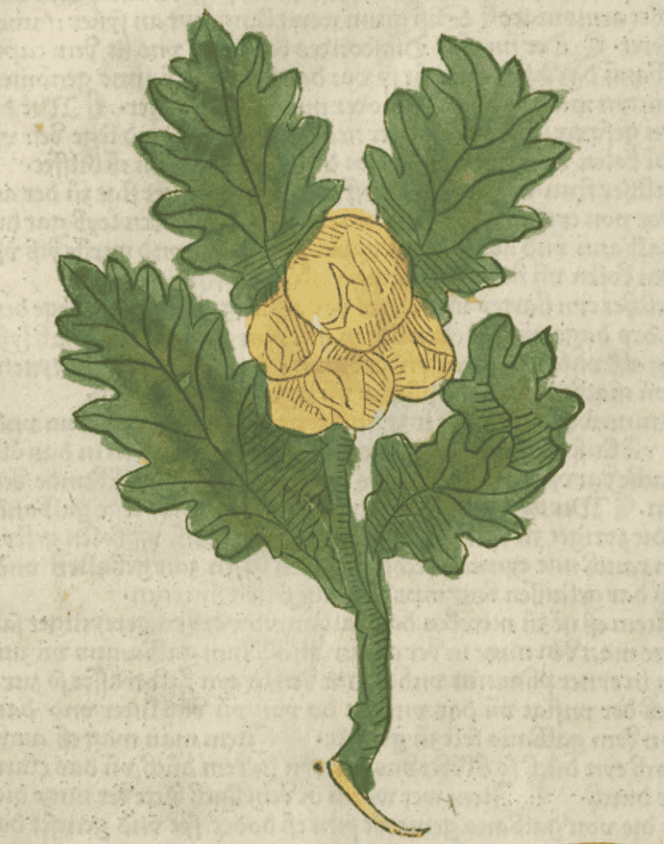
Oak Gall
Gart der Gesundheit, Cuba, 1485
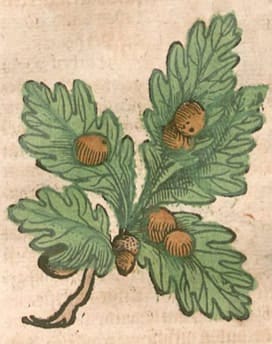
Oak Gall
Krauterbuch, Lonitzer, 1578
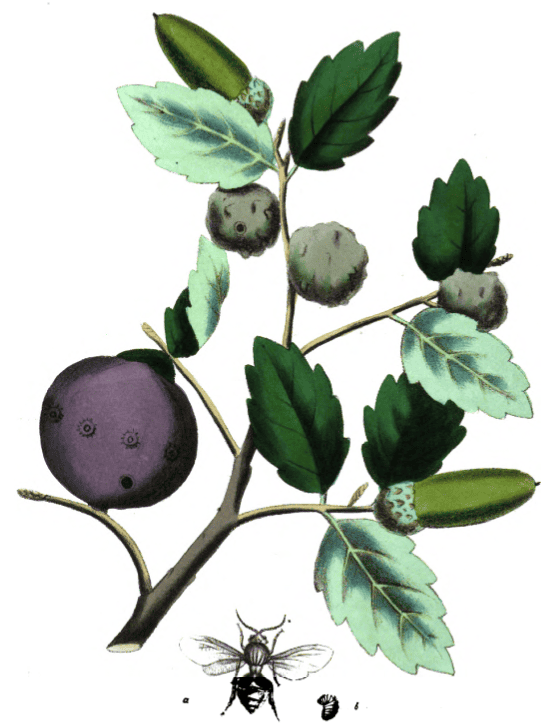
Oak Gall
Medical Botany, Bohn, 1832
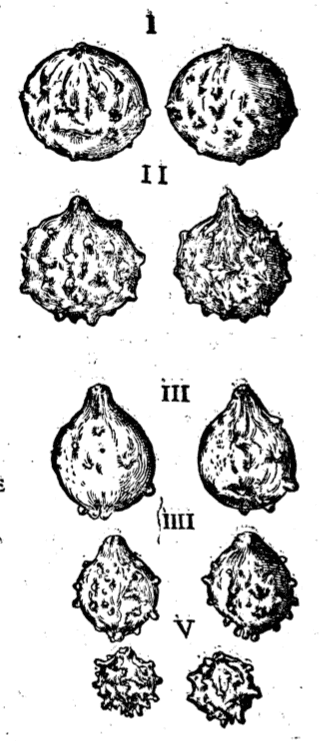
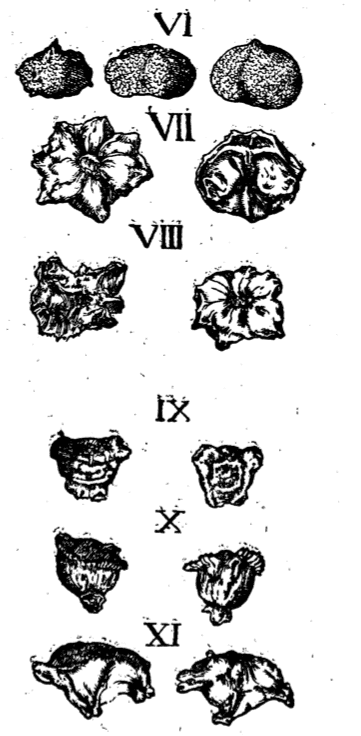
Some of the Gall varieties from Tabernaemontanus (1664)
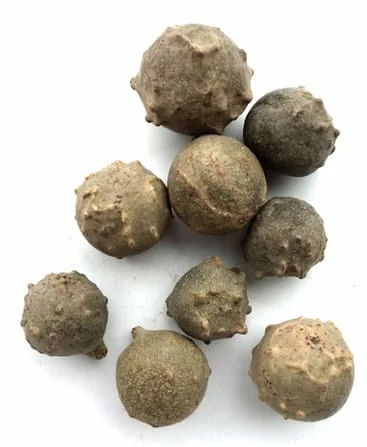
Oak Galls (Adam, 2016)
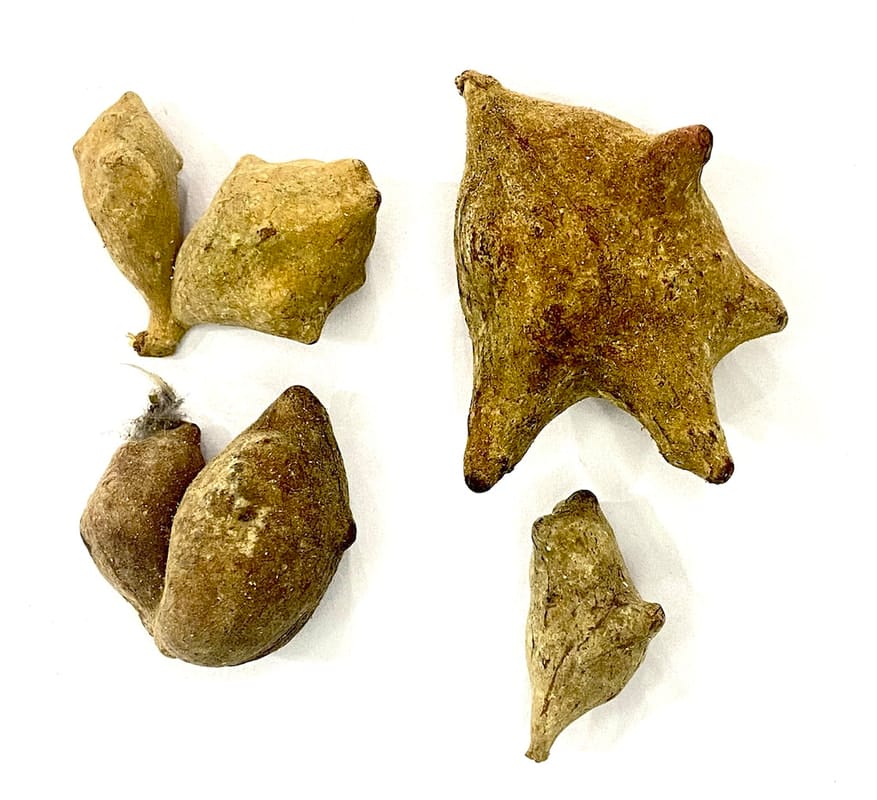
Chinese Galls (Rhus) (Adam, 2024)
Botanical name:
A number of Galls have been used:
1. Oak Gall, ‘True’, European or Turkish Galls: infection of Adleria (syn. Cynips) gallae-tinctoriae on Quercus infectoria
2. Chinese or Japanese Galls: infection of Melaphis chinensis or Schlectendalia chinensis on Rhus chinensis, R. potaninii and R. punjabensis
3. English Galls: formed by Adleria kollari on Quercus robur
4. Hungarian Galls: produced by Cynips lignicola on Quercus robur
5. Pistacia Galls: Galls obtained from Pistacia integerrima (syn. P. chinensis, Rhus integerrima) or Rhus succedanea. These are used in Ayurveda and Unani medicine, but Chinese galls are also recognised.
6. Tamarisk Galls: Galls from Tamarisk gallica or T. nilotica
Parts used:
Gall nuts from the insects which have infected the above-named trees
“Its best variety is unripe heavy and hard” (Avicenna)
Temperature & Taste:
Cold, very dry. Salty, Sour, slightly Sweet aftertaste.
Li Shi Zhen said it is Warm; some viewed them as Neutral. Their dryness is their primary quality.
Classifications:
2N. REPELLENTS. 2O. ASTRINGENT. 2Z. CICATRIZING
4i. UTERINE
TCM
R. Astringent
Uses:
1. Astringes to Stop Leakage (West, TCM, Ayurveda):
-chronic Diarrhea and Dysentery, including that with Blood
-Leukorrhea, Gonorrhea.
-prolapse of the Rectum or Uterus; woman would sit over a hot decoction to lift a prolapsed Uterus.
-Diabetes
-Spontaneous Sweating, Night sweats.
-“good for treating dysentery with bloody and whitish discharge and watery stool” (TCM: Tang Ben Cao)
-“They pull back Anal Prolapse, and Prolapse of the Uterus”. (Li Shi Zhen)
2. Stops Bleeding (West, TCM, Ayurveda):
-chronic bleeding from the bowels with blood in the stool, bleeding Piles,
-all types of Bleeding in general. Can be used topically to stop bleeding.
-burnt or prepared Galls were preferred as a Hemostatic. (West)
-“The five kinds of Piles with unending bleeding”. (TCM, Kai Bao)
3. Clears Phlegm, Stops Coughs, Consolidates the Lungs (West, TCM, Ayurveda):
-chronic Cough from Lung deficiency, evening cough due to Lung congestion;
-“it expels and dries up Rheum and other fluxes, especially those that fall upon the Gums, almonds of the Throat, and other places of the Mouth”. (Culpeper)
-clears the Lung, transforms Phlegm and stop Cough (Fermented Galls, Li Shi Zhen)
-resolves Phlegm Nodes and Swellings
4. Clears Heat and Damp, Resists Poison:
-topically for Sores, damp Sores and Ulcers, Ringworm, and various toxic swellings.
-topically for local infections, both bacterial, viral and fungal.
-ancient physicians said it cleansed the skin if taken with Honey. (Celsus etc.)
5. Resists Poison:
-‘A general antidote to Poisons’; traditionally used for various poisons;
-in India they have been used as antidotes to the venom of Snakes and Scorpions
-“they dissolve Wine Poison”. (Ri Hua)
6. Astringes Essence:
-Spermatorrhea, involuntary emission of Urine or Sperm
-“It reinforces the blood and helps produce Jing [Essence], harmonizes qi and pacifies the mind”. (TCM: Li Xun)
7. Externally:
-applied topically as a wash or powder to Sores, Toxic Swellings, Stubborn Ulcers, Fistulas, Ringworm, Skin Infections and ulcerous Dermatitis etc., where there is excess moisture.
-Fistula, burn the drug to ashes and apply (TCM)
-with Honey to whitlows, hang-nails, malformed nails, running ulcers, condylomatous swellings (Pliny)
-applied with Vinegar to Ringowrm (Avicenna)
-the powder is applied to damp-type Eczema.
-a paste is applied to Psoriasis.
-a wash to Sores in the Mouth and Nose, or a gargle for a Sore Throat.
-a decoction used as a mouth wash stops Bleeding of the Mouth; or burn the Galls, powder and apply.
-“Apply them to oral sores, and this will enable one to drink and eat again”. (Kou Zong Shi)
-“Local application proves to be an effective treatment for corroded Teeth”. (Avicenna)
-boiled in Vinegar, it makes a good wash for Itches.
-Burns. (TCM, West)
-traditionally to dye the whiskers and hair black (decocted in vinegar and used as a wash; since Dioscorides, also TCM)
-topically, it is applied to Scar Tissue. (TCM)
-applied to Liver spots (decoction)
-in douches for Leukorrhea.
-in enemas for chronic Diarrhea, Prolapses
-topically to Hemorrhoids
-discharge of pus from the ears, blow Gall powder directly into the ear. (Ben Cao Gang Mu)
Dose:
Taken with Vinegar to Reduce the Spleen
Powder: 500mg–2 grams
Correctives:
Tragacanth, Gum Arabic
Substitutes:
1. Aleppo Galls were always regarded as best; English and Chinese Galls are used synonymously with the English being weaker.
2. Pomegranate bark or pericarp, Acorns and Chebulic Myrobalans are all accepted substitutes (Unani)
Preparation:
1. Steamed Galls
The fresh Galls are steamed to kill the insect inside or they can rot. Stir-frying will do the same.
Steamed Galls have been proven to be more effective as an anti-cancer medicine. (see here)
2. Scorched Galls
“The Galls are burnt on live coal” (Avicenna)
Burning helps reduce their cold nature, and enhances their astringent property.
3. Vinegar-prepared Galls
“The nuts [Galls] are burnt on live coals, soaked in vinegar and pounded to form a hemostatic application for all kinds of haemorrhage”. (Avicenna)
Used as a Hemostatic, since Pliny and Dioscorides. The same preparation appears in Chinese texts to stop Diarrhea.
4. Fermented Galls
Galls have been fermented for use which renders them lighter and milder. A Chinese method of fermentation: 600 grams of Galls are coarsely powdered and boiled to a syrupy extract with 1 oz. of Tea leaves. Four ounces of yeast is then added and mixed well. It is covered and left to rise as in making bread. It is then rolled into cakes or pills and dried.
“It clears the lung, transforms phlegm and holds cough. It resolves heat, generates body fluid and ends thirst … and all kinds of sores caused by wind and moisture”. (Li Shi Zhen)
Main Combinations:
Leakage, Bleeding:
1. Chronic Diarrhea:
i. Galls with Chebulic Myrobalan
ii. Chronic Cold-type Diarrhea, Galls with Nutmeg
iii. Heat-type, Galls with Rhubarb
iv. Galls with Pomegranate, Comfrey, Red Earth, Rose, Cinnamon, Mastic (as in Pills Against Fluxes of Nicolas)
v. Galls with Pomegranate flower, Sumac, Indian Spikenard, Aloeswood, Coriander, Raisin (as in Powder for Chronic Diarrhea of Nicholas)
vi. Galls with Sorrel juice, Rose, Myrtle berry, Sandalwood, Tabasheer, Aloeswood, Clove, Nutmeg (as in Troches of Ramich of Mesue)
2. Bleeding:
i. blood in the Stool, combine Galls with torrefied Rhubarb root.
ii blood in the stool, take Galls in powder (3 grams) with Mugwort decoction.. (Ben Cao Gang Mu)
iii. bleeding from the Stomach, Galls with Chebulic Myrobalan, Alum
iv. Bleeding during pregnancy, take 6 grams of Chinese Gall powder with a little wine. “Divinely effective”. (Ben Cao Gang Mu)
3. Diabetes, Nocturnal Emission, Galls with Poria Fu Ling, Dragon Bones (Long Gu) (as in Yu Suo Dan fromTai Ping Hui Min He Ji Ju Fang [Formulas of the Peaceful Benevolent Dispensary]). This formula was found 87% effective in the treatment of Diabetes according to Chinese sources.
4. Spontaneous Sweating: chew Galls and insert the paste into the navel. Leave on overnight and it will stop the sweating. (TCM, Ji Ling)
Externally:
5. Scars, apply Galls and Centipede made into a paste with vinegar (TCM)
6. Gargle for Sore Throat, Galls with Pomegranate peel, Rose, Licorice (as in Gargle for Swollen Tonsils)
7. Mouth or Tongue Sores and Ulcers or Gums Boils:
i. apply Gall powder directly
ii. apply powder of Myrrh, Galls and Frankincense bark (or Gum) mixed with Honey (Avicenna)
iii. Chinese Gall, Talcum, Phellodendron Huang Bai roasted with Honey, powder and apply. (Ben Cao Gang Mu)
iv. Mouth or Tongue sores or ulcers, apply a powder of equal parts of Chinese Gall and Litharge directly to the sore. (Ben Cao Gang Mu)
8. Loose Teeth, make a decoction with Galls, Acorns, Alum and Rose to be held in the mouth
9. Toothache:
i. make a paste of Chinese Gall powder with cold water and apply to the cheek over the tooth. “Very effective”. (Ben Cao Gang Mu)
ii. a decoction of Galls in vinegar is held in the mouth; or the inner part of the Gall is chewed
iii. apply powder of Galls and Sichuan Pepper or Clove
10. Loose Teeth, apply a powder of equal parts Chinese Galls and roasted dried Earthworm to the teeth and gums. (Ben Cao Gang Mu)
11. Hemorrhoids:
i. prepare an ointment of Galls with oil and wax or petroleum jelly.
ii. boil beaten Chinese Galls to use as a wash and to steam the affected area. (Ben Cao Gang Mu)
iii. simmer equal parts of Chinese Galls and chimney soot in vinegar to a paste. Apply with a Goose feather. (Ben Cao Gang Mu)
iv. Galls powdered (2 drams), Camphor dissolved in a little alcohol (half dram), Lard (1 oz.). Mix.
12. Rectal prolapse:
i. apply Chinese Gall powder, or make a strong decoction, add Alum and use as a wash. (Ben Cao Gang Mu)
ii. prepare a decoction of Galls and Chebulic Myrobalan, strain, add Alum, and use as a wash.
13. Sores, Pyogenic infections:
i. Chinese Galls, Phellodendron Huang Bai, topically
ii. apply powder of Chinese Galls topically with Rhubarb (Da Huang)
iii. swelling from poison (Heat-Toxin) in early stages before a head has formed, apply equal parts of Chinese Gall, Rhubarb root, Phellodendron Huang Bai, topically. (Ben Cao Gang Mu)
14. Furuncles, mix Galls with Sesame oil and applied
15. Discharge of pus from the ears, Chinese Galls, dried over a fire (10 parts), Scorpions (3 parts), burnt in a closed vessel. Powder and blow into the ear. (Ben Cao Gang Mu)
16. Moist Sores of the Scrotum, Chinese Gall powder with a little Calomel, mixed with Sesame oil and applied. (Ben Cao Gang Mu)
Major Formulas:
West / Unani:
Decoction for Sore Throat
Powder for Chronic Diarrhea (Nicholas)
Powder for Scrofula (Pharmacopoea Argentorarensis)
Powder for Scrofula (Arnold de Villa Nova)
Powder for Scrofula (Bononiense)
Powder for Phlegmatic Abscess of the Throat
Troches of Ramich (Mesue)
Electuary for Sadness and Worry
Electuarium Acharistum (Nicholas)
Pills Against Fluxes (Nicholas)
Ayurveda:
Balacaturbhadrika (Ayurveda)
Eight-Limbed Electuary (Ayurveda)
TCM:
Gu Chong Tang
Cautions:
1. Not used for acute Cough or acute Sore Throat
2. Not used in Constipation
Toxicity
Acute toxicity tests showed LD50 in rats for Chinese Galls was over 5000mg/kg
Subchronic administration of 1500mg/kg had no adverse effect.
Main Preparations used:
Infusion, Decoction, Tincture, Extract, Ointment, Astringent Injection, Astringent gargle
1. Infusion of Galls:
i. Bruised Galls (2 oz.), Boiling Water (1 pound). Macerate 24 hours, strain and filter. Dose: 2 spoonfuls every 2 hours for Diarrhea.
ii. Some used 1:8 (Galls to Water)
2. Decoction of Galls:
i. Galls (half oz.), Spring Water (2 lbs.). Boil to 1 pound. Dose: 1 spoonful. Also applied in lotions, prolapsed rectum, Liver spots.
3. Tincture of Galls:
i. Gall in powder (1 part), Proof Spirit (8 parts). Macerate 7 days, filter. Dose: 1–3 drams (Edinborough)
ii. Gall (half oz.), Alcohol (2 oz.). (Niemann)
4. Extract of Galls:
i. Galls, coarsely powdered, any quantity; exhaust them with several decoctions, add the decoctions together and evaporate the liquid in a water-bath.
5. Ointment of Galls:
i. Gall powder (1 part), Lard (8 parts). Mix. (Edinborough)
6. Astringent Injection (Enema, Douche):
i. Powdered Gall (2 drams), Boiling Water (1 pound). Infuse 1 hour, strain. (Pharmacopoeia extemporanea, Augustin, 1822)
ii. Gall (half oz.), Water (sufficient to obtain 8 oz. of decoction); strain and dissolve in Alum (2 drams), Zinc sulphate (2 grains). Mix. Used for obstinate mucus discharge from the urethra or vagina (blenorrhea). (Pharmacopoeia extemporanea, Augustin, 1822)
7. Astringent Gargle:
i. Decoction of Barley (4 oz.), Rose, Gall, Pomegranate bark (1 dram each), Red Wine (4 oz.), Honey of Roses (2 oz.), Sulphuric acid (sufficient to make acidic) (Ratier)
Click the above Tabs for more information on this medicine
Pliny on Galls:
‘And no fewer are the varieties of the gall-nut which we have described; we have, for instance, the full-bodied gall-nut, the perforated one, the white, the black, the large, the small, all of them possessed of similar properties; that, however, of Commagene is generally preferred. These substances remove fleshy excrescences on the body, and are serviceable for affections of the gums and uvula, and for ulcerations of the mouth. Burnt, and then quenched in wine, they are applied topically in cases of coeliac affections and dysentery, and with honey, to whitlows, hang-nails, malformed nails, running ulcers, condylomatous swellings, and ulcerations of the nature known as phagedaenic. A decoction of them in wine is used as an injection for the ears, and as a liniment for the eyes, and in combination with vinegar they are employed for eruptions and tumours. The inner part of the gall, chewed, allays tooth-ache, and is good for excoriations between the thighs, and for burns. Taken unripe in vinegar, they reduce the volume of the spleen; and, burnt and then quenched in salt and vinegar, they are used as a fomentation for excessive menstruation and procidence of the uterus. All varieties of the gall-nut stain the hair black.’ (The Natural History of Pliny, trans. by Bostock and Riley, Vol. 5, 1856)
Pharmacographia, Fluckiger & Hanbury, 1879
‘In China these galls are probably known and used both medicinally and in dyeing since very long; they are mentioned in the herbal Pen tsaou, written in the middle of the 16th century. They also occur in Cleyer’s “Specimen medicine sinicae,” Frankfort, 1682, No. 225, under the name u poi cu. Kampfer also mentions a tree “Baibokf, vulgo Fusi,” growing on the hills, the pinnate leaves of which he found often provided with an be imported into Europe about 1724, and are noticed by Geoffroy ‘ as Oreilles des Indes, but they seem to have soon disappeared from the market. Pereira directed attention to them in 1844, since which time they have formed a regular and abundant article of import both from China and Japan.’
GENERAL / REVIEW
–Galla Chinensis, a Traditional Chinese Medicine: Comprehensive review of botany, traditional uses, chemical composition, pharmacology and toxicology.
–Rhus chinensis and Galla Chinensis–folklore to modern evidence: review.
ANTIBACTERIAL
–Tannins extract from Galla Chinensis can protect mice from infection by Enterotoxigenic Escherichia coli O101.
–The Antibacterial Activity of Mass Galla Chinesis et Camelliae Fermentata on Helicobacter pylori Infection.
–Antibacterial activity of methyl gallate isolated from Galla Rhois or carvacrol combined with nalidixic acid against nalidixic acid resistant bacteria.
–[Study of antibacterial effect of Galla Chinensis on the bacteria biofilm in chemostat].
–[The effect of galla chinensis on the growth of cariogenic bacteria in vitro].
–[The inhibitory effect of extracts from Galla chinensis on marine fouling bacteria].
ANTIFUNGAL
–In Vivo Evaluation of Galla chinensis Solution in the Topical Treatment of Dermatophytosis.
ANTI-VIRAL
–Antiviral compounds from traditional Chinese medicines Galla Chinese as inhibitors of HCV NS3 protease
–Anti-viral activity of compounds from Agrimonia pilosa and Galla rhois extract mixture.
–Potent antiviral activity of Agrimonia pilosa, Galla rhois, and their components against SARS-CoV-2.
–Antiviral compounds from traditional Chinese medicines Galla Chinese as inhibitors of HCV NS3 protease.
ANALGESIC
–Evaluation of Analgesic and Anti-Inflammatory Activities of Water Extract of Galla Chinensis In Vivo Models.
ANTI-INFLAMMATORY
–Evaluation of Analgesic and Anti-Inflammatory Activities of Water Extract of Galla Chinensis In Vivo Models.
ANTIPLATELET
–Galla rhois exerts its antiplatelet effect by suppressing ERK1/2 and PLCβ phosphorylation.
CIGARETTE INDUCED LUNG INJURY
–Galla Chinensis attenuates cigarette smoke-associated lung injury by inhibiting recruitment of inflammatory cells into the lung.
DIARRHEA
–Anti-diarrheal effect of Galla Chinensis on the Escherichia coli heat-labile enterotoxin and ganglioside interaction
–Preparation of Galla Chinensis Oral Solution as well as Its Stability, Safety, and Antidiarrheal Activity Evaluation.
–Anti-diarrheal effect of Galla Chinensis on the Escherichia coli heat-labile enterotoxin and ganglioside interaction.
OBESITY
–Anti-obesity effects of galla rhois via genetic regulation of adipogenesis
NEUROPROTECTIVE
–Anti-Oxidant Activity of Gallotannin-Enriched Extract of Galla Rhois Can Associate with the Protection of the Cognitive Impairment through the Regulation of BDNF Signaling Pathway and Neuronal Cell Function in the Scopolamine-Treated ICR Mice.
CEREBRAL ISCHEMIA
–Protective effects of Galla Rhois, the excrescence produced by the sumac aphid, Schlechtendalia chinensis, on transient focal cerebral ischemia in the rat.
HEPATOPROTECTIVE
–1,2,3,4,6-penta-O-galloyl-beta-D-glucose from Galla Rhois protects primary rat hepatocytes from necrosis and apoptosis.
–Phenolic constituents of galla Rhois with hepatoprotective effects on tacrine- and nitrofurantoin-induced cytotoxicity in Hep G2 cells.
RENOPROTECTIVE
–1,[Formula: see text]2,[Formula: see text]3,[Formula: see text]4,[Formula: see text]6-Penta-O-Galloyl-β-D-Glucose from Galla rhois Ameliorates Renal Tubular Injury and Microvascular Inflammation in Acute Kidney Injury Rats.
–[Protective effect of Galla chinensis apozema on adriamycin-induced nephropathy in rats].
CANCER
BREAST
–1,2,3,4,6-Penta-O-galloylglucose within Galla Chinensis Inhibits Human LDH-A and Attenuates Cell Proliferation in MDA-MB-231 Breast Cancer Cells.
COLORECTAL
–Galla Rhois water extract inhibits lung metastasis by inducing AMPK‑mediated apoptosis and suppressing metastatic properties of colorectal cancer cells.
–Water extract of Galla Rhois with steaming process enhances apoptotic cell death in human colon cancer cells.
LUNG
–Effects of Gallotannin-Enriched Extract of Galla Rhois on the Activation of Apoptosis, Cell Cycle Arrest, and Inhibition of Migration Ability in LLC1 Cells and LLC1 Tumors.
ENHANCEMENT OF ANTI-CANCER EFFECT BY STEAMING
–Water extract of Galla Rhois with steaming process enhances apoptotic cell death in human colon cancer cells.
ANTI-METASTASIS
–Galla Rhois water extract inhibits lung metastasis by inducing AMPK‑mediated apoptosis and suppressing metastatic properties of colorectal cancer cells.
CHEMOTHERAPY SIDE EFFECTS
–[Protective effect of Galla chinensis apozema on adriamycin-induced nephropathy in rats].
REMINERALIZATION
–Effect of Galla Chinensis on Remineralization of Early Dentin Lesion.
–Galla chinensis Compounds Remineralize Enamel Caries Lesions in a Rat Model.
–Chemical composition of Galla chinensis extract and the effect of its main component(s) on the prevention of enamel demineralization in vitro.
–[Re-mineralization ability of Galla chinensis extracts on root carious lesions with or without non-collagen proteins].
–Combined effects of nano-hydroxyapatite and Galla chinensis on remineralisation of initial enamel lesion in vitro.
TOOTH DECAY
–The Effects of a Toothpaste Containing the Active Ingredients of Galla chinensis and Sodium Fluoride on Dentin Hypersensitivity and Sealing of Dentinal Tubules: An In Vitro Study and an Eight-Week Clinical Study in 98 Patients.
–Comparison of Composition and Anticaries Effect of Galla Chinensis Extracts with Different Isolation Methods.
–Anti-carious Effects of Galla chinensis: A Systematic Review.
–[Effect of Galla chinensis on the surface strengthening of bovine dentine in vitro].
–Effect of pH on Galla chinensis extract’s stability and anti-caries properties in vitro.
–Anticaries effect of compounds extracted from Galla chinensis in a multispecies biofilm model.
–[The effect of galla chinensis on the growth of cariogenic bacteria in vitro].
UV PROTECTIVE
–Effects of Galla chinensis extracts on UVB-irradiated MMP-1 production in hairless mice.
WOUNDS
–Potential Wound Healing Activities of Galla Rhois in Human Fibroblasts and Keratinocytes.
You must be logged in to view this content, please login. If you're not a member then Click this link to subscribe