Galium, Cleavers
Goosegrass, Clivers, Bedstraw
Gallion, Aparine, Aspergula, Philanthropos
Zangs rtsi dkar po ཟངས་རྩི་དཀར་པོ་ (Tibet)
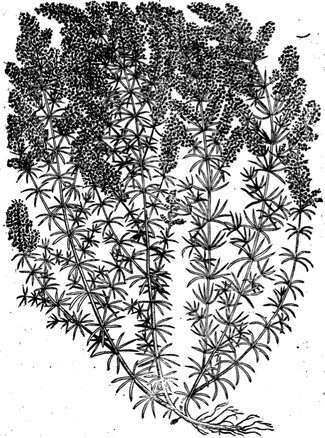
New Kreuterbuch, Matthiolus, 1563
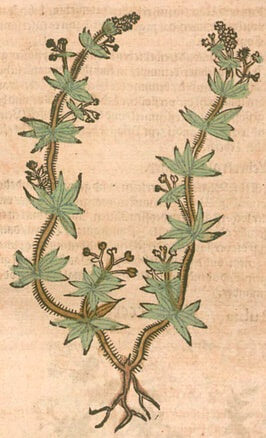
Krauterbuch, Lonitzer, 1578
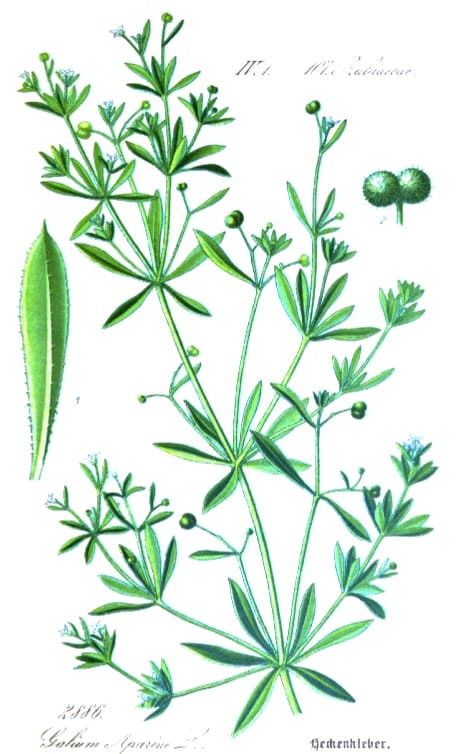
Flora von Deutschland (28), Kohler, 1886
Botanical name:
Galium aparine
Galium hirtiflorum (syn Galium ciliatum) is also used in Tibetan Medicine.
Parts used:
Herb
Temperature & Taste:
Mildly Cool, dry (slightly Moist when fresh). Bitter, Pungent, slightly Sweet
Classifications:
Uses:
1. Clears Heat and Poison, Resolves Swellings and Masses:
-Swellings, Lymphatic nodes, Scrofula, Tumors
-Cancer, especially of the Breast or Lymphatics (Salmon listed it for Breast Cancer)
-topically applied to open Cancers.
2. Clears Heat from the Blood, Resists Poison:
-Eczema, Psoriasis, Leprosy
-specific for “nodulated growths or deposits in skin or mucous membranes”. (Scudder)
-Fever, Scarlet Fever, Eruptive Fevers
-Venomous Bites; Spider, Snake (juice taken)
3. Clears Liver Heat:
-Jaundice
-Hepatitis
-Epilepsy, Hysteria
-Taken in Spring to “cleanse the Blood and strengthen the Liver, thereby keeping the body in health” (Culpeper)
-used for Bile disorders and yellowing of the eyes in Tibetan Medicine.
4. Clears Heat, Promotes Urine, Clears Stones:
-hot, burning or obstructed Urine; Edema, Gonorrhea, Cystitis, Prostatitis, Hematuria
-“It is an excellent and speedy remedy in suppression of the urine and Gravel … it is regarded as a solvent of stone in the Bladder” (Vitalogy)
-“Used with decided success in treating children for incontinence of Urine (wetting the bed)”. (Vitalogy)
-Good for Obesity and to keep slim; “Taken in broth, it keeps them lean and lank that are apt to grow fat”. (Culpeper)
5. Moves the Blood:
-Hippocrates used it to promote Menstruation
6. Externally:
-Sunburn, Scalds and Burns, Sores and Blisters;
-“the Cold infusion will remove Freckles when it is drunk 2-3 times a day for 2-3 months, and the parts frequently washed with it”. (Vitalogy)
-“many cutaneous diseases, as Psoriasis, Eczema, Lichen, Cancer and Scrofula”. (King’s)
-Scrofula, mixed with Lard and applied (Dioscorides)
-Indolent Tumors; it is applied as a wash to Skin Cancers, and is used as a mouth wash and gargle for Mouth Cancers.
-Earache.
-Burns Wounds and Abscesses Wounds (Tibet)
-The ointment has been recommended for Spinal Injuries.
-internal and external injuries in TCM; also applied externally to stop bleeding
-powder is used as a snuff to stop nose Bleeding.
-poultice of the fresh herb has cured many cases of chronic Leg Ulcers including Varicose Ulcers.
-ointment made with butter is applied to Anal Prolapse (The Physicians of Myddvai, translated by John Pughe esq., 1861)
Dose:
Decoction: 6–15 grams, up to a maximum of 50 or 60 grams (or 15–45 grams of the fresh)
A handful of the fresh herb boiled in 1 liter of water can be taken over the day. The decoction taken throughout the day as common drink for up to 6–12 months has been credited with curing numerous cases of Cancer.
Tincture (1:5 in 40% alcohol): 2–4, or 6 mls, 2–3 times daily
Fluid Extract (1:1 in 25% alcohol): 2–4, or 6 mls
Fresh juice: 5–15 mls several times daily. In Cancer and Tumour treatment, 120–250 grams of the fresh moistened plant is squeezed to obtain its juice which may be given as a dose.
Extract: 300–1200mg (5–20 grains) are taken.
Substitute:
In Tibetan Medicine, Artemisia hedinii is used as a type of Zangs rtsi.
Main Combinations:
1. To promote Urine, Cleavers with Broom
2. Suppressed Urine, Cleavers with Parsley root and Sea Holly (equal parts)
3. Suppressed and Burning Urine:
i. Cleavers with Marshmallow root (2 parts) and Broom (1 part)
ii. Cleavers with Elder flower and Yarrow (equal parts)
4. Gravel and Stones, Cleavers with Juniper berry, Parsley, Linseed (Gablick)
5. Skin diseases in general, Cleavers with Fumitory
6. Acne, Abscess, Skin disease, Arthritis, Cleavers with Couch Grass, Butchers Broom, Parsley root, Dandelion (as in Decoction to Purify)
7. Psoriasis:
i. Cleavers with Red Clover, Nettle (2 parts), Figwort (1 part)
ii. Cleavers with Heart’s Ease, Yellow Dock, Red Clover and Nettle (equal parts)
8. Swollen Glands:
i. Cleavers and Calendula
ii. Cleavers, Hyssop, Agrimony
9. Scrofula:
i. Cleavers, Figwort, Violet
ii. Cleavers with Burdock, Fumitory (2 parts ea.), Bittersweet (1 part)
10. Hepatitis, Liver inflammation, Cleavers with Agrimony, Juniper berry, Centaury, Dandelion (as in Decoction for Hepatitis)
11. Obesity:
i. “A pottage made of Cleavers, a little mutton and oatmeal is good to cause lankness and keep from fatness”. (Pliny)
ii. Culpeper said ‘… it is familiarly taken in broth, to keep them lean and lank that are apt to grow Fat’.
iii. More recently, it has been combined with Kelp for Obesity.|
12. Swelling following injury: “For a swelling, the result of an injury. Take the juice of the yellow Bed straw, the juice of the plantain, rye meal, honey and the white of eggs. Make into a plaster, and apply thereto”. (The Physicians of Myddvai, translated by John Pughe esq., 1861)
13. Tumors:
i. Scudder in Specific Medications and Specific Medicines relays a “case of hard nodulated tumor of the tongue, apparently cancerous, is reported in the British Medical Journal, as having been cured with it”.
ii. “The juice in combination with the juice (or infusion) of Violet leaves taken in large and frequent doses at least three times daily has dispersed long-standing growths”. (Wonders in Weeds, W. Smith)
14. Cancer:
i. for “an open cancer, to take freely of Clivers, or Goose-grass, whilst covering the sore with the bruised leaves of this herb”. (Primitive Physic, Wesley, 1769)
ii. 30 grams of the herb is decocted, then strained, and sweetened with brown sugar, and taken as a dose, 3-6 times daily for an extended period. Alternatively, 250 grams of the fresh herb can be pressed to obtain its juice which may also be sweetened with brown sugar and taken. Used for Breast, Thyroid and Cervical Cancer, Submandibular Adenocancer among others.
iii. “This herb has a special curative reputation with reference to cancerous growths and allied tumours. For open cancers an ointment is made from the leaves and stems wherewith to dress the ulcerated parts, and at the same time the expressed juice of the plant is given internally. Dr. Tuthill Massy avers that it often produces a cure in from six to twelve months, and advises that the decoction shall be drank regularly afterwards in the Springtime” … “Dr. Thornton, in his excellent Herbal (1810), says: “After some eminent surgeons had failed, he ordered the juice of Cleavers, mixed with linseed, to be applied to the breast, in cases of supposed cancer of that part, with a teaspoonful of the juice to be taken every night and morning whilst fasting; by which plan, after a short time, he dispersed very frightful tumours in the breast.” … “In cancer,” says Dr. Boyce, “five fluid ounces of the fresh juice of the plant are to be taken twice a day, whilst constantly applying the bruised leaves, or their ointment, to the sore.” (Herbal Simples Approved for Modern Uses of Cure, W. T. Fernie, M.D., 1897)
iv. form an ointment with Cleaver juice (20 parts), Pig fat (80 parts)
15. Plaster for Trauma and Bruising, juice of Cleavers and Plantain mixed with Rye meal, Honey and Egg white
16. Leg Ulcers: “Dr. Quinlan, at St. Vincent’s Hospital, Dublin, successfully employed poultices made with the fresh juice, and applied three times in the day, to heal chronic ulcers on the legs. Its effects, he says, in the most unlikely cases, were decisive and plain to all. He gave directions that whilst a bundle of ten or twelve stalks is grasped with the left hand, this bundle should be cut into pieces of about half-an-inch long, by a pair of scissors held in the right hand. The segments are then to be bruised thoroughly in a mortar, and applied in the mass as a poultice beneath a bandage”. (Herbal Simples Approved for Modern Uses of Cure, W. T. Fernie, M.D., 1897)
Major Formulas:
Decoction to Purify
Decoction for Hepatitis
Cautions:
1. Not used in Cold bodies
“It is contraindicated in diseases of a passive character, on account of its refrigerant and sedative effects on the system”. (King’s)
Main Preparations used:
Distilled Water, Ointment
Click the above Tabs for more information on this medicine
-The Doctrine of Signatures suggested its influence on the Kidneys as the seed pod looks like a pair of Kidneys.
-The roasted seeds of Cleavers are said to be a good coffee substitute. They are dried, then roasted over a fire.
-A red dye has been made of the roots.
-It has long been used to feed poultry, horses, cattle and sheep.
You must be logged in to view this content, please login. If you're not a member then Click this link to subscribe