Fumaria, Fumitory
Traditionally called Fuma Terra (‘Earth Smoke’)
Parpata (Ayurveda)
Shahtara (Unani)


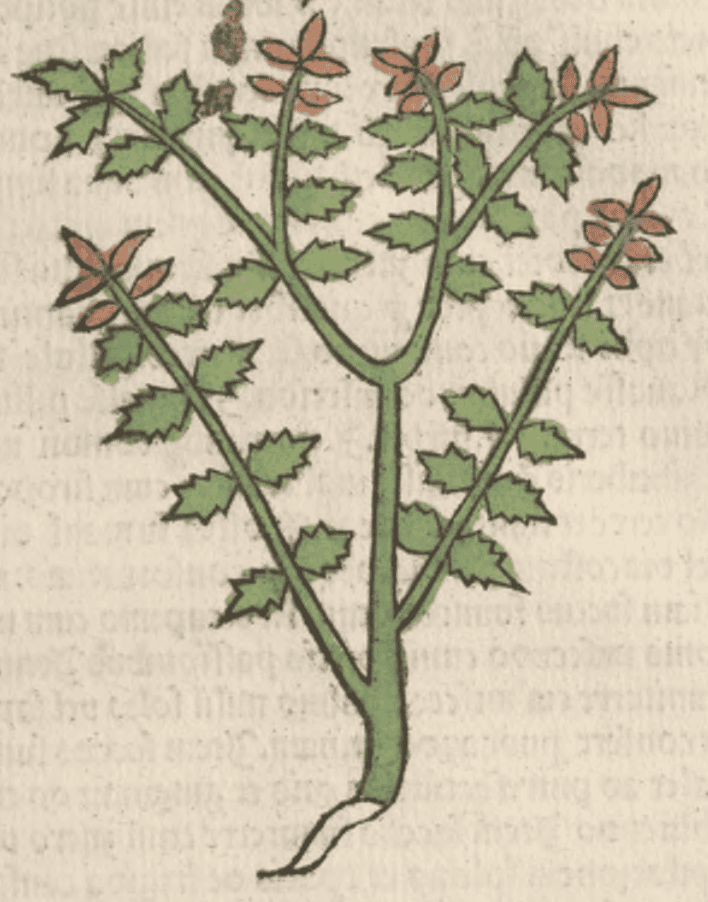
Herbarius latinus, Petri, 1485
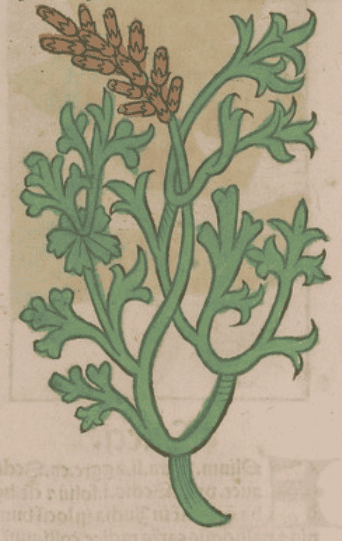
Ortus Sanitatis, Meydenbach, 1491
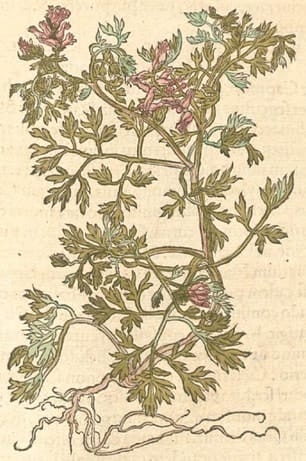
Herbarum Vivae Eicones, Otto Brunfels, 1530
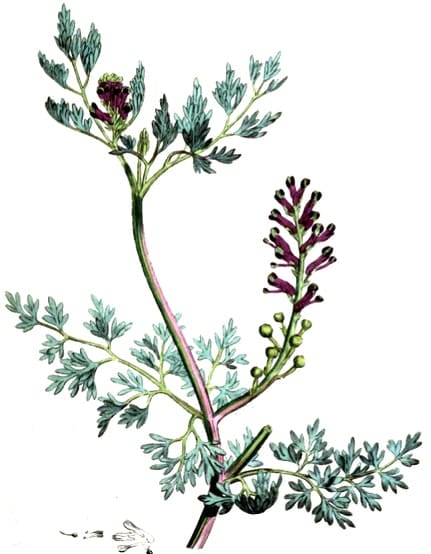
Medicinal Plants, Millspaugh, 1892
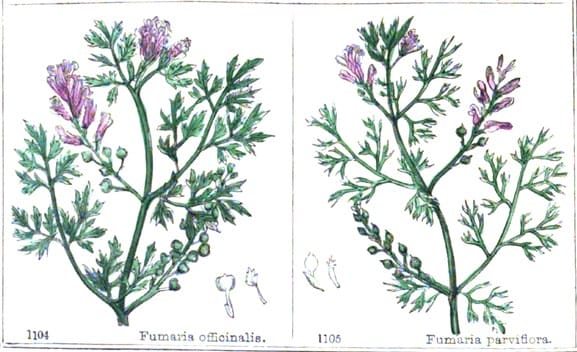
F. officinalis (left), F. parviflora (right)
Florigraphia Britannica, Deakin, 1857
Botanical name:
Fumaria spp.
- F. officinalis (official western)
- F. claviculata (Climbing Fumitory)
- F. parviflora (Lesser or Small Fumitory, from hotter regions)
- F. densiflora (Sothern Europe)
- F. capreolata (Ramping Fumitory, Europe and U.K.)
- F. muralis (Wall Fumitory)
- F. spiculata (Narrow Leaved Fumitory, Europe, Mediteranean)
- F. lutea (Yellow Fumitory, Barbary)
- F. capnoides (White-Flower, Sothern Europe).
- F. indica, F. parviflora, F. vaillantii (used in Ayurveda)
- F. racemosa and F. officinalis have been used in China.
- F. indica and F. sempervirens (in U.S.)
Salmon listed 4 kinds of Fumitory:
- Common or Purple Fumitory (F. officinalis)
- Fine-leaved or Lesser Fumitory
- White Broad-leaved or Climbing Fumitory
- Yellow or Mountain Fumitory
Parts used:
Herb in flower; rarely the Seed
‘The seeds of Fumitory are stronger’ (Avicenna)
Temperature & Taste:
Cool, dry. Bitter
“Cold in the First and Dry in Second degree”. (Avicenna)
Classifications:
2A APERIENT. 2F. PURIFYING
3B. FEBRIFUGE & ANTIPYRETIC. 3E. DIURETIC
4e. STOMACHIC. 4f. SPLENETIC. 4g. HEPATIC
TCM:
B. Clears Heat and Damp
Uses:
1. Clears Liver Heat, Opens Obstructions:
-good for the Liver and Spleen; opens Obstructions, Jaundice
-purges Choler (Bile); Liver heat disorders
-diseases of the Spleen and Abdomen from Heat, Bile or Melancholy
-Alcoholism (Ayurveda)
2. Clears Melancholy and Heat from the Blood
-purges burnt Humors, cleanses the Blood
-chronic skin diseases, Acne, Spots, Scabs, Eczema, Psoriasis
-Leprosy, Syphilis, Scrofula, Fibroid tumors, Cancers. (West, Ayurveda)
-“taken orally in case of Itching and Scabies” (Avicenna)
-“Fumitory’s reckoned to be a great cleanser of the Blood”. (Tournefort, 1730)
-“eminently good against Hypochondriac Melancholy” (Salmon)
3. Clears Heat and Damp, Promotes Urine:
-Edema; Gravel, Stones, Gout, Rheumatism
-“it cleanses by Urine”. (Salmon)
4. Benefits Stomach, Promotes Digestion:
-“strengthens the stomach” (Avicenna)
-opens the Bowels, and strengthens them
5. Promotes Menstruation:
-obstructed and painful menstruation
-claimed by some to benefit Fertility
6. Externally:
-chronic and obstinate skin diseases including Eczema, Psoriasis, Acne, Pimples, Leprosy, either topically as a plaster or paste, or more commonly as a wash or bath.
-wash for Spots and Pimples.
-Boiled in water or whey, or the distilled water used as a wash, it was long used as a cosmetic to improve skin complexion and make it fair.
-wash for Venereal Sores, Pustules and Ulcers including those coming from Venereal Disease.
-wash for mouth and throat sores.
-eyewash for Conjunctivitis, Spots of the Eyes and similar Eye conditions.
-topically for Lice (juice mixed with vinegar or the acid tincture as a wash
-“Fumitory strengthens the gum” (Avicenna)
Dose:
1. The Seed has the vertues of the Herb, but is regarded as stronger
2. Avicenna gave particularly large doses of Fumitory. Taken in larger doses will act as a purgative.
3. Avicenna also said it is taken with Sugar.
4. Alcoholic Tincture: used for Fevers, Pestilence, Plague, as well as Colic and Griping.
5. Acid (Vinegar) Tincture is “Good against Vapours and Tumors which cause fiery Eruptions”. Used to promote appetite and digestion. Also antiscorbutic. Usually, enough drops are added to water to give it a pleasant acidity.
6. Saline (Salt Water) Tincture: used as a hot wash over the skin for various skin diseases including Pimples, Eczema, Psoriasis and Leprosy. Also for Spots and Freckles.
Decoction: 6–15 grams; Avicenna said 30–200 grams (probably referring to the fresh plant)
Powder of the Herb: 2–4 grams; Avicenna said 10–23 grams
Powder of the Seed: 1–2 grams (up to 3 or 4 grams)
Juice: 2–3 spoonfuls in wine
Tincture (1:5 in 45% alcohol): 1–4, or 5 mls.
Fluid Extract (1:1 in 25% alcohol): 2–4, or 6 mls (½–1 dram)
Correctives:
Chicory
Substitutes:
1. Chebulic Myrobalan. (Unani)
2. Senna in half its quantity, especially for Scabies and Chronic Fever.. (Avicenna)
3. Celandine
Main Combinations:
Borage & Fumitory
Hops & Fumitory
1.. Chronic Skin diseases, Psoriasis, Leprosy, Fibroid Tumors:
i. Fumitory Water and Syrup of Endive (Herbarium Horstianum, 1630)
ii. Fumitory with Aloe, Chebulic, Yellow and Black Myrobalans as in Pills of Fumitory of Avicenna)
iii. Fumitory with Bugloss, Hops, Endive, Chicory, Raisin, Licorice (as in Decoction of Fumitory of Andernacus)
iv. Fumitory with Yellow Myrobalan, Violet, Dodder, Wormwood (as in Syrup of Fumitory Lesser of Mesue)
v. Fumitory with Endive, Wormwood, Hops, Dodder (as in Syrup of Fumitory)
vi. Fumitory with Dodder, Oregano, Pennyroyal, Polypody, Black Myrobalan, Yellow Myrobalan, Rhubarb (as in Electuary of Dodder and Fumitory of Mesue)
2. Pruritus:
i. Fumitory water, Strawberry water, Veronica water (Herbarium Horstianum, 1630)
ii. Fumitory with Yellow Myrobalan, Senna, Wormwood (as in Electuary for Scabies and Pruritis of Rhasis)
iii. Fumitory juice, Oil of Walnuts (3 oz. each), with wax form an ointment. (The Secrets of Alexis, 1615)
3. Eczema, Fumitory with Burdock and Cleavers
4. Cleanse Heat and Melancholy from the Blood:
i. Fumitory, Senna
ii. Syrup of Fumitory with Water of Scabious or Endive (Herbarium Horstianum, 1630)
iii. Fumitory with Thyme, Chicory, Agrimony, Wormwood, Polypody, Senna, Licorice (as in Decoction of Fumitory)
5. Scrofula:
i. Fumitory with Figwort
ii. Fumitory with Cleavers, Burdock, Bittersweet (as in Infusion for Scrofula)
6. Clear Heat from the Stomach, Fumitory with Wormwood and Chebulic Myrobalan (Wirtzung)
7. Liver Heat:
i. Fumitory Water and Syrup of Endive (Herbarium Horstianum, 1630)
ii. Fumitory with Chicory and Agrimony (Herbarium Horstianum, 1630)
8. Liver heat and obstruction:
i. Fumitory, Endive, Chicory root (Herbarium Horstianum, 1630)
ii. Fumitory with Chicory, Agrimony, Horehound, Wormwood, Aniseed, Fennel seed, Ginger, Raisin, Senna (as in Opening Hepatic Decoction)
9. Liver and Spleen obstruction: Fumitory with Scolopendra (Dorsetn, 1540)
10. Hepatitis A, Fumitory, Tephrosia, Swertia, Sphaeranthus, Red Sandalwood, Madder (Unani)
11. Gall Stones, Fumitory with Celandine, Wormwood, Balm, Peppermint.
12. Cachexia and Liver weakness, take Diarrhodon Abbatis with Fumitory water. (Herbarium Horstianum, 1630)
13. Liver weakness, Conserve of Fumitory with Conserve of Rose (Herbarium Horstianum, 1630)
14. Fever:
i. Fumitory has been combined with Chicory or Dandelion
ii. Fumitory, Tinospra, Emblic Myrobalan, White Sandalwood (Ayurveda)
15. Leukoderma, Fumitory with Alum, Saltpeter, Red Earth, mixed with Vinegar and applied. (Ayurveda)
16. Strangury, decoction of Fumitory in Wine.
Major Formula:
Potion for Ascites
Potion for Unulcerated Cancer
Decoction of Fumitory of Mesue
Decoction of Fumitory of Andernacus
Decoction of Fumitory Compound
Syrup of Fumitory
Syrup of Fumitory Lesser (Mesue)
Syrup of Fumitory Greater (Mesue)
Syrup of Fumitory Compound (Augustana)
Confection of Rhubarb (Mesue)
Electuary of Dodder and Fumitory (Mesue)
Electuary for Scabies and Pruritis (Rhazes)
Electuary for Liver Obstruction (Rhazes)
Pills of Fumitory (Avicenna)
Pills of Fumitory and Senna (Unani)
Cautions:
1. Not used during pregnancy.
2. Large doses irritate the Stomach and may cause drowsiness.
3. An alkaloid from Fumitory (Sanguinarine) has been shown to raise intraocular pressure, which could aggravate glaucoma if used in large doses.
Toxicity
Studies in rodents have shown no toxic effects with long term administration. (See here)
Main Preparations used:
Water of the Herb, Spirit, Distilled Oil, Dehydrated Juice, Conserve of the Tops, Syrup of the Juice, Extract, Salt of the Ashes
1. Conserve of Fumitory:
i. Fresh leaves of Fumitory (stalks removed) 1 part; bruise until a homogenous mass is formed, then with White Sugar 2 parts, mix to form a conserve. Some used 3 parts of Sugar.
“This Confection is especially good for all them which be full of unclean blood, and also for all them that be plagued with Scurf, with the Pox, and with such like uncleanliness: it keeps men in health, and also from all Venomous air. Of this Conserve may freely be taken, as much as the quantity of a great nut, before that men will bathe, for that it expels out the sweat, and all bad humours of the body: therefore it is also good in the beginning of the Dropsy, for that it opens the Liver and all obstructions of the inward parts; it drives out the Yellow Jaundice by the urine, and is very commodious for many other things”. (Wirtzung)
2. Fumitory Juice:
i. Bruise the fresh herb in a stone mortar, express strongly, and clarify by briefly boilings; strain again and preserve it. (Pharmacopoeia Hispana, 1798)
ii. some just kept the freshly expressed juice under a layer of oil which will preserve it for some time.
3. Extract of Fumitory:
i. Bruise and express the juice, evaporate it until one fourth of the powdered herb is required to give it the consistency of an extract.
ii. Fumitory (1 pound), Spring Water (10 pounds). Macerate 2 days, strain, set aside, then decant the clear liquor. Then evaporate to the consistency of an extract.
iii. Bruise the fresh herb in a mortar and express the juice. Add to it half its weight of dried herb and macerate several hours; then heat to almost boiling, strain with slight expression and clarify with the white of an egg. Then evaporate to the required consistency. (Pharmacopee Usuelle, Louvain, 1821)
4. Syrup of Fumitory Juice.
i. Juice of Fumitory, clarified by boiling and straining, White Sugar (of each 3 pounds); boil slowly to the thickness of Honey.
ii. Depurated Fumitory Juice (1 part), Sugar (2 parts). Dissolve in a water-bath. (Pharmacopoeia Gallica, 1818)
5. Distilled Water of Fumitory:
i. Fumitory, bruised (1 part), Water (2 parts). Distil to two-thirds. (Pharmacopoeia Sardoa, 1773)
ii. Some distilled the juice to near dryness to obtain the Distilled Water.
iii. Fumitory 850 grams; Soak overnight in 12 litres of water, then distil off 7 ½ litres.
It has the vertues of the Juice, but is weaker, although was still usually preferred to the infusion.
It is a Depurative, used for all types of Blood disease. Dose: 125mls. (Unani)
Used to cleanse the Body, promote Sweat, strengthen the Stomach and help Yellow Jaundice. Also for Morphew, Leprosy, Eczema, Psoriasis, Scabs, Dropsy, illness of the Liver, Spleen, or Uterus. Taken to prevent against Poison, Plague and Pestilence, usually with Venice Treacle. Women used to wash their face with this to promote clear Skin.
6. Spirit of Fumitory:
i. Fumitory (6 parts), Proof Spirit (4 parts), Water (1 part). Distil one pound and a half, and re-distil from fresh herb. (Dispensatorium medico pharmaceuticum Palatinatus, 1764)
Click the above Tabs for more information on this medicine
–Galen said Fumitory “Opens the Liver, clears burnt Bile, and cools the Blood”.
-The name “Fumitory” is derived from the ancient name Fumus Terra which means “Earth Smoke”, this possibly being a signature of its use against Burnt Melancholy. Some have suggested this name is derived from the smell of the plant being like smoke, others have proposed the fresh greyish-colored herb to look like smoke rising from the Earth. The Greek name Kapnos also comes from the Greek word for smoke. Both Pliny and Dioscorides make reference to its name coming from the fact that the juice or fumes of it irritates the eyes just as smoke does. By the middle ages, the name had evolved into Fumytere, and eventually, Fumitory.
-Traditionally used for all Saturnian diseases; Saturn was associated with obstructions and Morbid disease, and Fumitory was used to help open obstructions from anywhere in the body. Also said to Strengthen the all the parts governed by Saturn (ie. Spleen and Melancholy humour).
-Since Anglo-Saxon times, the herb was much associated with Witches, the smoke of the burning herb also being used to fumigate areas to ward off evil and avert spells, and was also used in exorcism.
–John Hill (1756) said “Some smoke the dried leaves in the manner of Tobacco for disorders of the head with success”.
-This is a much revered herb in some parts, by the Gypsies for example.
-Previously, Fumitory has been much used to cleanse and whiten the skin:
“Whose red and purpled mottled flowers
Are cropped by maids in weeding hours
To boil in water, milk, or whey,
For washes on a holiday;
To make their beauty fair and sleek,
And scare the tan from summers cheek”.
Vegetable Materia Medica of Western India, Dymock, 1885
“The Pitpapra sold in Bombay does not appear to be the Fumaria parviflora, as it has a smooth fruit without a double pit at the apex; it is imported from Persia, and is doubtless F. officinalis. Several species of Fumitory have long been used medicinally, and were highly esteemed by the Greeks and Romans on account of their diuretic and alterative properties. Dioscorides calls the plant Kapnos, and Pliny derives the name Fumaria from Fumus, smoke, with the explanation that the plant irritates the eyes like smoke; it has also been called Fumus terra with reference to the colour of the foliage, or its smell. Fumitory does not appear to have been mentioned by the early Sanskrit writers. The Arabians and Persians probably derived their knowledge of it from the Greeks, as they hold the same high estimate of its properties. In the Makhzan-el-Adwiya two varieties are mentioned, one with violet-coloured flowers, and a large kind with white flowers; it is described as diuretic and alterative, removing hepatic obstructions, aperient and expellant of the humors, but more especially of Atrabilis; two Greek names are given, Kiasusi and Kafnus ; the Arabic names are Baklat-el-Malik, andShahteraj, a corruption from the Persian. In India the drug is still highly esteemed by the Mahometans.
For a European account of the properties and uses of Fumitory, Handschuch “De plantia Fumariaceis,” &c, may be consulted. Fumitory is laxative and diuretic; it is beneficial in dyspepsia depending upon torpidity of the liver and in scrofulous skin affections. Dose— 2 ounces of the decoction (1 ounce to 1 pint) three times a day.”
GENERAL / REVIEW
–Morpho-anatomical and physicochemical studies of Fumaria indica (Hausskn.) Pugsley
–A review on ethnobotany, phytochemistry and pharmacology of Fumaria indica (Fumitory)
ANTIBACTERIAL
–A review on ethnobotany, phytochemistry and pharmacology of Fumaria indica (Fumitory)
ANTI-FUNGAL
–A review on ethnobotany, phytochemistry and pharmacology of Fumaria indica (Fumitory)
ANTI-INFLAMMATORY
–Niosomes of active Fumaria officinalis phytochemicals: antidiabetic, antineuropathic, anti-inflammatory, and possible mechanisms of action
–A review on ethnobotany, phytochemistry and pharmacology of Fumaria indica (Fumitory)
ANTI-OXIDANT
–Evaluation of Polyphenolic Content, Antioxidant and Diuretic Activities of Six Fumaria Species
–A review on ethnobotany, phytochemistry and pharmacology of Fumaria indica (Fumitory)
HEPATOPROTECTIVE
–A review on ethnobotany, phytochemistry and pharmacology of Fumaria indica (Fumitory)
ANTI-PLATELET / ANTICOAGULANT
–Bioactive Natural Compounds with Antiplatelet and Anticoagulant Activity and Their Potential Role in the Treatment of Thrombotic Disorders
SPASMOLYTIC
–A review on ethnobotany, phytochemistry and pharmacology of Fumaria indica (Fumitory)
ANTI-CONVULSANT
–In Vivo Anticonvulsant Activity of Extracts and Protopine from the Fumaria schleicheri Herb
DIURETIC
–Evaluation of Polyphenolic Content, Antioxidant and Diuretic Activities of Six Fumaria Species
URINARY STONES
–Identification of medicinal plants for the treatment of kidney and urinary stones
ANTI-DIABETIC
–Niosomes of active Fumaria officinalis phytochemicals: antidiabetic, antineuropathic, anti-inflammatory, and possible mechanisms of action
TUMOR / CANCER
–UPLC-MS/MS Profile of Alkaloids with Cytotoxic Properties of Selected Medicinal Plants of the Berberidaceae and Papaveraceae Families
–Cytotoxic and Proapoptotic Activity of Sanguinarine, Berberine, and Extracts of Chelidonium majus L. and Berberis thunbergii DC. toward Hematopoietic Cancer Cell Lines
–In Vitro Screening for the Tumoricidal Properties of International Medicinal Herbs
ECZEMA
–The Effects of Fumaria Parviflora L Extract on Chronic Hand Eczema: A Randomized Double-Blind Placebo Controlled Clinical Trial
You must be logged in to view this content, please login. If you're not a member then Click this link to subscribe