
Fritillaria, Bei Mu 贝母
Bei Mu (TCM)
A bhi kha ཨ་བི་ཁ་ (Tibetan, F. cirrhosa)
A bhi sa mchog (Tibet, F. delavayi)
Kshira Kakoli (Ayurveda, F. cirrhosa)
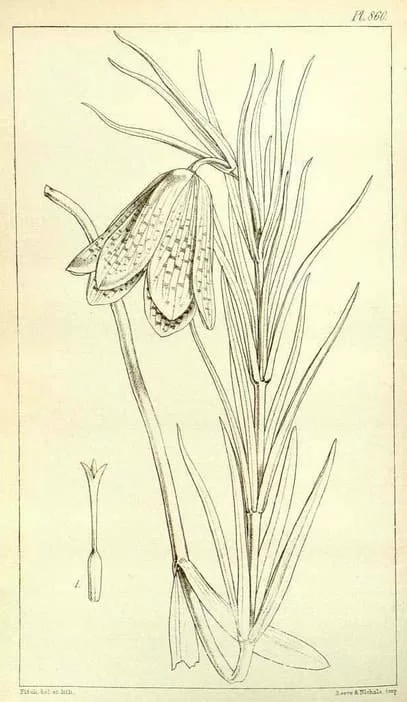
Fritillaria cirrhosa, Chuan Bei Mu
Hooker, Icones Plantarum 1852
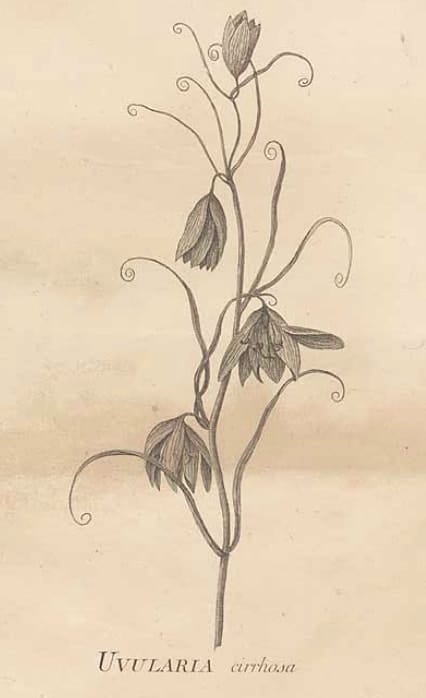
Fritillaria thunbergii, Zhe Bei Mu
Thunberg, Icones plantarum japonicarum, 1800
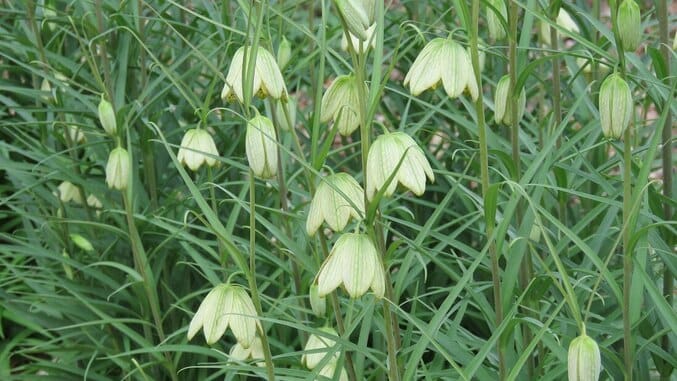
Fritillaria thunbergii
(Photo by Piropiro77) (Wikimedia)
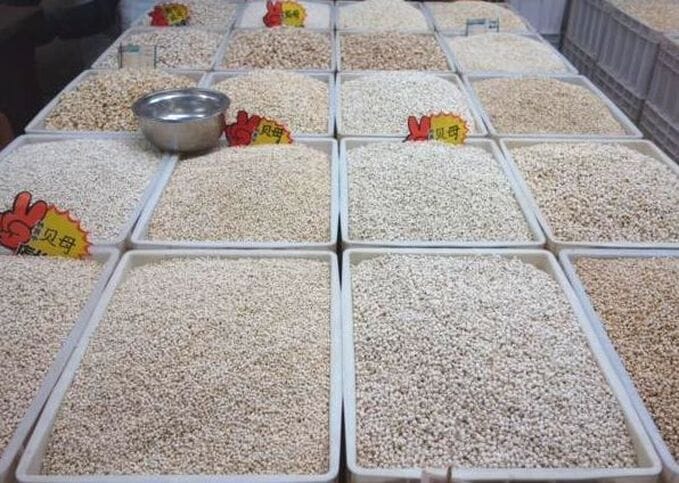 Grades of Fritillaria Bei Mu (Adam, 2017)
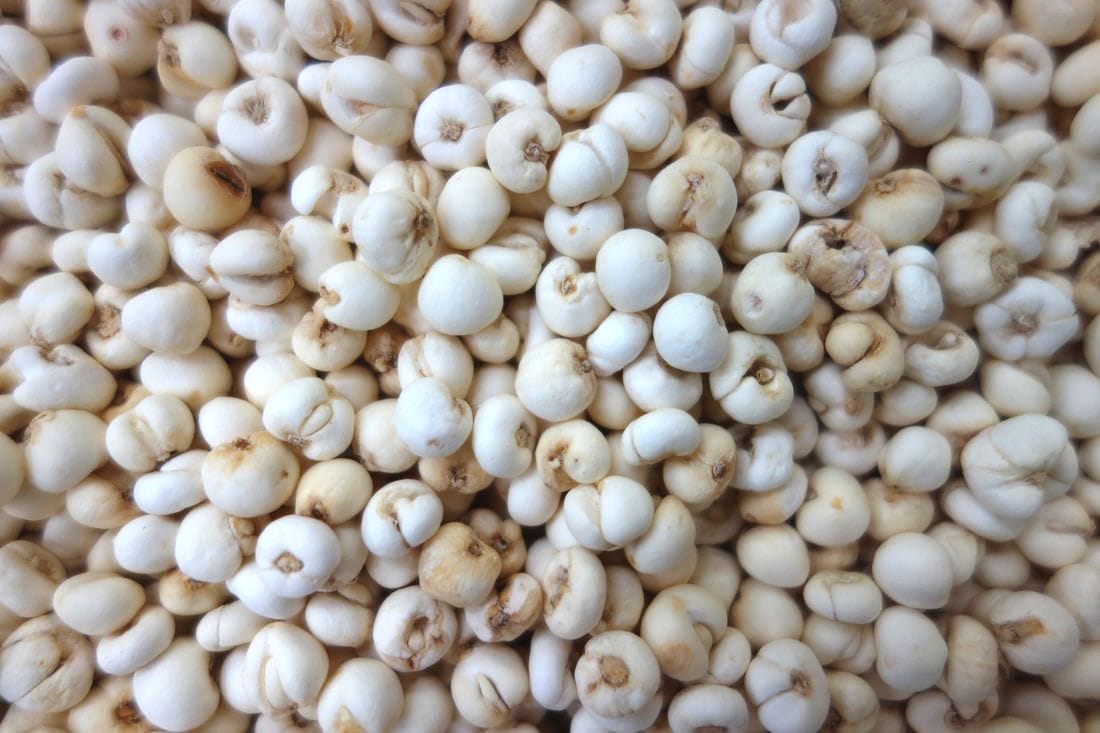
Fritillaria Bei Mu (Chengdu Medicine Market. Adam, 2017)
Botanical name:
Fritillaria spp.
A number of species are used in TCM:
- Chuan Bei Mu: F. cirrhosa (syn. F roylei), F. unibracteata, F. przewalskii, F delavayi
- Zhe Bei Mu: F. thunbergii (syn. F. verticillata var. thunbergii)
- Hubei Bei Mu: F. hupehensis
- Yi Bei Mu: F. walujewii, F. pallidiflora
- Ping Bei Mu: F. ussuriensis
The first 2 are most used and have similar, but distinctly different uses (see below)
In older TCM texts, these were all used synonymously.
F. cirrhosa and F. delavayi are used in Ayurveda and Tibetan Medicine.
Parts used:
Dried bulb
Temperature & Taste:
Cool, dry. Bitter
Chuan Bei Mu is less Cold, and also slightly Sweet, therefore more strengthening.
Zhe Bei Mu is more Cold and Bitter, therefore better to clear Heat.
Classification:
Uses:
1. Clears Phlegm-Heat, Stops Cough: (TCM, Ayurveda, Tibetan)
–Cough, chronic Cough, Cough with Blood-streaked sputum
–Bronchitis, Asthma, Tuberculosis
–Chuan Bei Mu (F. cirrhosa et. al.) is stronger for this function
2. Clears Phlegm-Heat, Reduces Masses:
–Phlegm-Heat nodes, nodules, swellings, Scrofula
–Breast Abscesses
–traditionally to promote Labor and expel the Placenta
–Zhi Bei Mu (F. thunbergii) is stronger for this function
3. Resists Poison, Heals Fractures: (Tibet)
–Fractures including Cranial Fractures
–nourishes the Bones and Marrow (TCM: Mingyi Bielu)
–Deficient Heat disorders
–Poisoning, Fever (Ayurveda, Tibetan)
–“Treates Epidemics” (TCM: Zhen Quan)
–“Fever and restlessness in cases of febrile diseases caused by Cold … Inflammation of the Throat” (Shen Nong Ben Cao Jing)
4. Nourishes Yin:
-regarded as strength and longevity promoting in Ayurveda. (F. cirrhosa)
-also regarded as nourishing and strengthening in TCM, but primarily for the Lungs.
-“It benefits bones and marrow” (Bie Lu)
5. Calms the Mind:
-benefits Memory, calms mental disorders (Tibet)
–“used to treat cases of Depression and Melancholy. It is very effective indeed”. (Chen Cheng)
6. Promotes Milks (TCM, Ayurveda):
-used to increase and enrich Milk production
7. Externally:
-applied to Wounds
-burn the root, powder and mix with oil. Apply to malgnant sores (Da Ming)
-“Grind the drug to powder, and apply it to treat eye nebulae and opacity” (Zhen Quan)
Difference between Chuan Bei Mu and Zhe Bei Mu
1. Chuan Bei Mu: more moistening and strengthening, better for dry and chronic Cough, Asthma and Tuberculosis with Lung weakness
2. Zhe Bei Mu: more effective for clearing Heat and dispersing Lumps. Better for acute Heat-type Cough with thick, yellow, hard-to-clear sputum and for Phlegm-Heat Lumps, Nodes and Scrofula.
Hubei Bei Mu and Yi Bei Mu are also listed separately in the Chinese Pharmacopoeia. They are less commonly used and are more similar to Zhe Bei Mu in effect, lacking the tonic qualities of Chuan Bei Mu
Use in Ayurveda and Tibetan Medicine
F. cirrhosa is used in TCM, Tibetan Medicine and Ayurveda, indicating that the medicine is potentially collected from the same species. In Ayurveda, it is regarded as strength-promoting, longevity enhancing, aphrodisiac, and a balancer of Dosas (Humors). It is most indicated for chronic Respiratory diseases as well as Tuberculosis and tissue wasting, and is used for sexual debility. From this, a couple of things can be noted. Firstly, F. cirrhosa is regarded as the more strengthening of the Fritillaries used in TCM, although their focus is on the Lungs. We can see, therefore, that Fritillaria has tonic properties beyond what it is used for in TCM.
Dose:
Decoction 3–9 grams
Powder: 2–5 grams
Substitute:
1. To clear Cold Phlegm and reduce Nodules, Pinellia Ban Xia can usually substitute
2. In Tibetan Medicine (Buryat), Lillium spp. is substituted. Lilium polyphyllum has been recommended as a substitute in Ayurveda. Lilium nanum is reportedly used in Nepal.
3. Roscoea purpurea (an orchid-like ginger rhizome) is an accepted substitute in Ayurveda.
4. Withania is used as a substitute in Ayurveda.
Preparation:
Generally not processed today. However, traditionally it was sometimes processed as follows:
Bake the root in willow ashes until it turns yellow. Remove the core which is the size of a grain of rice. Then stir-fry with glutinous rice until it turns yellow.
Main Combinations:
1. Cough
i. mix with sugar and hold in the mouth to stop Cough (Da Ming)
ii. with copious sputum, Fritillaria Chuan Bei Mu with Almond kernel (Xing Ren)
iii. acute Cough with Heat, Fritillaria Zhe Bei Mu with Forsythia Lian Qiao and Burdock seed (Niu Bang Zi)
iv. from Heat, Fritillaria Zhe Bei Mu with Coptis Huang Lian and Scutellaria Huang Qin
v. from Yin deficient Heat with sputum that is hard to clear, Fritillaria Chuan Bei Mu with Anemarrhena Zhi Mu, Soft Shelled Turtle (Bie Jia)
vi. Chronic Cough, grind Crab Shells (15 grams), Fritillara Bei Mu (30 grams), Platycodon Jie Geng and Gleditsia seeds (a little), form honey pills to be held in the mouth. (Ben Cao Gang Mu)
2. Cough, Bronchitis, Asthmatic Bronchitis, Pneumonia from Phlegm-Heat, Fritillaria Chuan Bei Mu, Antelope horn (Ling Yang Jiao), Cow Bile (Niu Dan), Musk (She Xiang), Aloeswood (Chen Xiang), Tabasheer (Tian Zhu Huang), calcined Borax (Duan Peng Sha). This is a patent medicine.
3. Scrofula, Abscess:
i. combine Fritillaria Chuan Bei Mu and Fritillaria Zhe Bei Mu
ii. Fritillaria Zhe Bei Mu with Figwort root (Xuan Shen), Self Heal (Xia Ku Cao)
iii. Fritillaria Zhe Bei Mu with Kelp (Kun Bu) and Sargassum (Hai Zao)
iv. Fritillaria Zhe Bei Mu with Dandelion (Pu Gong Ying) and Chrysanthemum flower (Ju Hua)
4. Cold Phlegm obstructing the Chest, Fritillaria Zhe Bei Mu with Platycodon Jie Geng and Croton seed (Ba Dou).
5. Goiter, Scrofula:
i. Fritillaria Zhe Bei Mu with Forsythia Lian Qiao.
ii. Fritillaria Zhe Bei Mu with Scrophularis Xuan Shen, Prunella Xia Ku Cao.
6. Promote Milk, Fritillaruia Bie Mu, Anemarrhena Zhi Mu and Oyster powder (equal parts), take 6 grams with Pig Trotter decoction.
7. Difficult Labor: “Grind seven pieces of the drug to powder, and wash down with wine to treat difficult labor and retention of placenta” (Zhen Quan)
Major Formula:
TCM:
Bai He Gu Jin Tang
Bei Mu Gua Lou San
Bo Ying Compound
Ding Xian Wan
Er Mu San
Jiu Xian San
Ling Jiao Gou Teng Tang
Qing Fei Tang
Ren Shen Ge Jie San
Sang Xing Tang
Yang Yin Qing Fei Tang
Xiao Luo Wan
Zhen Ren Huo Ming Yin
Ayurveda:
Sudarshan Churna (Auspicious Sight Powder)
Cautions:
1. Not used for Cold-Phlegm disorders (unless corrected).
2. Fritillaria is traditionally considered Incompatible with Aconite
Endangered Status:
Fritillaria spp. listed above are not on CITES lists of endangered species, however, some species are endangered, including F. cirrhosa. It is a protected plant in China and is recognised as critically endangered in India. However, various species of Fritllaria are farmed on a massive scale for medicine in China.
Main Preparations used:
Click the above Tabs for more information on this medicine
GENERAL / REVIEW
–Natural drug sources for respiratory diseases from Fritillaria: chemical and biological analyses
–A Systematic Review on Traditional Uses, Sources, Phytochemistry, Pharmacology, Pharmacokinetics, and Toxicity of Fritillariae Cirrhosae Bulbus
–Bulbus Fritillariae Cirrhosae as a Respiratory Medicine: Is There a Potential Drug in the Treatment of COVID-19?
–Fritillariae Thunbergii Bulbus: Traditional Uses, Phytochemistry, Pharmacodynamics, Pharmacokinetics and Toxicity
ANTI-INFLAMMATORY
–Anti-inflammatory effects of Fritillaria thunbergii Miquel extracts in LPS-stimulated murine macrophage RAW 264.7 cells
COPD
–The Isosteroid Alkaloid Imperialine from Bulbs of Fritillaria cirrhosa Mitigates Pulmonary Functional and Structural Impairment and Suppresses Inflammatory Response in a COPD-Like Rat Model
ANTI-TUMOR / ANTI-CANCER
–Evaluation of antitumor property of extracts and steroidal alkaloids from the cultivated Bulbus Fritillariae ussuriensis and preliminary investigation of its mechanism of action
–Fritillariae Thunbergii Bulbus: Traditional Uses, Phytochemistry, Pharmacodynamics, Pharmacokinetics and Toxicity
You must be logged in to view this content, please login. If you're not a member then Click this link to subscribe

“After taking the drug, the patient will no longer feel hungry, and may even stop eating” (Tao Hong Jiang)