Echinops, Camel’s Thistle
Globe Thistle, Camel Thorn
Qasa-Barith, R`ai al-Jamal (Arabic)
Barham Dandi , Unta Katera (Unani)
Utkantaka, Brahmadandi (Ayurveda)
Yu Zhou Lou Lu (TCM)
Spyang tsher sngon po (Tibetan Medicine)

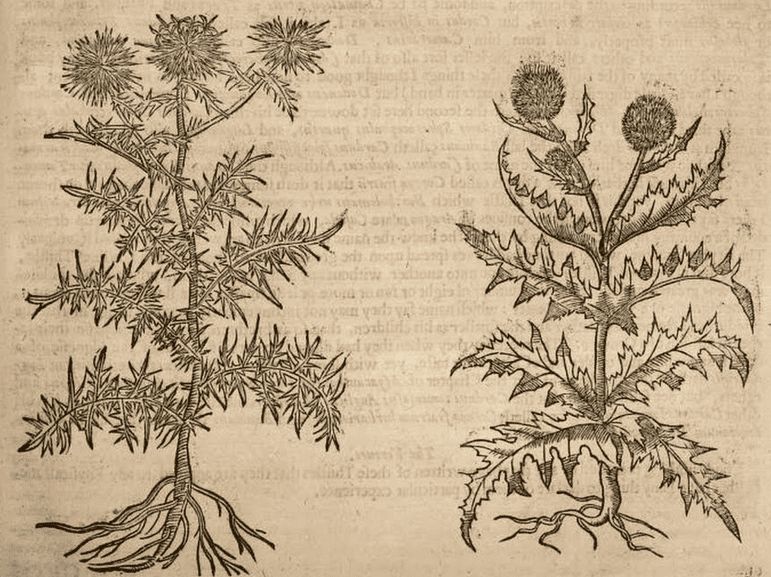
Greater and Lesser Globe Thistle
Theatrum Botanicum, Parkinson, 1640
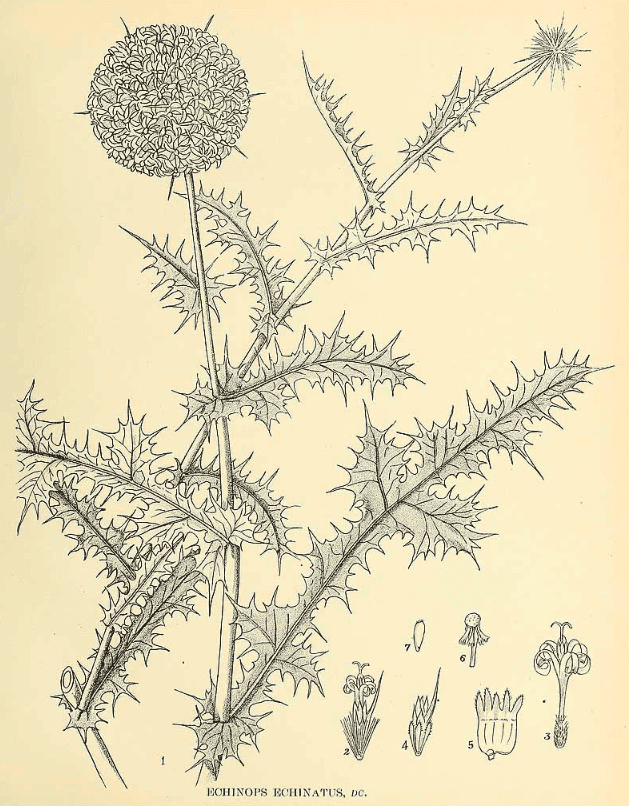
Echinops echinatus
K.R. Kirtikar, B.D. Basu, Indian medicinal plants (1918)
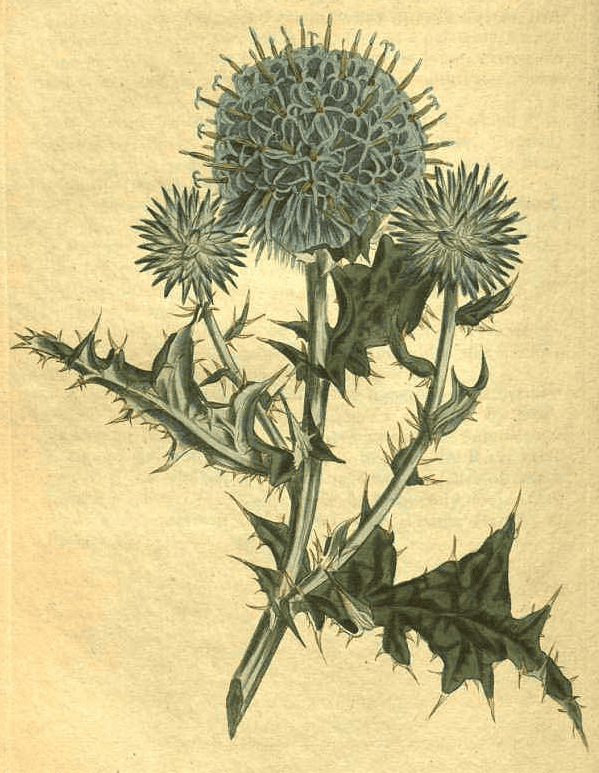
Echinops ritro
Curtis’s Botanical Magazine (1806)
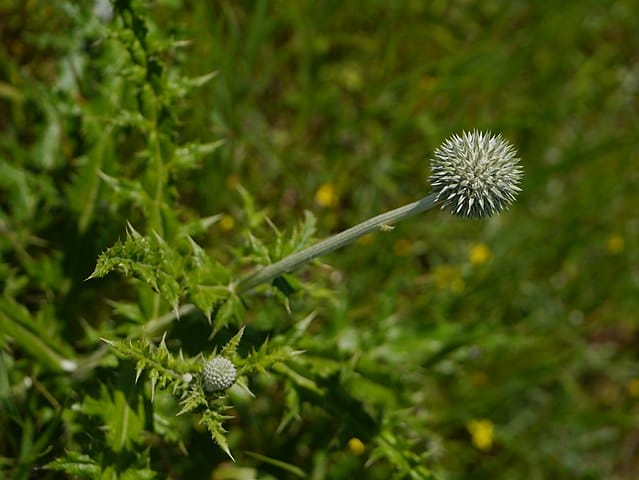
Echinops echinatus
(Photo by Dinesh Valke) (Wikimedia)
Botanical name:
Echinops echinatus
E. ritro (Small Globe Thistle) and E. ruthenicus has also been used
Parkinson listed several Globe Thistles:
- Great Globe Thistle
- Lesser Globe Thistle (probably E. ritro)
- Smallest Globe Thistle with Most Prickly Leaves
- Arabian Globe Thistle
In TCM, several Echinops spp. are used:
- E. grijsii (East China Globe Thistle)
- E. ritro (Small Globe Thistle, used in Xin Jiang)
- E. latifolius (syn. E. dahuricus, E. gmelinii, Sphaerocephalus dauricus)
Tibetan medicine uses E. dahuricus and E. sphaerocephalus
As can be seen, at leats one species (Echinops ritro) is common to both the Western tradition and TCM.
Parts used:
Herb, root
Temperature & Taste:
Very Warm, Dry. (Unani)
Regarded as Cool in TCM
Constituents:
Alkaloids: echinopsine, echinopsidine and echinozolinone
Taraxasterol acetate (potent anti-inflammatory)
Uses:
1. Strengthens Brain and Nerves: (Unani)
-believed to strengthen the Brain; enhances Intellect
-Nerve tonic; Paralysis
2. Warms and Strengthens the Kidneys: (Unani)
-Seminal Debility, Impotence
-regarded as Aphrodisiac
-Hysteria
3. Resists Poison:
-Boils, Pimples, Pustules, Scabies
-cough with Hoarseness
-chronic persistent Fever
-Scrofula, Syphilis
-“It is immensely useful for Rabies”. (Avicenna)
-the Chinese use it for skin inflammation, mastitis
4. Externally:
-topically to destroy maggots in wounds (of cattle etc)
-topically to kill Lice
Dose
1. Taken with Milk as a tonic to Body and Brain (Unani)
2. In our opinion, this herb should only be used in formula with other herbs, and only in pills or powders. Large doses or extended use are toxic.
In Decoction: 3–6 grams (6–12 grams fresh); In India, a 1 in 10 decoction is given in doses of half–2 fluid ounces.
Of the Powder: 1–3 grams
Juice expressed from the leaves: 30–60 drops
Comment:
1. Chinese use their varieties of Globe Thistle to clear Heat and Poison, primarily for skin conditions, boils, as well as for Mastitis and other Heat-Toxin swellings. While it is used for this purpose in Unani, it is regarded as warming, tonic, used for impotence and as a brain and nerve tonic. The principle alkaloid Echinopsine, found in all the above-mentioned species has been shown to have a strychnine-like effect, thereby supporting its use as a nerve tonic and aphrodisiac. It can also be pointed out that Nux Vomica is also regarded as cold in TCM.
2. This is an example of opposing reading of signatures. All Thistles were generally regarded as being under the planet Mars, and therefore, Warm or Hot and Dry. Conversely, TCM views the nett effect as Cold.
Correctives:
1. Honey
2. Licorice
Substitutes:
1. Sphaeranthus indicus
2. Chrozophora prostrata
3. In TCM, Echinops grijsiiand E. ritro are regarded as equivalent plants for Rhaponticum uniflorum (Lou Lu). These plants are primarily used to clear Heat and Toxin in skin diseases, abscesses, boils, scrofula etc. Rhaponticum uniflorum (Lou Lu) should be used in all cases where Echinops is required in TCM formulas, due to the toxicity of Echinops.
4. Echinops latifolia has occasionally been used as a substitute for Costus root in Russia. The latter may therefore be a suitable substitute in some cases.
Main Combinations:
1. Sexual Debility, Aphrodisiac:
i. Echinops with Tribulus, Curculigo, Withania
2. Paralysis, Echinops with Cumin, Frankincense, Clove, Nutmeg, Saffron
3. Skin diseases including Acne, Pustules, Boils, Echinops with Black Pepper (Unani)
4. See Rhaponticum uniflorum (Lou Lu) for more formulas used in TCM, as Echinops and Rhaponticum uniflorum are considered equivalent in effect in TCM.
Major Formulas:
Cautions:
1. Excessive use dries the body (damages Yin).
2. Not used in Pregnancy.
3. Avoid overdose.
Toxicity:
1. Echinopsine, the main alkaloid (found in West and Chinese species listed above) is toxic, having an effect similar to strychnine. Toxic doses can cause cardiac arrest.
2. Toxic reactions have occurred with doses of 30 grams
Main Preparations used:
You must be logged in to view this content, please login. If you're not a member then Click this link to subscribe