
Drosera, Sundew
Ros Solis, Lustwort, Youthwort, Herba Rorellae
Rtag ngu ་རྟག་ངུ་ (Tibet)
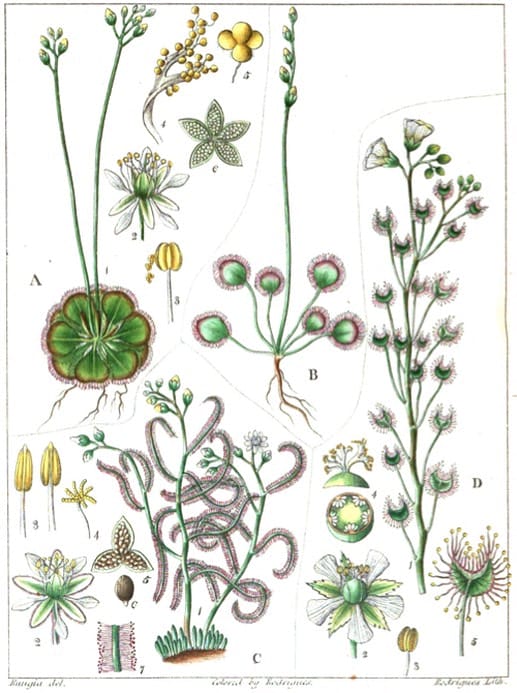
A. D. burmanni; B. D. intermedia; C. D. indica; D. D. peltata
Illustrations of Indian Botany, Wight, 1840
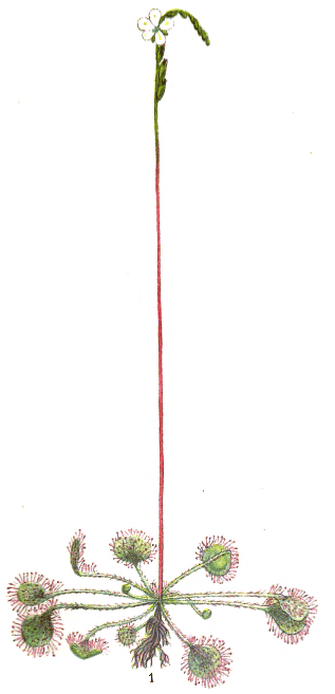
D. rotundifolia
Medicinal Plants, Millspaugh, 1892
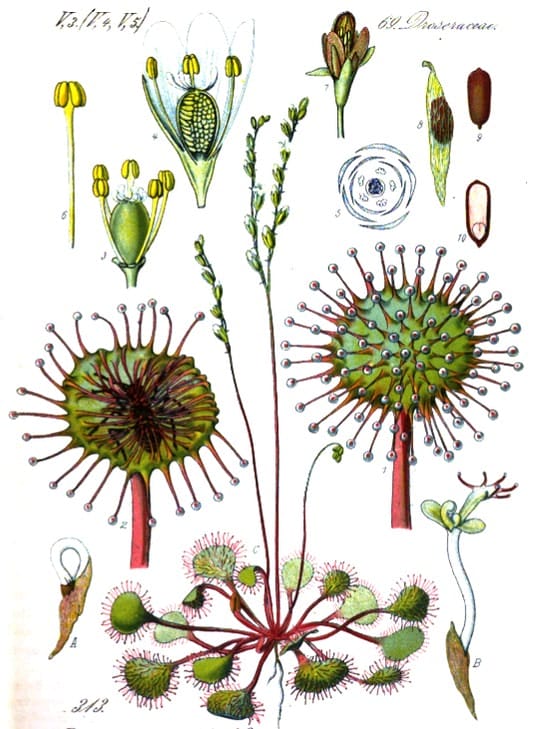
D. rotundifolia
Flora von Deutschland, Kohler, 1886
Botanical name:
Drosera spp.
1. D. rotundifolia (Common, European or Round-leaved Sundew)
2. D. peltata (Pale Sundew)
3. D. intermedia (Medium Sundew)
Round and Long-leaved varieties were known.
D. peltata (and others) are used in Tibetan Medicine.
Parts used:
Whole plant
The juice was also collected and used.
Temperature & Taste:
Warm, dry. Bitter, Pungent, Sour. Slightly Toxic.
“Dodonaes makes it Hot and Dry in the 4th Degree”
Salmon said “Sharp, biting, and caustic’”
Classifications
Uses:
1. Warms and Strengthens the Kidneys:
-impotence, lack of sex drive associated with cold and weak Kidneys
-juice and herb have traditionally been used as an Aphrodisiac as well as being used as a tonic in old age and to promote longevity
-restores vigor, balances the Three Humors; used in Rejuvenating compounds (Tibet)
-rheumatic pain of the back and legs (lower body) associated with Cold, Damp, and Weak Kidneys. (TCM)
-promotes menstruation when obstructed by cold.
-“breaks the Stone in the Bladder and Kidneys, and removes the Dropsy”. (The Compleat Herbal, Tournefort, 1719)
2. Stops Cough, Clears Phlegm:
-chronic coughs and wheezing; chronic Bronchitis or Asthma
-spasmodic coughs; persistent coughs with dry airways; uncontrollable tickling coughs; paroxysms of coughing with thick mucus
-Whooping Cough; Cough of Measles.
-traditionally used for consumption and phthisic, for which it may only be suitable in the early stages:
-“accounted good to help those that have a Salt Rheum distilling on the Lungs which causes consumption … held to be good for phthisis, wheezings, shortness of breath and Cough; also to heal ulcers in the Lungs”. (Culpeper)
–Grieves also lists it for “incipient phthisis and chronic Bronchitis”.
-“I use the Drosera as a specific in the cough attending and following Measles, especially where there is dryness of the air-passages, and much irritation of the nervous”. (Scudder, Specific Medicine, 1870)
-“The cough is expulsive as from irritation that can not be controlled; the cough of Measles; Whooping-cough” (Thomas, The Eclectic Practice of Medicine, 1907).
3. Settles Wind, Comforts the Heart:
-Epilepsy; Hypertension
-Arteriosclerosis in modern times
-Temporal Headache (TCM)
-poor functioning of the sense organs (Tibet)
4. Resists Poison:
-Plague, Fevers and Influenza. (Salmon)
5. Warms the Stomach:
-weakness or irritability of the stomach, nausea and upset stomach.
-stomach Ulcers and Gastritis.
6. Externally:
-the fresh leaves were bruised with salt and applied to raise blisters.
-the distilled water is good externally for old Ulcers and Fistulas
-“The juice destroys Warts and Corns, if a little be frequently put upon them”. (Culpeper)
-“Laid on the Abdomen it is said to hasten the Birth”. (The Compleat Herbal, Tournefort, 1719)
-“held in the Mouth, to ease the Toothache”. (Distilled Water or fresh Herb)
-the fresh herb put in a bag and laid to the chest was used to stop a Blood nose.
-“hung about the Neck, to ease Madness”. (Schroder)
Dose:
Start with small doses and build up gradually
Infusion: 1–3 grams;
Tincture (1:5 in 60% alcohol): ½–1 ml;
–Two fluid drams of the saturated tincture can be added to 4 fluid drams of water or wine, and this can be taken in teaspoonful doses.
–For Children (4–8 years old) 2 drops may be given in a little water several times daily for Whooping Cough; some recommended diluting 1 part tincture to 9 parts water, this being given in 3–5 drops doses for Whooping Cough;
–4–10 drops is given in a little water 2 or 3 times daily for several weeks in the beginning of consumption.
Fluid Extract (1:1 in 25% alcohol): ½–2 mls (or 5–20 drops);
Solid Extract: 2–5 grains
Distilled Water: 2–3 oz.
In TCM, the whole fresh plant is made into a paste with water, and these are rolled into small pills. These may then be placed over sore parts and stuck on with plaster. Alternatively, 1–4 of these small pills may be taken internally (Barefoot Doctors Manual).
Main Combinations:
Regarded as synergistic with Thyme (Weiss)
1. Whooping Cough, Bronchitis:
i. Weiss suggests Thyme and Sundew to be synergistic in effect when used for the Lungs; especially for Whooping Cough
ii. Sundew, Thyme, Cowslip (Meyer)
iii. Sundew with Violet and Peony root (Kroeber)
iv. Sundew with Elder flower, Lance-leaf Plantain and Heartsease (Kneipp)
v. Sundew with Thyme, Licorice, Lance-leaf Plantain, Eucalyptus (Peyer)
vi. Sundew with Peppermint, Cowslip, Soapwort, Violet root, Thyme, Mullein
2. Asthma, Sundew has been combined with Pill-Bearing Spurge
3. Asthmatic Bronchitis, Sundew with Polygala amara, Horehound, Tansy, Germander, Fennel seed (Kroeber)
4. To Warm the Kidneys, Sundew with Cinnamon, Cloves, Mace, Ginger, Nutmeg (as in Rosa Solis)
5. Consumption, to preserve from Epidemics, and for Palpitations, Sundew with Licorice, Nutmeg, Cinnamon, Sandalwood, Aniseed, Coriander, Rose, Ginger, Clove
6. Anemia, Sundew, Lycium Gou Qi Zi, Soloman’s Seal, Asparagus root, Angelica glauca, Mirabilis (or Withania) (as in Lycium 6 of Tibetan Medicine)
Cautions:
1. Avoid overdose or long-term use
2. Not suitable for Yin deficiency or Yin deficient Heat conditions.
From Gerard:
‘The later Physicians have thought this herb to be a rare and singular remedy for all those that be in a Consumption of the Lungs, and especially the distilled water thereof: for as the herb doth keep and hold fast the moisture and dew, and so fast, that the extreme drying heat of the Sun cannot consume and waste away the same: so likewise men thought that herewith the natural and radical humidity in mens bodies is preserved and cherished. But the use thereof doth otherwise teach, and reason showeth the contrarie: for seeing it is an extreme biting herb, and that the distilled water is not altogether without this biting quality, it cannot be taken with safety: for it hath also been observed, that they have sooner perished that used the distilled water hereof, than those that abstained from it, and have followed the right and ordinate course of diet’.
Main Preparations used:
Tincture, Distilled Water (Simple and Compound)
1. Tincture of Sundew (“Tincture of the Sun“)
The liquid (‘dew’) that forms on the plant is collected from the plant and made into a tincture with Aqua Vitae. In reality, this was made by steeping the fresh plant in Aqua Vitae and repeating several times with fresh herb.
It strengthens the Head, Stomach and Liver, cures Hot Headaches, prevents and cures Plague, and is given for heat, pain and inflammation of the Eyes.
One or 2 spoonfuls “is of admirable Efficacy against the Stone”. (The Compleat Herbal, Tournefort, 1719)
“An excellent Pectoral, Alexipharmic, and Analeptic”. (Salmon)
2. Compound Tincture of Sundew
Put the herb in Aqua Vitae, add Cinnamon, Clove, Mace, Ginger, Nutmeg, with a little sugar and Musk. Stop the glass and leave in the sun for 10 days.
This was regarded as a warming, strengthening tonic. (Gerard)
3. Distilled Water of Sundew
“Water of Rosa Solis, which in distilling comes yellow, as Water of Saffron, which is strange”. This occurs when gathered at the rising of the Sun, in the decrease of the Moon. (Royal Chemistry, 1670)
4. Spirit of Sundew (“Rosa Solis“)
“it strengthens and nourishes the Body, especiaIly if it be distilled with Wine”. (Gerard)
Click the above Tabs for more information on this medicine
-“This Genus is called Rosa Solis because there is always to be found on it, even in the most excessive Heat of the Sun, Drops of Water in the hollow Places of the Leaves, as if it were a Dew”. (The Compleat Herbal, Tournefort, 1719)
-“The leaves are continually moist in the hottest day, yea, the hotter the Sun shines, the Moister they are, the small hairs always holding this moisture” (Culpeper). This fact was much contemplated by the old Alchemists who called the Plant Rosa Solis and Sun Dew for this reason, believing the Sun was responsible for the dew. This posed a paradox to the old Alchemists as the Hot and Dry Sun seemed to be ‘supplying’ moisture to the Sun Dew, and was therefore very special.
–Gerard translates the Dutch name as Lustwort, explaining this was because “sheep and other cattle, if they do but only taste of it, are provoked to Lust… for it doth not move nor provoke cattle to lust, for that it increaseth the substance of the seed, but because through his sharp and biting quality it stirreth up a desire to lust, which before was dulled, and as it were asleep”.
-“Hung about the neck, it cures Madness”. (Salmon)
-These plants absorb nutrition from insects which are attracted to the sparkling, but very sticky ‘Dew’ on the finger-like leaf tips; the sap contains protein-digesting enzymes which converts the insects protein into more simple nitrogen rich plant food.
You must be logged in to view this content, please login. If you're not a member then Click this link to subscribe


Its use may darken the urine.