Dictamnus, White Dittany, Bai Xian Pi 白鲜皮
Polemonium of the ancients; Fraxinella
Bai Xian Pi (Root-bark of the Chinese Dittany)
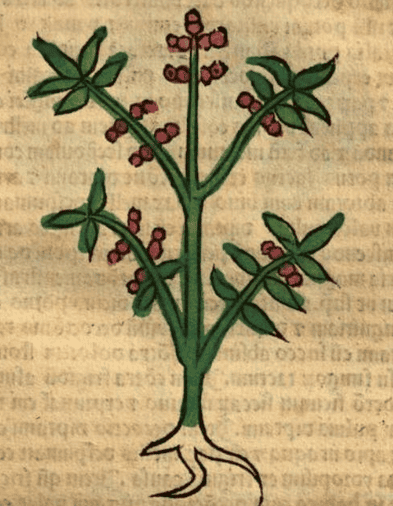
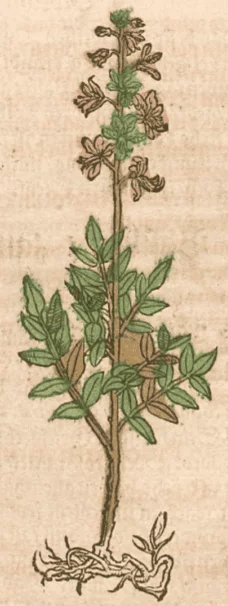
White Dittany
Krauterbuch, Lonitzer, 1578
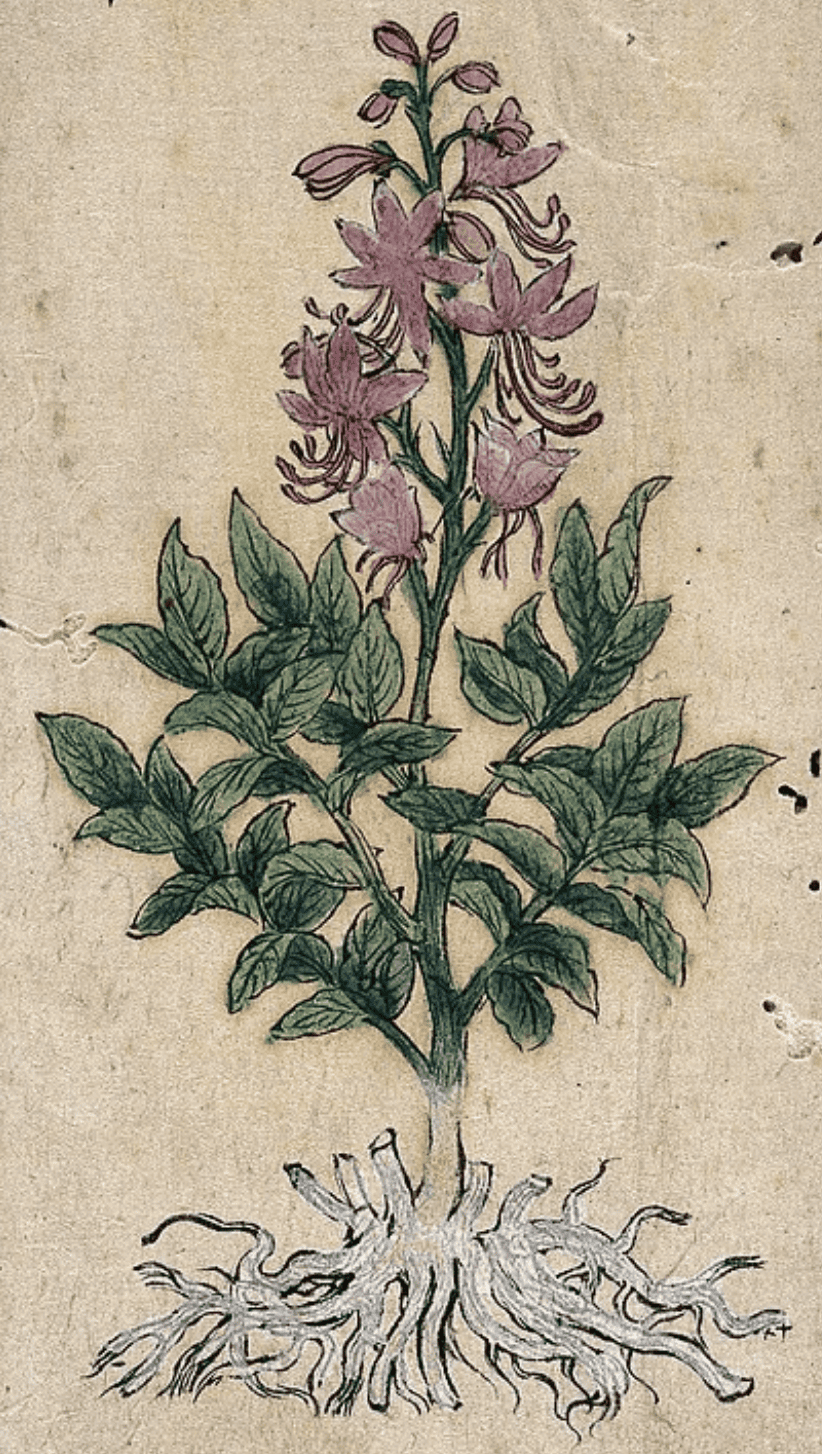
Dictamnus Bai Xian Pi
Japanese Herbal, 17trh Century (Welcome)
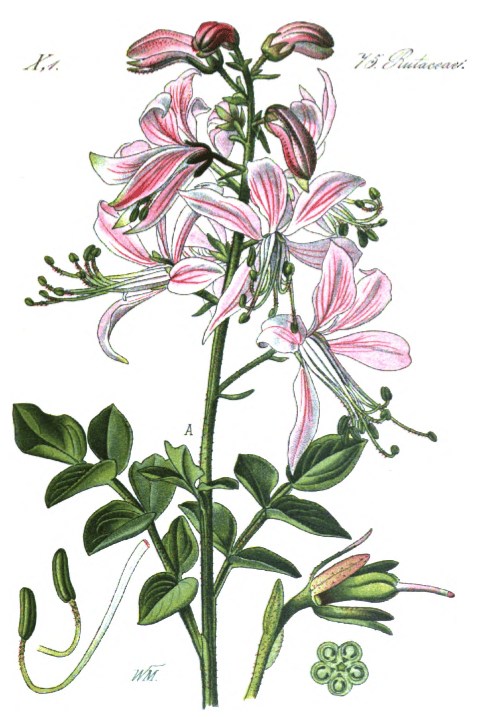
Dictamnus albus
Flora von Deutschland (21), Kohler, 1885
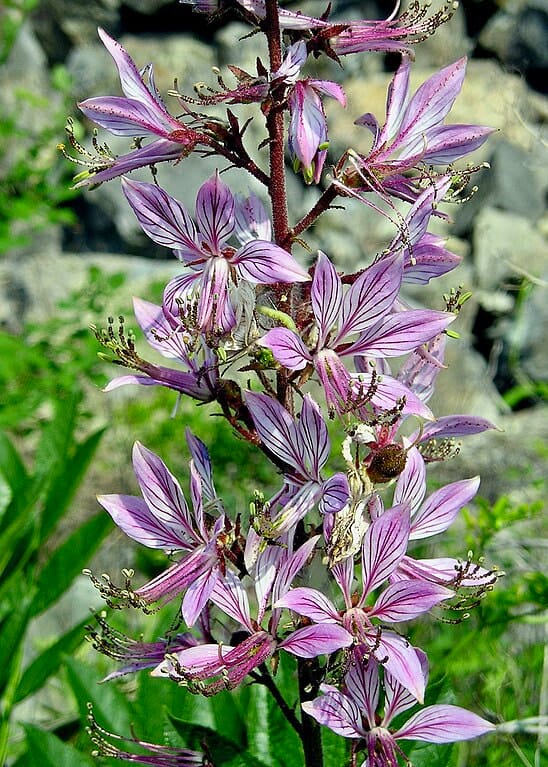
Dictamnus dasycarpus
(Photo by Dr. Alexey Yakovlev) (Wikimedia)
Botanical name:
Dictamnus spp.
- D. albus (syn. D. fraxinella, Fraxinella dictamnus) (West)
- D. hispanicus (West)
- D. dasycarpus (syn. Dictamnus albus subsp. dasycarpus) and D. angustifolius are the Chinese White Dittany (TCM)
A number of species were known and used in the West.
Parts used:
Root; Chinese use the Root-bark
Temperature & Taste:
Cold, dry. Bitter (TCM)
Considered Warm to Very Warm in the West.
“Hot and dry upto the third degree” (Avicenna)
Classifications:
2F. PURIFYING 2M. DRAWING
3A. SUDORIFICS & DIAPHORETICS 3C. ALEXIPHARMICS 3D. CORDIALS & CARDIACS 3G. EMMENAGOGUE
4c. CARDIAC
Preparers and Purgers of Melancholy
TCM:
B. Clear Heat and Toxin
Uses:
1. Clears Wind-Heat, Resists Poison (West, TCM);
-Infectious and Epidemic diseases
-Venomous Bites and Poisons
–diseases of various kinds due to Wind-Heat (Zhen Quan)
-“treats Epidemics” (Da Ming)
-“The juice and wine are drunk against poisons”. (Dorsetn, 1540)
-“useful against pestilential Contagions”. (Tournefort, 1730)
-“good against Poison, and the Stings of venomous Animals”. (Matthiolus)
2. Clears Heat from the Blood (TCM, West):
-Eczema, Dermatosis, Urticaria, Scabies, Pustules, Boils etc.
-skin inflammations with Yellow Watery discharge (Chinese Pharmacopoeia)
3. Clears Heat and Damp (TCM, West):
-Jaundice; Hepatitis (TCM, West)
-obstruction of Urine, water retention
-distilled water was used for Stones (Lonicerus)
-acute Rheumatic Arthralgia (Chinese Pharmacopoeia); used for joint diseases in East and West
-Vaginal pruritus with discharge (TCM)
-“beneficial for water between the skin.” (Dorsetn, 1540)
-“a drug for all types of Jaundice”. (Li Shi Zhen)
-“difficulty in moving the extremities” (Ming Yi Bie Lu)
4. Clears Phlegm, Stops Cough and Wheezing (TCM, West):
-Cough, Asthma, Wheezing
-“Dittany expels the viscous fluids from the Chest and Lungs” (Avicenna)
-“Dittany mixed with honey and taken, cures Coughs”. (Dorsetn, 1540)
-“It relieves coughing due to disorder of the Lung” (Su Song)
5. Clears Heat, Calms the Heart:
-Cordial
-Melancholy, Epilepsy, Neurasthenia, Nervousness, Hysteria
-Cheers the Spirits; “revives a languishing nature”
-“very good in weaknesses, if it be given in wine”. (Boerhaave)
6. Moves the Blood, Promotes Menstruation (West):
-benefits the Womb
-clears obstructions, promotes Menstruation; Amenorrhea, Dysmenorrhea (West)
-it (Dictamnus Bai Xian Pi) has been used for absent or delayed menstruation in Chinese Folk medicine.
-promotes Birth and Afterbirth
-has been used for Birth Control in India.
-“it acts as an emmenagogue, and is an expellent of the Foetus when dead or lying transversely in the uterus.” (Pliny)
–“Its oral use helps in clearing post-parturition Blood” (Avicenna)
-“Women with continuing pain after delivery”. (TCM, Bie lu)
-“When applied expels stillborn babies from the womb”. (Dorsetn, 1540)
7. Kills Worms
-used for Worms (1 dram of the root in Powder)
8. Externally:
-boiled in oil for Bruises, Aches, Sprains, Joint-pain etc.
-externally for inflammatory skin conditions, boils, rashes, carbuncles etc.
-powder with Honey was applied to Ulcers or Fistulas, including those in the corner of the Eyes
-“Dittany, instilled in the ears with milk, relieves pain.” (Dorsetn, 1540)
-powder with Honey was applied to Ulcers, Abscesses and Cancers of the Nose (Wirtzung)
-Extracts darts and thorns from the skin
-the Chinese Dittany is used topically for vaginal discharge with Itching.
Dose:
Decoction: 4 ½–9 grams
Powder: 1–3 grams
To promote menstruation and expel the afterbirth or a dead fetus, Pliny said the leaves were used.
Comment:
1. The Chinese Dittany Bai Xian Pi (root bark of D. dasycarpus) is Cold, dry, and Bitter. It is used primarily to clear Heat and Poison; used for Sores, Carbuncles and Rashes associated with Damp-Heat (red sores with lots of pus), including those associated with Wind (with itching). It is also used for Damp-Heat vaginal discharge with Pruritis. It is also classically used for Jaundice and Joints disorders.
2. Dictamnus dasycarpus has been given as a synonym of D. alba by some sources (The Plant List), while a synonym for D. dasycarpus is Dictamnus albus subsp. dasycarpus, showing the similarity between the Eastern and Western species.. Even the Chinese name of the herb Bai Xian represents the White (Bai) form of Dittany. The uses are similar, and while Western writers regard Dittany as Warm, the Chinese view it as Cold. Despite this, it also “mobilizes the Blood”, which perhaps explains its regard of being Warm in the West, as well as its Emmenagogue uses.
3. Western writers regarded White Dittany as being capable of inducing abortion, making it forbidden for use during Pregnancy. Interestingly, Chinese sources do not regard it as contraindicated during Pregnancy. This suggests the Blood-moving effects of the Western variety to be superior. Nevertheless, there is enough similarity in appearance, general uses and chemical composition to regard the Western and Chinese varieties as fairly synonymous in effect, especially when used in Traditional formulas. The fact that the plant has shown toxicity in susceptible individuals suggests it is wise to avoid during Pregnancy.
4. According to a famous Chinese Physician, Dictamnus Bai Xian Pi clears Wind-Heat from the Upper body (head and eyes) and Damp-Heat from the Spleen and Stomach (Rectification of the Meaning of Materia Medica, Zhang Shan-Lei)
Substitute:
1. Origanum dictamnus, Dittany of Crete: “It has the virtues of the former [White Dittany] (but not altogether so powerful) and is especially dedicated to the Womb’. (Salmon)
2. “a substitute for mint but is comparatively stronger” (Avicenna)
3. White Dittany was used as a substitute for Anthora.
Main Combinations:
Dittany is often combined with Angelica (West)
Gynecology & Obstetrics:
1. To promote Menstruation, or for Mola:
i. White Dittany, Mugwort, decocted in wine
ii. White Dittany, Mugwort, Southernwood decocted in wine (Villanova)
iii. White Dittany, Angelica, Saffron
iv. White Dittany, Myrrh, Pennyroyal
v. as a pessary, White Dittany, Myrrh, made into a pessary with Mugwort juice (Villanova)
2. Dysmenorrhea, Uterine growths, White Dittany with Myrrh, Lupin, Madder, Rue, Cumin, Asafetida (as in Troches of Myrrh)
3. Hysteria:
i. White Dittany with Balm and Valerian (Meyer)
ii. White Dittany, Cyperus rotundus, Orange peel
4. Metrorrhagia, White Dittany with Balm, Valerian, Mistletoe and Walnut leaf. (Finsterwalder)
5. To promote Birth:
i. take 2 drams of the Powder is taken wine.
ii. White Dittany, Cinnamon, Saffron
6. Expel the Afterbirth:
i. White Dittany, Mugwort, Southernwood decocted in wine (Villanova)
7. To expel a Dead Fetus:
i. White Dittany, Mugwort, Southernwood decocted in wine (Villanova)
ii. White Dittany powder expels a Dead Child, taken with wine, unless there is Fever, then it is taken with water. (The Treasury of Health, 1550)
iii. Dittany, Gentian, Birthwort, mixed with Mugwort juice (Dorsetn, 1540)
8. Postpartum:
i. “When that person experiences depletion to a degree that she is unable to ingest any other medication”, decoction of Dictamnus Bai Xian Pi, is used as a single herb. (Xiao Pin Fang)
ii. Debility following Birth, Dictamnus Bai Xian Pi with Sophora Ku Shen in decoction with wine added. (TCM)
Skin Diseases:
9. Red, Itchy skin lesions:
i. China root with White Dittany root (Bai Xian Pi) (TCM)
ii. Eczema, Psoriasis, White Dittany root (Bai Xian Pi) with Dandelion (Pu Gong Ying), Mume fruit, and Indian (Qing Dai) (as in Fu Fang Qing Dai Wan)
iii. Cicada shell (Chan Tui) with White Dittany (Bai Xian Pi), Saposhnikovia Fang Feng
iv. of the Genitals, Kochia Di Fu Zi with Dittany (Bai Xian Pi), Sophora Ku Shen
10. Psoriasis:
i. Psoriasis Vulgaris, White Dittany root (Bai Xian Pi) with Rehmannia Sheng Di, Paeonia Mu Dan Pi, Paeonia rubra Chi Shao Yao, Dang Gui (as in Xiao Yin Pian)
ii. Psoriasis, White Dittany root (Bai Xian Pi) with Sophora Ku Shen, Smilax Tu Fu Ling, Saposhnikovia Fang Feng, Licorice (as in Yin Xie Ling Gao)
iii. Sophora Ku Shen with Rehmannia Sheng Di, Paeonia Mu Dan Pi, Paeonia Chi Shao Yao, Dang Gui, Figwort (Xuan Shen), Burdock seed (Niu Ban Zi), White Dittany root (Bai Xian Pi), Saposhnikovia Fang Feng, Cicada shell (Chan Tui) (as in Xiao Yin Pian of the Chinese Pharmacopoeia)
iv. Externally for Psoriasis, prepared Castor seed, White Dittany (Bai Xian Pi), Carrot seed (He Shi), Phellodendron Huang Bai, Dang Gui, Rehmannia Sheng Di Huang, Realgar (Xiong Huang), made into a plaster with Beeswax
11. Vitiligo, White Dittany root (Bai Xian Pi) with Psoralen Bu Gu Zi, Astragalus Huang Qi, Ligusticum Chuan Xiong, Safllower (Hong Hua) (as in Bai Dian Feng Jiao Nang)
Urinary:
12. Edema from Cold, White Dittany with Celery seed (Herbarius latinus, Petri, 1485)
13. Stoppage of Urine, Stones: decoct Saxifrage, Pellitory of the Wall, Water Cress, White Dittany, Fennel seed, Aniseed in white wine; use as a fomentation over the bladder, or it can be injected into the bladder (Wirtzung)
Other:
14. Jaundice:
i. Dictamnus Bai Xian Pi with Artemesia Yin Chen Hao (TCM)
ii. White Dittany, Wormwood
15. Cold Asthma, decoct dry figs in wine, strain and take with powder of White Dittany. (Villanova)
16. Phthisis and Consumption, White Dittany, Angelica, Saffron, Laudanum and the 4 Cold Seeds (‘Proven’, Wirtzung)
17. Epilepsy:
i. White Dittany with Peony, Mistletoe, Valerian (as in Powder for Epilepsy)
ii. with a yellow color (ie. Jaundice), Dictamnus Bai Xian Pi with Artemesia Yin Chen Hao (TCM)
18. Strengthen the Heart, benefit the Memory, comfort Nature and strengthens the whole Body, Balm with Bugloss, Scorzonera, White Dittany, Rosemary, Blessed Thistle seed, Fennel seed, Cinnamon, Sandalwood (as in Syrup of Balm)
19. Against Poison: “The powder of Dittany mixed with Gentian and Birthwort in equal weight, when tempered with the wine in which Dictamnus is boiled, has all the virtue of Theriac”. (Dorsetn, 1540)
20. Stomach pain, White Dittany and Wormwood (Herbarius latinus, Petri, 1485)
21. Worms:
i. White Dittany (1 dram), form a Bolus with Syrup of Wormwood. (Tractatus de materia medica, Geoffroy, 1741)
ii. White Dittany with Gentian, Aloe, Wormseed, Bull Bile as a plaster applied to the umbilicus (Wirtzung)
Major Formulas:
Syrup of Balm (Fernelius)
Troches of Myrrh (Rhasis)
Electuary of Horehound Diaprassium
Confection of Hyacinth (Confectio de Hyacintho)
Orvietan Antidote
Electuary of Eggs (Maximilian)
Si Wu Xiao Feng Yin
Cautions:
1. Not used during Pregnancy. “Its oral intake or fumigation or use in the form of a suppository causes abortion” (Avicenna)
2. The related Chinese species has been found to induce severe allergic reaction in a very small percentage of people. It should be avoided in peoiple with Liver diseases, or those prone to hypersensitivity or allergies.
3. “may sometimes cause Hematuria” (Avicenna)
Toxicity
1. Hepatotoxic effects have been reported. Dictamnine (common to both European and Chinese species) has shown potential hepatotoxic effects.
–Dictamni Cortex powder-induced liver injury based on integrated evidence chain.
2. Two deaths (in the UK and New Zealand) have been reported with the use of Dictamnus dasycarpus. These cases are believed to have been associated with a rare hypersensitivity. (Bensky)
3. Mutagenic and Phototoxic effects have been reported (Duke)
Main Preparations used:
Distilled Water
Click the above Tabs for more information on this medicine
GENERAL / REVIEW
—An ethnopharmacological and historical analysis of “Dictamnus”, a European traditional herbal medicine.
—The traditional uses, phytochemistry, pharmacology and toxicology of Dictamnus dasycarpus: a review.
—Medicinal uses, phytochemistry and pharmacology of the genus Dictamnus (Rutaceae).
ANTIBACTERIAL
—Antibacterial and fungicidal activities of ethanol extracts of 38 species of plants
—Antimicrobial alkaloids from the root bark of Dictamnus dasycarpus.
ANTIFUNGAL
—Antibacterial and fungicidal activities of ethanol extracts of 38 species of plants
—Screening of antifungal activities of plant extracts against phytopathogenic fungi
ANTI-INFLAMMATORY
—Anti-inflammatory Limonoids From Cortex Dictamni.
—Anti-inflammatory quinoline alkaloids from the root bark of Dictamnus dasycarpus.
—Anti-inflammatory effects of a methanol extract of Dictamnus dasycarpus Turcz. root bark on imiquimod-induced psoriasis.
—Three new compounds from Dictamnus dasycarpus and their anti-inflammatory activities.
CAUSES BRONCHOCONSTRICTION
—Pharmacological and toxicological effects of gas plant (Dictamnus Albus L.)
SEDATIVE
—Pharmacological and toxicological effects of gas plant (Dictamnus Albus L.)
HYPOTENSIVE EFFECT
—Pharmacological and toxicological effects of gas plant (Dictamnus Albus L.)
NEUROPROTECTIVE
—Neuroprotective Constituents of Dictamnus dasycarpus Root Bark
—Neuroprotective effects of constituents of the root bark of Dictamnus dasycarpus in mouse hippocampal cells.
—Neuroprotective limonoids of root bark of Dictamnus dasycarpus.
ANTI-NEUROINFLAMMATORY
—Rapid identification, isolation, and evaluation on anti-neuroinflammatory activity of limonoids derivatives from the root bark of Dictamnus dasycarpus.
MAO INHIBITOR
—Monoamine oxidase inhibitory coumarins from the aerial parts of Dictamnus albus.
ANTIFERTILITY
—Antifertility principle of Dictamnus albus root bark.
CANCER
—[Chemical constituents from root barks of Dictamnus dasycarpus and their cytotoxic activities].
—Fraxinellone has anticancer activity in vivo by inhibiting programmed cell death-ligand 1 expression by reducing hypoxia-inducible factor-1α and STAT3.
GASTRIC
—Apoptosis of AGS human gastric adenocarcinoma cells by methanolic extract of Dictamnus.
LUNG
—Dictamnine, a novel c-Met inhibitor, suppresses the proliferation of lung cancer cells by downregulating the PI3K/AKT/mTOR and MAPK signaling pathways.
PANCREATIC
—Dictamnine inhibits pancreatic cancer cell growth and epithelial-mesenchymal transition by blocking the PI3K/AKT signaling pathway.
You must be logged in to view this content, please login. If you're not a member then Click this link to subscribe