
Convallaria, Lily of the Valley
May Lily
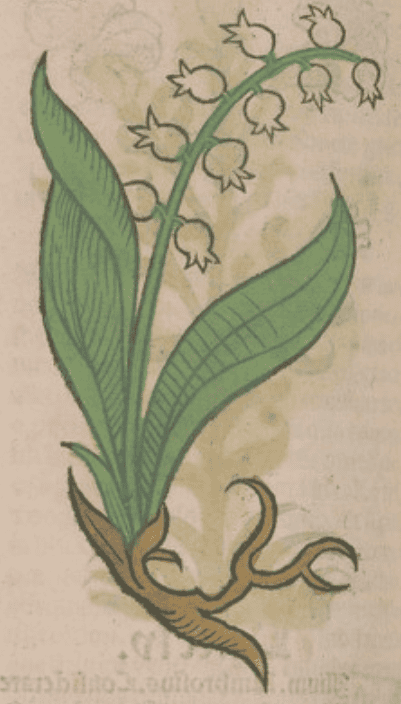
Ortus Sanitatis, Meydenbach, 1491
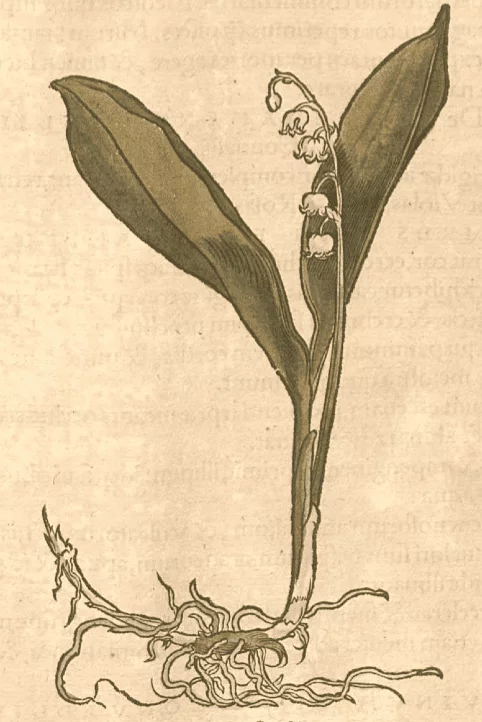
Herbarum Vivae Eicones, Otto Brunfels, 1530
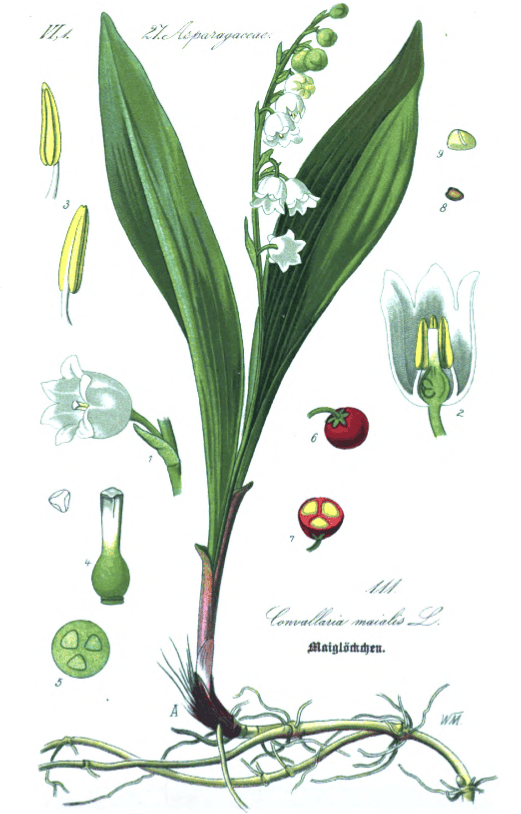
Flora von Deutschland, Kohler, 1886
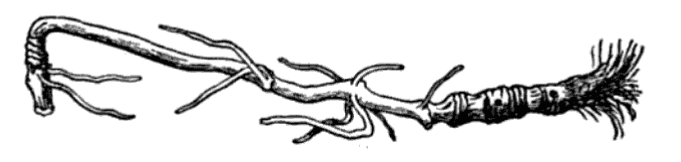
Dried Root
Notes on Pharmacognosy, Otto Augustus Wall, 1902
Botanical name:
Convallaria majalis
Parts used:
Root, Flower
Temperature & Taste:
Slightly Cool, dry. Bitter, Sweet
Tabernaemontanus classed it as Warm and dry, while such as Lonicerus, classed it as Cool and moist.
Classifications:
Uses:
1. Nourish the Heart, Calms the Spirit:
-insomnia, palpitations with anxiety, nervousness, melancholy
-benefits Brain, Reasoning and Memory (Tabernaemontanus)
-Flowers are better to calm the mind and spirit, and settle the Heart
2. Moves the Blood, Regulates the Heart:
-Hypertension, palpitations, arrhythmia, arteriosclerosis
-Valvular Heart diseases
-good substitute for Digitalis or Digoxin when poorly tolerated.
-regarded as good to condition the Heart of athletes
-“those who suffer from tremor of the Heart”. (Dorsetn, 1540)
-“Childbirth is accelerated, and the menstruation” (Dorsetn, 1540)
-“Heart irregularities due to mechanical impediments; mitral insufficiency; dropsy of cardiac origin; palpitation and vehement heart action, with arrhythmical movements, dyspnoea, and diminished arterial pressure. Quickened pulse with capillary obstruction”. (King’s)
-“Painful cardiac affections, with difficult breathing, excited heart’s action, palpitation and dropsy”. (Thomas, The Eclectic Practice of Medicine, 1907
3. Settles Wind, Calms the Mind and Nerves, Stops Spasms:
-used for diseases of the Head, Apoplexy, Paralysis, Migraine, Epilepsy, Fainting
-recovery after Strokes; loss of Speech
-good for confusion, amnesia and poor mental clarity
-benefits Memory; strengthens the Brain
4. Externally:
-powdered finely and used as a sneezing powder
-as an ointment for Ulcers, Burns and Scalds
-“It suppresses Scabies and Impetigo, without any ill effects: that is, you may apply some ointments with its water”. (Dorsetn, 1540)
-“It dulls the stings of venomous animals and stinging insects, so that they do not flare up: as are the stings of wasps, spiders, bees, and the like, if it is anointed”, (Dorsetn, 1540)
-“Eye doctors use it for inflammation and cloudiness of the eyes”. (Dorsetn, 1540)
Dose:
1. Traditionally, the distilled water, Spirit, or Decoction in Wine was the preferred mode of use.
2. Begin with lower doses (even 50mg) and increase as needed
3. Generally recommended to take regular breaks in treatment, alternating with other herbs like Hawthorn.
4. Best combined with herbs like Cinnamon, Hawthorn, Motherwort, Valerian etc.
5. Monitor during use for Heart irregularities.
Herb or Root in Powder: 150–500mg (daily maximum 500mg; 450mg according to British schedule)
Tincture (1:8): ½–1.2 mls (daily maximum 3.6 ml)
Fluid Extract (1:1) of the Root: ½ ml (8 drops)
Main Combinations:
1. Apoplexy, Lily of the Valley with Lavender, Cinnamon, Mace, Galangal, Mistle, Peony
2. Apoplexy, Dizziness, Epilepsy, Lily of the Valley with Peony, Red Coral, Pearl, Amber
3. Epilepsy:
i. Lily of the Valley flower with Lavender, Saffron, Amber, Camphor (Pharmacopee Usuelle, Louvain, 1821)
ii. Lily of the Valley flower with Lavender, Rosemary, Linden flower, Lavender, Nutmeg, Mistletoe, Peony (Dispensatorium medico pharmaceuticum Palatinatus, 1764)
4. Heart disease, Lily of the Valley with Hawthorn
5. Heart weakness:
i. following Fever, Lily of the Valley with Cinchona
ii. Lily of the Valley with Bugle, Motherwort, Hawthorn berry
6. Heart Arrhythmia:
i. Lily iof the Valley, Hawthorn, Motherwort
ii. Lily of the Valley, Sage, Saffron
7. Palpitations:
i. Lily of the Valley with Lavender, Valerian
ii. Lily of the Valley with Pulsatilla, Hawthorn
8. To promote Urine, Lily of the Valley with Juniper berry, Broom tops
9. Sneezing Powder:
i. Lily of the Valley flower with Orris
ii. Lily of the Valley flower with Orris, Marum, Marjoram
iii. Lily of the Valley flower with Marjoram and Cubeb
iv. Lily of the Valley flower with White Hellebore, Marjoram, Basil, Tobacco, Licorice, Cinnamon
v. Betony, Rosemary Sage, Lavender, Lily of the Valley flower, Rose, White Mustard, Clove
Cautions:
1. Toxic in overdose.
2. Not used in Pregnancy
Toxicity:
-Side effects can include headache, nausea, vomiting, stupor, distorted perception of color and cardiac arrhythmias. Rarely, these side effects can occur with therapeutic doses
-The red fruits are regarded as highly poisonous
-“the remedy is a perfectly safe one, and no harm has been known to occur from taking it experimentally in full and frequent doses; so that, in this respect, it is far preferable to the Fox Glove, which is apt to accumulate in the blood with poisonous results”. (Herbal Simples Approved for Modern Uses of Cure, W.T. Fernie, 1897)
Drug Interactions:
Simultaneous use of Quinidine, calcium salts, diuretics, laxatives and glucocorticoids enhances effects and side-effects of Convallaria.
Main Preparations used:
Distilled Water of the Flowers, Conserve of the Flowers, and an Infused Oil of the Flowers
1. Conserve of the Flowers:
i. Flowers (1 part), White Sugar (3 parts). Beat and mix well.
2. Distilled Water of Lily of the Valley Flowers
“Take the Flowers and steep them in New Wine for the space of a month; which being finished, take them out again and distil the wine 3 times over in a Limbeck. The wine is more precious than gold, for if any one that is troubled with Apoplexy drink thereof with six grains of Pepper and a little Lavender Water they shall not need fear it that month”. (Coles, 1657)
It strengthens the Brain and Senses. Restores Speech, helps Palsy, good for Apoplexy, and comforts the Heart and Spirits. Also for head and nerve disorders such as Epilepsy, Vertigo and Convulsions. Traditionally used to strengthen the Memory, and can be applied to Gout, Sprains, and Rheumatism. Dose: 1 spoonful
3. Spirit of Lily of the Valley Flowers.
“A Glass being filled with the flowers of May Lilies and set in an Ant Hill with the mouth close stopped for a month’s space and then taken out, ye shall find a clear liquor in the glass”.
A very good application to Gout.
Click the above Tabs for more information on this medicine
-The use of Lilly of the Valley in medicine goes back to at least 200 AD when it was used by Apuleius (4th Century).
-Said to have been very useful during the First World War for people poisoned by gas.
–THE ACTION OF CONVALLARIA MAJALIS. (Lancet, 1883)
–Proving of Convallaria Majalis (1885)
CARDIOTONIC / CARDIAC INSUFFICIENCY
–[Convallatoxin in cardiac insufficiency, with special reference to its immediate effects].
–[Convallatoxin treatment of severe heart insufficiency].
–[About the cardiotonic properties of convallatoxin].
PROGESTERONIC
–Determination of progesterone in vegetative organs and cell organelles of Convallaria majalis L. by radioimmunoassay.
URIC ACID, SIGNIFICANT REDUCTION OF
–Effect of Convallaria majalis on kidney function
EMPHYSEMA / BRONCHITIS
–[CONVALLATOXIN THERAPY OF COR PULMONALE IN CHRONIC EMPHYSEMA BRONCHITIS].
CYTOTOXIC
–Steroidal Glycosides from Convallaria majalis Whole Plants and Their Cytotoxic Activity.
–Cytotoxic effects of the cardenolide convallatoxin and its Na,K-ATPase regulation.
ANTI-ANGIOGENESIS
–Convallatoxin, a dual inducer of autophagy and apoptosis, inhibits angiogenesis in vitro and in vivo.
CANCER
BONE
–Convallatoxin suppresses osteosarcoma cell proliferation, migration, invasion, and enhances osteogenic differentiation by downregulating parathyroid hormone receptor 1 (PTHR1) expression and inactivating Wnt/beta-catenin pathway
BRAIN
–Convallatoxin inhibits proliferation and angiogenesis of glioma cells via regulating JAK/STAT3 pathway.
BREAST (Triple-Negative)
–Antitumor effects of naturally occurring cardiac glycosides convallatoxin and peruvoside on human ER+ and triple-negative breast cancers.
COLORECTAL
–Convallatoxin promotes apoptosis and inhibits proliferation and angiogenesis through crosstalk between JAK2/STAT3 (T705) and mTOR/STAT3 (S727) signaling pathways in colorectal cancer.
LUNG
–Inhibition of cell proliferation, invasion and migration by the cardenolides digitoxigenin monodigitoxoside and convallatoxin in human lung cancer cell line.
ANTI-ANGIOGENIC
–Anti-angiogenic activity of convallamaroside, the steroidal saponin isolated from the rhizomes and roots of Convallaria majalis L.
–Anti-Angiogenic Activity Of Convallamaroside
You must be logged in to view this content, please login. If you're not a member then Click this link to subscribe

“Lily of the valley strengthens the heart, brain, liver, kidneys, and spiritual organs, as they call them, and is therefore indicated for cardiac patients, those suffering from vertigo, epileptics, apoplectics, phrenics, and those with a brain prone to syncope”. (Dorsetn, 1540)