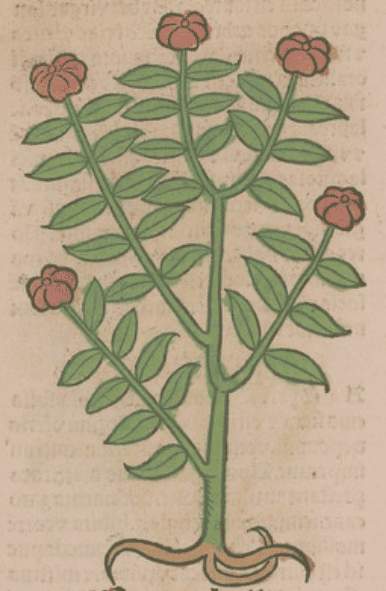
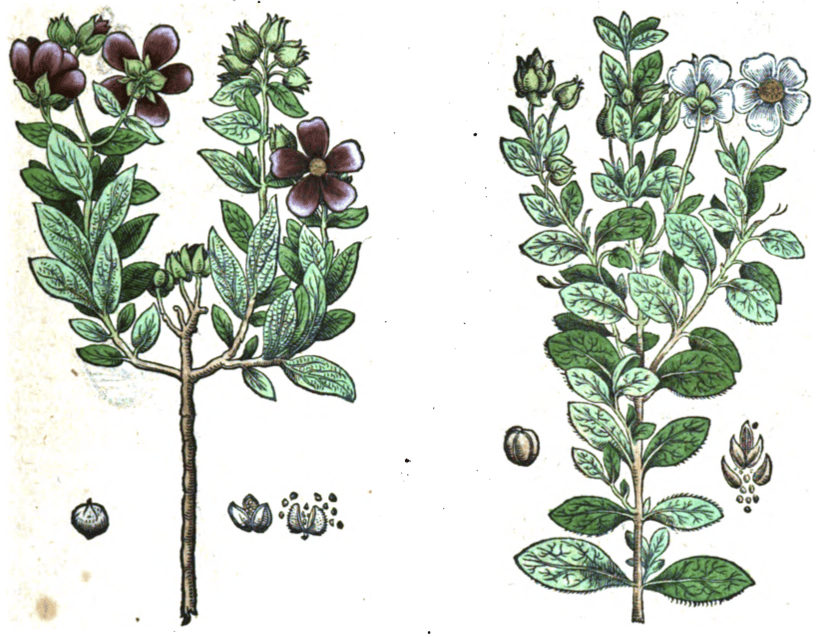
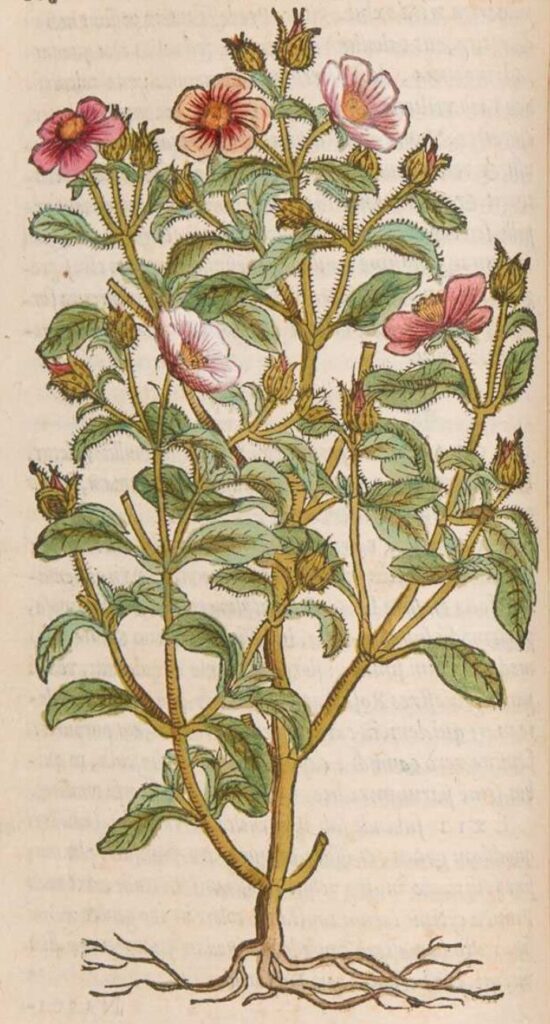
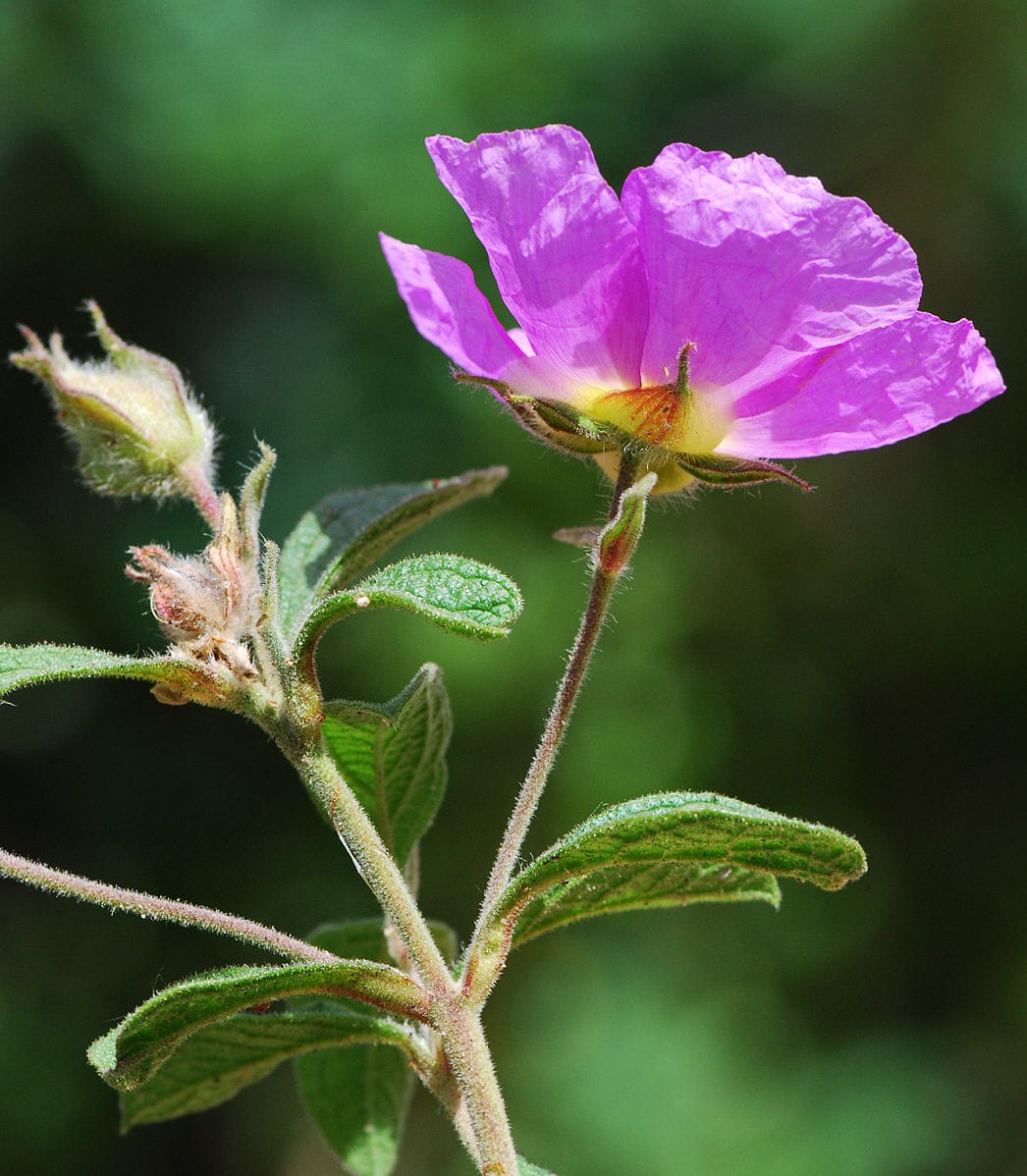
Cistus ladanifer, Labdanum
Rockrose
Ladan, Qissus (Unani)
Ladham (Arabic)

Botanical name:
Cistus creticus, C. ladanifer
Parts used:
Resin exuding spontaneously from the leaves and branches, or otherwise collected.
The best is dark, very aromatic, smells sweet when warmed, and becomes soft with warmth.
Traditionally there were 3 ways of collecting Labdanum
1. From Goats:
- Beard or Natural Labdanum: collected from Goat beards after they have eaten the herb (contains hair and other admixture)
- Liquid Labdanum: the above is heated by fire or the Sun until soften, pushed through a sieve and keep the best and most liquid part which were traditionally sold in little bladders.
- Rolled or Solid Labdanum: after the liquid has been expressed, the remainder is dried and formed into rolls. This is lower quality and has lots of admixture, sand, hair etc.
2. Greek: The Cistus plant is beaten with straps of leather which is then scraped off and formed into balls. This was said to be the best and sweetest smelling.
3. Spanish: the leaves of the Cistus plant are boiled in water, then the Labdanum sitting on top of the water is removed, and dried. This is the lowest quality, as a lot of the scent is lost in the boiling process.
Two varieties are found on the modern market:
- Labdanum in mass: soft, glutinant masses, blackish-red or blackish (best, but rare)
- Labdanum in tortis: flattened, twisted cylinders, dry, hard and brittle, blackish-grey in color
On the market today, the resin extracted by boiling the leafy twigs in most commonly available.
Avicenna said there are three varieties: Black, White and Red.
Temperature & Taste:
Warm, dry. Pungent, Bitter, Aromatic
“Labdanum is Hot in the last phase of the First degree and Dry in the Second degree”. (Avicenna)
Uses:
1. Opens the Orifices, Moves Qi, Clears Phlegm:
-suffocative Cough and Asthma from thick Phlegm, Catarrh
-Cough in children, applied in plasters to the chest and upper back
-used in perfumes and fumigations to uplift the Spirit, clear the Head and remove obstruction of Qi
-“There is nothing better for such as have a flatulent Melancholy”. (The Compleat Herbal, Tournefort, 1719).
2. Warms the Stomach, Moves Qi:
-pain, distention of the Stomach
-Vomiting
3. Moves the Blood, Regulates Uterus:
-obstruction of the Uterus, Hysteria
-Schirrus [Fibroids] of the Womb”. (Tournefort)
-helps cleanse the Afterbirth
-fumigation is used for Puerperal diseases (Unani)
-“good in a particular Manner for all the Diseases of the Womb”. (Tournefort)
4. Externally:
-added to plasters as a local warming stimulant, principally to warm the Stomach or Head
-in plasters for Hernia
-“very much celebrated in old and hollow Ulcers, which have hard Lips and very much swelled”. (The Compleat Herbal, Tournefort, 1719)
-helps retain and strengthen the hair, applied to the scalp
-removes Scars with repeated application
Dose:
Of the Dried Resin: 250mg–2 grams
Usually used in formula
In Folk Medicine 1–2 teaspoons of the dried leaves has been boiled in a cup of water to form a decoction which can be taken 2–3 times daily.
Corrective:
1. Sandalwood
2. Rose water
Substitute:
1. Indian Spikenard (Unani)
2. Storax
3. Labdanum is an accepted vegetable substitute for Ambergris and Musk in perfumery
Main Combinations:
1.. Asthma, Labdanum with Storax, Aloeswood, Camphor (as in Alipta Moschata of Nicholas)
2. Stomach pain, make pills with Labdanum and Bdellium
3. Hysteria, Labdanum with Asafetida, Rue
Externally:
4. As a fumigant, Labdanum with Olibanum, Myrrh, Amber, Storax, Benzoin
5. As a plaster to warm the Stomach, Labdanum with Olibanum, Storax, Benzoin
6. Plaster for Hernia. Labdanum with Turpentine, Mastic, Comfrey root, Cypress nuts, Armenian Earth
7. Chronic Headache, used as a snuff with Orris root. (Avicenna)
8. To nourish the strengthen the Hair, Labdanum with Storax, Saffron, Gum ammoniac, infused in wine and applied
9. To stop falling of hair, Labdanum, Wine, Myrrh, Oil of Myrtle. (Avicenna)
10. Toothache, prepared drops with Labdanum and Pomegranate peel, and drop into the opposite ear. (Avicenna)
Cautions:
1. Not used during pregnancy
2. Some people may have allergic reactions
3. “Labdanum is harmful for the nerves”. (Avicenna)
Toxicity:
LD50 in rats is 8980 mg/kg
Main Preparations used:
Click the above Tabs for more information on this medicine
You must be logged in to view this content, please login. If you're not a member then Click this link to subscribe