Chelidonium majus, Celandine
Hirundinaria or Swallow-wort
Bai Qu Cai 白屈菜 (TCM)
Stong ri zil pa སྟོང་རི་ཟིལ་པ་ (Tibetan)

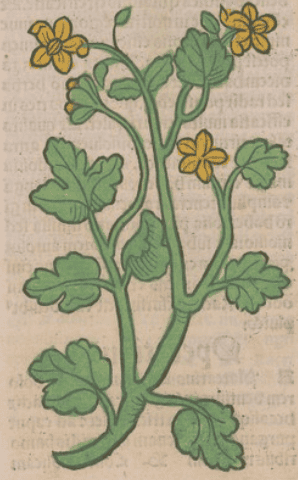
Ortus Sanitatis, Meydenbach, 1491
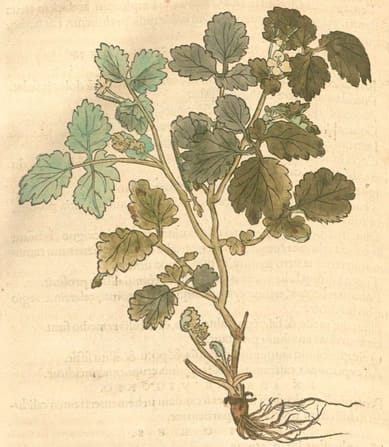
Herbarum Vivae Eicones, Otto Brunfels, 1530
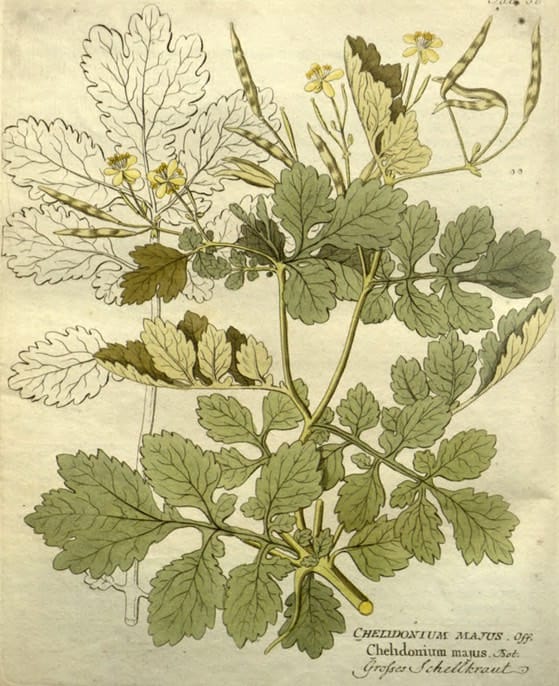
Icones Plantarum Medcio-oeconomico, Vietz, 1800
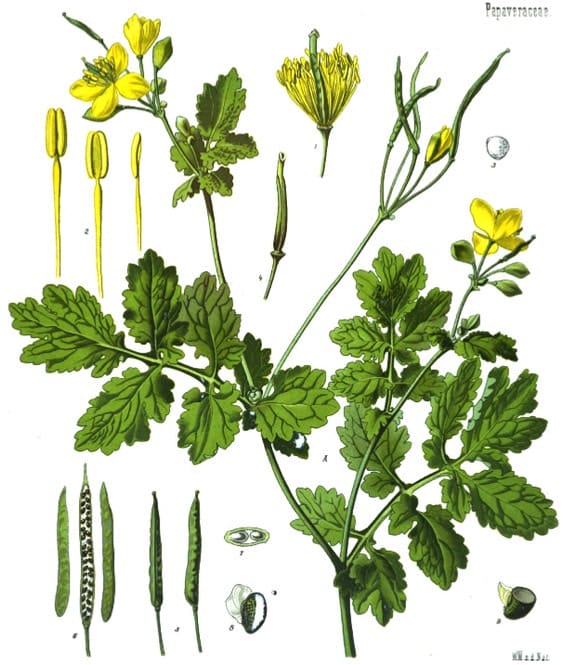
Kohler’s Medizinal Pflanzen, 1887
Botanical name:
Chelidonium majus
Parts used:
Whole plant in flower; Root
“The root is most efficacious; the herb is less so. The root is of greater efficacy”. (Villanova)
Temperature & Taste:
Cold, dry. Bitter, pungent. Slightly Toxic.
Regarded as Warm in the West. Some western writers said it was Hot in the 4th degree.
Chinese texts regard it as Cold, although some Chinese sources state it to be slightly Warm.
Classifications:
Uses:
1. Clears Liver Heat, Clears Damp-Heat, Opens Obstructions:
-’purges Choler (Bile) by stool and urine’ (Schroder);
-obstruction of the Liver and Spleen: used for Jaundice, Cholecystitis, Gall Stones
-Hepatitis, Liver Swelling
-root is especially commended for Jaundice (Unani)
-Chronic Gastritis, Gastro-duodenal Ulcers (TCM)
-promotes Urine; used for obstruction of the urine
-Headache, Migraine, Hypertension
-“very good for such as have Yellow Jaundice”. (Culpeper)
-“carries off Bile by Stool and Urine”. (The Compleat Herbal, Tournefort, 1719)
2. Promotes Sweat, Resists Poison:
-Cold, Flu, Infectious diseases (both to prevent and cure)
-often used in Antidotes and Preservatives
-used for Poisons
-Snake Bite (TCM)
3. Clears Heat, Stops Cough:
-heat-type Cough, chronic Bronchitis, Asthma, Whooping Cough
4. Moves the Blood, Clears Stasis:
-promotes Menstruation (the salts of the Roots of Celandine were also used).
-Palpitations, Angina and stabbing Chest Pain.
-Tumors, Cancers (Breast, Bowel, Kidney, Liver, Spleen, Stomach, Uterus, Mouth, Jaw and Testicles)
-Bruising, congealed Blood
-“To provoke menstruation and cleanse the uterus, a fomentation is often made from the water of the decoction”. (Dorsetn, 1540)
5. Clears the Sight:
-internally and topically to clear Heat from the Eyes, improve Eyesight and remove visual obstructions
-clears the Eyes, quickens the Sight (juice boiled with Honey and applied: Dioscorides)
-sore, red eyes, Conjunctivitis; Films and Cloudiness of the Eyes (juice applied with milk or the ointment applied to the eyelids)
-it has been used for Blindness
-Cataracts; the fresh juice, preserved with Olive oil is applied to advanced cases of Cataract daily for up to 4 months to cure (Meyer)
-in eye salves for Dim-sightedness since ancient Greece.
-often regarded as superior to Eyebright for the Eyes.
-“The juice, boiled in a brass vessel with honey, clears the eyes”. (Dorsetn, 1540)
6. Preserves Health:
-‘The Essence hereof preserves from old age, or makes age look youthful’ (Salmon)
-often credited with preserving youth.
7. Externally:
-externally for red eyes, for styes, sores and ulcers of them (diluted juice, infusion, or juice mixed with the distilled water, or the thickened juice which is best)
-Toothache (fresh herb chewed, root powder applied, or the herb boiled in wine used as a mouthwash)
-“Applied with wine or chewed, it soothes Toothache.”. (Dorsetn, 1540)
-juice is applied to Warts and Corns, Ringworm, Itchy Skin, Tinea, Eczema, Herpes
-applied to Scabies (West, TCM)
-topically to Tumors and Cancers
-internally and externally for chronic and filthy sores and ulcers, especially of the legs (Juice applied)
-“Its powder sprinkled on sores and ulcers cleanses and heals them.” (Dorsetn, 1540)
-“the powder of the root of Celandine mixed [with the right things] is good for fistulas of the mouth”. (Villanova)
-‘Some … writers believe that this agent is superior to Arnica or Hamamelis, as an external application to bruises and sprains’ (Ellingwood)
–Salmon said applied as a Cataplasm to the Breast hinders excessive menstruation
-Breast Cancer, applied topically; other Cancers such as of the Mouth or Face also.
-“its decoction mixed with honey is good against cancer of the mouth”. (Villanova)
Dose:
1. In Epidemics and Plague, it was taken with Vinegar
2. To move the Blood and open Obstructions, taken with Wine
Herb or Root in Decoction (or infusion): 2–6 grams (up to 10 or 15 grams), or 5–20 grams fresh
Tincture (1:10 in 45% alcohol): 2–4 or 5 mls. (up to 3 drams were traditionally given)
Fluid Extract (1:1 in 25% alcohol): 1–3, or 4 mls.
Fresh Juice: 10–20 drops
Dehydrated Juice: 200–500mg (up to 1 gram)
Used externally in washes, poultices, compresses, ointments, eye baths, gargles etc.
Comment:
Research has shown that only Celandine herb that is dried in a temperature of 80º C maintains alkaloid contents as that of the fresh herb; when it is dried between 20-50º C, up to half or more of the alkaloid content is lost. Further, there is a great loss of effect after about 6 months of storage of either the herb, or of preparations of it, meaning that this is an herb that should be grown by herbalists who wish to use it.
Correctives:
1. Honey
2. Tragacanth
3. Dodder
4. Aniseed
Main Combinations:
Infection, Epidemics:
1. Infection of Epidemic diseases (including Plague) Celandine with Rue, Blessed Thistle, Lemon peel, Zedoary, Angelica, Cinnamon (as in Bezoar Water)
2. To prevent and treat Epidemic diseases:
i. Celandine juice with 1 dram of Mithridate
ii. Celandine with Scorzonera, Dittany, Zedoary, Angelica, Gentian, Tormentil, Elecampane (as in Bezoardic Vinegar of Frankfurt)
iii. Celandine with Walnut, Juniper berry, Citron peel, Angelica, Gentian, Elecampane, Blessed Thistle, Saffron (as in Treacle Vinegar)
iv. Celandine with Rosemary, Rue, Sage, Mugwort, Wormwood, Balm, Blessed Thistle, Angelica, Tormentil, Gentian, Zedoary, Licorice (as in Plague Water)
Liver, Gall Bladder:
3. Jaundice:
i. Celandine with St. Johns wort and Saffron
ii. Celandine with Madder and Turmeric
iii. Celandine root (2 handfuls), Juniper berry (1 handful) (Gazophylacium Medico-Physicum, Woyts, 1746)
iv. Celandine with Madder, Wormwood, Centaury, Cinnamon, Saffron
4. Jaundice and Liver obstruction, Celandine with Aniseed, decocted in wine (Gerard)
5. Gall Stones, Cholecystitis:
i. Celandine with Barberry and Dandelion (BHP)
ii. Celandine with Wormwood, Hyssop, Horehound (as in Decoction for the Gall Bladder)
6. Paralysis; Salmon said the constant use of the Tincture (for 6 months) cured one of Paralysis
Eyes
7. For the eyes
i. “the juice of the herb is good to sharpen the Sight, for it cleanses and consumes away the slimy things that cleave about the ball of the eye and hinder the sight and especially being boiled with Honey in a brasen vessel, as Dioscorides teaches”. (Gerard)
ii. combine Celandine with Eyebright and Fennel seed
Other:
8. Gastrointestinal Pain, Gastritis: Celandine, Cuttlefish bone, Winter Melon seeds (TCM)
9. Fractures, decoct Celandine in wine with Pepper, add Honey, and drink for 9 days. (Physicians of Myddvai)
Externally:
10. As a bath for Eczema, Celandine with Elecampane, Artichoke leaf, Chicory, Broom flowers, Lavender and Nettle
11. Itch, Dandruff, Eczema, apply the juice Celandine (4 oz.), Olive oil 1 oz.) with Sulphur (1 ½ oz.)
12. Scabies, the juice is mixed with Sulphur and applied (Villanova)
13. Leprosy: “The juice of the root cures leprosy, if it is anointed, and then for nine days in a row, morning and evening, take syrup of Fumitory, and it helps without doubt”. (Dorsetn, 1540)
14. Topically for the Eyes:
i. Distilled water to apply to the Eyes: Celandine with Fennel seed, Rue, Eyebright, Clove, Camphor and Aloes; steeped in Wine and Rose water and distilled. For Heat, Pain, Redness, Inflammations, Cloudiness of the Eyes; also Fistulas, Cataracts etc.
ii. The distilled water mixed with Tutty (Zinc oxide) strengthens the Sight.
iii. “The juice, mixed with sal ammoniac, and instilled in the eyes, removes the white of the eyes, and provides clarity”. (Dorsetn, 1540)
15. Stye, Celandine juice mixed with honey and breast milk. (Natura exenterata, Philiatros, 1655)
16. Old and putrified Wounds, beat Celandine and apply with old Suet (The Secrets of Alexis, 1615)
17. Cancer of the Mouth:
i. “For cancer of the mouth or bone or nerves, the powder of its root is made with rose powder and vinegar, and boiled until medium thick, and the cancerous parts are anointed, it helps a lot.” (Dorsetn, 1540)
ii. the decoction mixed with Rose powder applied as a poultice (Villanova)
18. Breast Cancer, apply the juice with an equal amount of Goose dung
‘DEFENDER FROM DEATH’
Clove, Nutmeg, Cardamon, Cubeb, Mastic,
Ginger, Rosemary, Rue, Scabious 2 oz. each
Powder, and mix with equal parts Celandine juice and Brandy, enough to cover by 2 finger-widths, for 24 hours. Distil in a water bath with a gentle heat, and keep for use. (The Practise of the New and Old Phisicke, Gesner, 1599)
WATER OF YOUTH
Aloeswood, Clove, Ginger, Galangal,
Cardamon, Cubeb, Grains of Paradise,
Rhubarb, Cinnamon, Nutmegs, Aloe,
Calamus, Mace 2 drams each
Powder and seive, then add them to:
Celandine juice 2 pints
Juice of Sage, Bryony, Bugloss, Fumitory,
Rue, Betony, Mint, Borage, Fennel ½ pound each
Mix, add white wine, then distil. Dose: 1 spoonful in the summer, 2 spoonfuls in the winter. (The Practise of the New and Old Phisicke, Gesner, 1599)
Major Formulas:
Tincture of Celandine
Infusion for Jaundice (Riverius)
Decoction for Jaundice
Decoction for the Gall Bladder (2)
Decoction to Cleanse the Sight (Riverius)
Syrup of Betony (Bononiense)
Electuary for the Eyes (Grulingus)
Confection of Eyebright (Confectio Humain) (Mesue)
Cautions:
1. Avoid during pregnancy
2. Toxic in overdose
Toxicity
–Hepatotoxicity induced by greater celandine (Chelidonium majus L.): a review of the literature.
–Greater Celandine hepatotoxicity: a clinical review.
–Suspected Greater Celandine hepatotoxicity: liver-specific causality evaluation of published case reports from Europe.
Main Preparations used:
Extract/Dehydrated Juice, Distilled Water of the herb, Salt of the Ashes
1. Extract of Celandine:
i. Bruise a sufficient quantity of fresh Celandine with a little water; express the juice and immediately evaporate in a water-bath, stirring constantly. (Pharmacopoeia Wirtembergica, 1798)
ii. Bruise a sufficient quantity of fresh Celandine with a little water; express the juice and immediately evaporate in a water-bath until thick enough that a fourth part of powdered Celandine is required to make an extract.
iii. Celandine (1 lb.), Boiling Water (10 lbs.). Digest 24 hours, then boil for 2 hours, then strain; boil the residue again with Water (8 lbs.), and strain and press. Mix the 2 liquors and evaporate to the consistency of an extract. (Belgium Pharmacopoeia)
iv. Celandine juice, Brandy (or alcohol) equal parts
Mix well and steep them for a few days, then strain and decant the clear extract.
This is said by some to be the best preparation of Celandine for internal use. It is also a good preparation for external use on Warts etc.
Dose: 5-10 drops.
2. Tincture of Celandine:
Celandine leaves ½ lb.
Brandy 6 lbs.
Digest in a well stopped vessel for 3 days, strain and press out strongly; repeat the infusion with new leaves twice more, then keep the clarified liquor for use.
It quickens the Eyesight, cures Jaundice, and keeps back Old Age. (Salmon)
3. Distilled Water of Celandine:
i. Celandine (1 part), Water (2 parts). Distil two-thirds. (Pharmacopoeia Sardoa, 1773)
4. Honey of Celandine:
i. Honey (3 lbs.), Celandine Juice (2 lbs.). Boil together until no more scum is formed, then strain through flannel and evaporate to the consistency of Honey. Mostly used externally as a detergent. (Dispensatorium Fuldense, 1791)
Click the above Tabs for more information on this medicine
“It is called Chelidonium, from the Greek word Chelidon, which signifies a Swallow, because they say that if you put out the eyes of Young Swallows when they are in the nest, the old ones will recover them again with this herb”. (Culpeper)
-“Few plants have greater notoriety as folk remedies for Cancer”.. Celandine has had a long history and reputation as an anti-Cancer herb in Russia, used both internally and externally, as well as being injected topically.
-It was one of the 24 herbs of Mercer’s herbal.
-“This herb springeth in the time in which the Swallows, and also the Eagles, make their nests … and if the beforenamed herb be put upon the head of a sick man, if he should die, he shall sing anon with a loud voice, if not, he shall weep”. (Albertus)
–A Spell to Stop Going to Jail: Fill a small red flannel bag with Celandine, wear over the Heart so it touches your skin; replace the herb every three days. This is said to help prevent incarceration, or relieve the hardship of jail if it is inevitable.
“The herb CHELIDONTA, as Dioscorides and Pliny write, has its name in the Greek and Latin languages, from the Hirundinidae, because it comes out of the ground when the swallows come out: but when they leave, it withers: or because the Swallows with this herb restore life to their chicks in the nest, even with their eyes are cut off: whence it is also known, that it heals the eyes of men, the noble Herbarium Jerome calls this herb a gift from heaven to men, on account of the power and virtue with which it is cultivated” (Dorsetn, 1540)
For the CURE of ALL DISEASES.
“Also I have read, and it seems to be somewhat probable, that the herb, being gathered as I showed before [when the Sun is in Leo], and the Elements drawn apart from it by the art of the Alchymist, and after they are drawn apart rectified, the earthly quality still in rectifying them added to Terra Damnata (as alchymists call it), or Terra Sacratissima (as some philosophers call it) the elements so rectified are sufficient for the cure of all diseases, the humours offending being known, and the contrary elements given. It is an experiment worth the trying, and can do no harm’ (Culpeper)
This refers to the alchemical separation of a substance into either the 3 philosophical basics, Mercury, Salt and Sulphur, or, as in this case, into the 4 elements of Fire, Water, Earth and Air. This would give 4 preparations from the one plant, being Warm and dry, Cool and Moist, Cool and dry, and Warm and moist respectively. These are applied to a disease having opposite qualitites. If a disease was hot and dry, the ‘Water’ preparation, being cool and moist, would counteract it.
Paracelsus said the Quintessence “Renovates the Body”.
Salmon also noted “The Essence hereof preserves from old age, or makes age look youthful”.
Last Updated 02/24
GENERAL / REVIEW
–Chemical characterization of three different extracts obtained from Chelidonium majus L. (Greater celandine) with insights into their in vitro, in silico and network pharmacological properties.
–Pharmacological activities of Chelidonium majus L. (Papaveraceae).
–[The greater celandine (Chelidonium majus L.)–review of present knowledge].
–In vitro and in vivo studies of the metabolic activation of chelidonine.
–Greater Celandine’s Ups and Downs-21 Centuries of Medicinal Uses of Chelidonium majus From the Viewpoint of Today’s Pharmacology.
–[Study on the separation process of pharmacological active total alkaloids from Chelidonium majus L. growing in Georgia].
–Chelidonium majus–an integrative review: traditional knowledge versus modern findings.
ANTIBACTERIAL
–The Activity of Isoquinoline Alkaloids and Extracts from Chelidonium majus against Pathogenic Bacteria and Candida sp.
–Investigation of the composition and antibacterial activity of Ukrain™ drug using liquid chromatography techniques.
–Antibacterial alkaloids from chelidonium majus linn (papaveraceae) against clinical isolates of methicillin-resistant Staphylococcus aureus.
–Estimation of direct influence of Ukrain preparation on influenza viruses and the bacteria E. coli and S. aureus.
ANTI-VIRAL
–Milky Sap of Greater Celandine (Chelidonium majus L.) and Anti-Viral Properties.
–Estimation of direct influence of Ukrain preparation on influenza viruses and the bacteria E. coli and S. aureus.
–The Activity of Chelidonium majus L. Latex and Its Components on HPV Reveal Insights into the Antiviral Molecular Mechanism.
ANTI-FUNGAL
–In vitro antifungal activity and possible mechanisms of action of chelerythrine.
–The Activity of Isoquinoline Alkaloids and Extracts from Chelidonium majus against Pathogenic Bacteria and Candida sp.
–Antifungal activity of the benzo[c]phenanthridine alkaloids from Chelidonium majus Linn against resistant clinical yeast isolates.
COVID
–Greater celandine (Chelidonium majus L.) for COVID-19: A twenty-case series.
ANTI-INFLAMMATORY
–New lignanamides and alkaloids from Chelidonium majus and their anti-inflammation activity.
–Evaluation of anti-inflammatory and analgesic activities of extracts from herb of Chelidonium majus L.
ANTIOXIDANT
–Comparative analysis of metabolic variations, antioxidant potential and cytotoxic effects in different parts of Chelidonium majus L.
ANALGESIC
–Evaluation of anti-inflammatory and analgesic activities of extracts from herb of Chelidonium majus L.
ANTISPASMODIC
–Antispasmodic and relaxant activity of chelidonine, protopine, coptisine, and Chelidonium majus extracts on isolated guinea-pig ileum.
NEPHROPROTECTIVE
–Chelidonium majus leaves methanol extract and its chelidonine alkaloid ingredient reduce cadmium-induced nephrotoxicity in rats.
ULCERATIVE COLITIS
–Dihydroberberine, an isoquinoline alkaloid, exhibits protective effect against dextran sulfate sodium-induced ulcerative colitis in mice.
–The therapeutic effect of chelidonic acid on ulcerative colitis.
ENDOMETRIOSIS
–Effect of Protoberberine-Rich Fraction of Chelidonium majus L. on Endometriosis Regression.
ARTHRITIS
–Suppressive effects of Chelidonium majus methanol extract in knee joint, regional lymph nodes, and spleen on collagen-induced arthritis in mice.
IMMUNOMODULATORY
–Immunomodulatory activity of protein-bound polysaccharide extracted from Chelidonium majus.
–Action of Ukrain, a cytostatic and immunomodulating drug, on effects of irradiation.
–Ukrain both as an anti cancer and immunoregulatory agent.
CYTOTOXIC
–Comparative analysis of metabolic variations, antioxidant potential and cytotoxic effects in different parts of Chelidonium majus L.
–UPLC-MS/MS Profile of Alkaloids with Cytotoxic Properties of Selected Medicinal Plants of the Berberidaceae and Papaveraceae Families.
–In vitro Cytotoxic Activity of Four Plants Used in Persian Traditional Medicine.
CANCER
–Determination of Selected Isoquinoline Alkaloids from Chelidonium majus, Mahonia aquifolium and Sanguinaria canadensis Extracts by Liquid Chromatography and Their In Vitro and In Vivo Cytotoxic Activity against Human Cancer Cells.
–Medicinal plants show remarkable antiproliferative potential in human cancer cell lines.
–Chelidonium majus crude extract induces activation of peripheral blood mononuclear cells and enhances their cytotoxic effect toward HeLa cells.
–Comparison of Anticancer Activity and HPLC-DAD Determination of Selected Isoquinoline Alkaloids from Thalictrum foetidum, Berberis sp. and Chelidonium majus Extracts.
–Protoberberine compounds extracted from Chelidonium majus L. as novel natural photosensitizers for cancer therapy.
–Cytotoxic and Proapoptotic Activity of Sanguinarine, Berberine, and Extracts of Chelidonium majus L. and Berberis thunbergii DC. toward Hematopoietic Cancer Cell Lines.
–Sanguinarine Induces H2O2-Dependent Apoptosis and Ferroptosis in Human Cervical Cancer.
–Chelidonium majus crude extract inhibits migration and induces cell cycle arrest and apoptosis in tumor cell lines.
–In vitro and in vivo investigations on the antitumour activity of Chelidonium majus.
–Chelidonium majus L. extract induces apoptosis through caspase activity via MAPK-independent NF-κB signaling in human epidermoid carcinoma A431 cells.
–Modulation of multidrug resistance in cancer cells by chelidonine and Chelidonium majus alkaloids.
UKRAIN
–Chelidonium majus L. (Ukrain) in the treatment of cancer patients.
–Ukrain both as an anti cancer and immunoregulatory agent.
–Comparative investigation of the effect of ukrain on growth of ascites and solid forms of Ehrlich’s carcinoma.
–In-vitro toxicity of Ukrain against human Ewing tumor cell lines.
–Effect of lectin from Chelidonium majus L. on normal and cancer cells in culture.
–Proapoptotic activity of Ukrain is based on Chelidonium majus L. alkaloids and mediated via a mitochondrial death pathway.
–Ukrain – a new cancer cure? A systematic review of randomised clinical trials.
–Ukrain: a novel antitumor drug.
–Studies concerning the effect of Ukrain in vivo and in vitro.
BRAIN
–Chelidonine Induces Caspase-Dependent and Caspase-Independent Cell Death through G2/M Arrest in the T98G Human Glioblastoma Cell Line.
BREAST
–Evaluation of antitumor activity of peptide extracts from medicinal plants on the model of transplanted breast cancer in CBRB-Rb(8.17)1Iem mice.
HEAD AND NECK
–Anticancer effects of NSC‑631570 (Ukrain) in head and neck cancer cells: In vitro analysis of growth, invasion, angiogenesis and gene expression.
–Effect of chelidonine on growth, invasion, angiogenesis and gene expression in head and neck cancer cell lines.
LEUKEMIA
–Comparative cytotoxicity of chelidonine and homochelidonine, the dimethoxy analogues isolated from Chelidonium majus L. (Papaveraceae), against human leukemic and lung carcinoma cells.
–Potential antioxidant activity, cytotoxic and apoptosis-inducing effects of Chelidonium majus L. extract on leukemia cells.
–[Modified alkaloids from Chelidonium majus L. induce G2/M arrest, caspase-3 activation, and apoptosis in human acute lymphoblastic leukemia MT-4 cells].
LIVER
–Efficacy of a plant extract (Chelidonium majus L.) in combating induced hepatocarcinogenesis in mice.
LUNG
–Chelidonine selectively inhibits the growth of gefitinib-resistant non-small cell lung cancer cells through the EGFR-AMPK pathway.
–Comparative cytotoxicity of chelidonine and homochelidonine, the dimethoxy analogues isolated from Chelidonium majus L. (Papaveraceae), against human leukemic and lung carcinoma cells.
OVARIAN
–Chelidonium majus Induces Apoptosis of Human Ovarian Cancer Cells via ATF3-Mediated Regulation of Foxo3a by Tip60.
–Chelidonium majus Induces Apoptosis of Human Ovarian Cancer Cells via ATF3-Mediated Regulation of Foxo3a by Tip60.
PANCREATIC
–Chelidonine Induces Apoptosis via GADD45a-p53 Regulation in Human Pancreatic Cancer Cells.
–NSC-631570 (Ukrain) in the palliative treatment of pancreatic cancer. Results of a phase II trial.
PROSTATE
–Induced apoptosis in human prostate cancer cell line LNCaP by Ukrain.
RADIOPROTECTIVE
–Radiation protective effect of an extract from Chelidonium majus.
DERMATITIS
–Inhibitory effects of Chelidonium majus extract on atopic dermatitis-like skin lesions in NC/Nga mice.
You must be logged in to view this content, please login. If you're not a member then Click this link to subscribe