Canavalia, Sword Bean, Dao Dou 刀豆
Sword Bean; Dao Dou (TCM)
Mkhal ma zho sha (Tibetan)
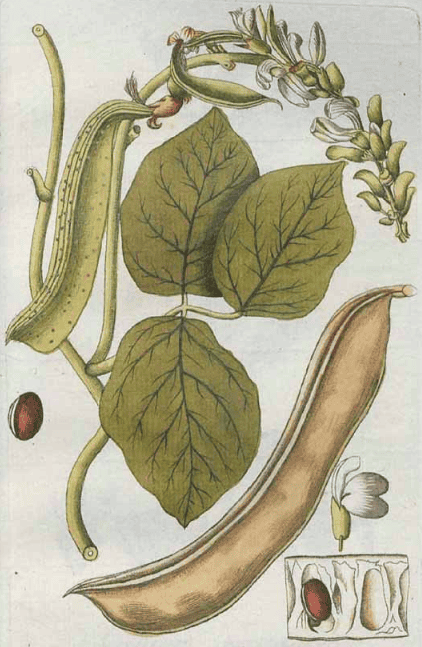
Canavalia gladiata
Plantarum indigenarum et exoticarum Icones ad vivum coloratae, 1790
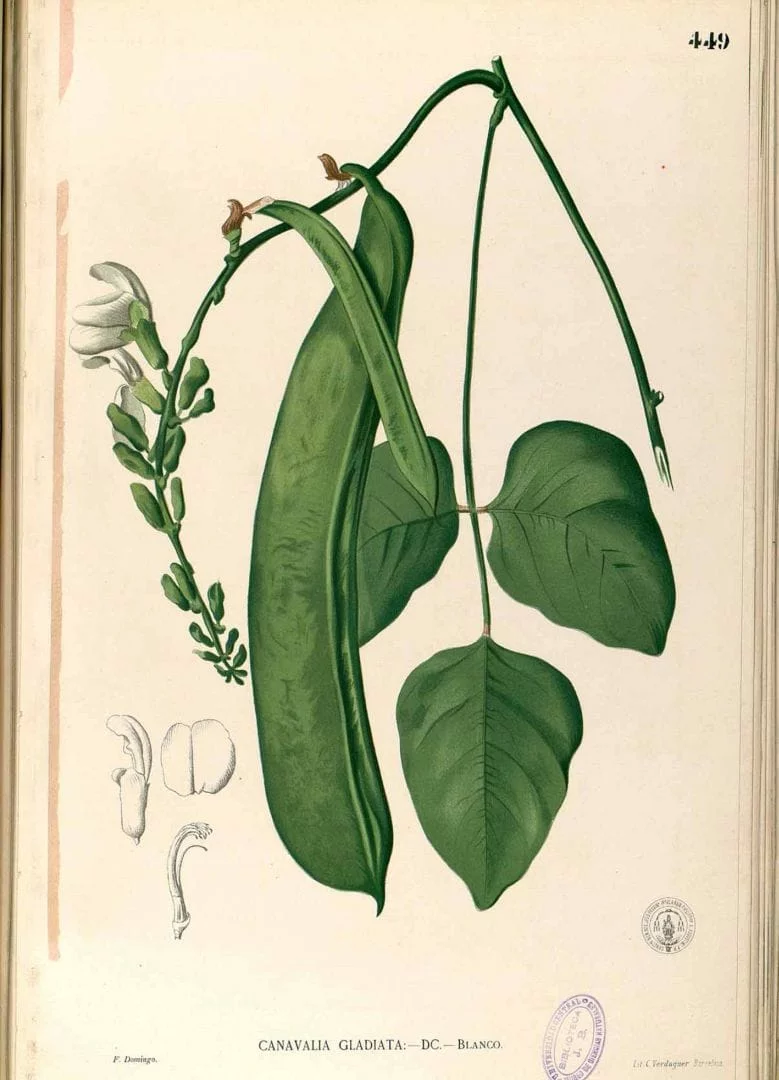
Canavalia gladiata
M. Blanco, Flora de Filipinas. (1875)
Botanical name:
Canavalia gladiata (syn. Dolichos gladiatus), C. ensiformis
In Tibet there are 2 varieties of Mkhal zho:
- Mkhal zho dmar po: Canavalia gladiata
- Mkhal zho dkar po: Phaseolus lunatus
Both are used synonymously (Drungtso)
Parts used:
Seed
Temperature & Taste:
Warm (Neutral in Tibetan), Sweet
Classification:
Uses:
1. Warms and Strengthens the Kidneys:
-Cold and Weak Kidneys, aching lower back, copious pale urine
-used for both Hot and Cold Kidney disorders in Tibetan Medicine; “all Kidney disorders” (Drungsto)
-“tones the Kidney and Yuan Qi“. (Li Shi Zhen)
-it mildly strengthens Kidney Yang
2. Warms the Stomach, Directs Qi Down:
-“Warms the Interior and brings down adverse ascending of Qi, facilitates function of the Intestines and Stomach, stops Nausea and Retching”. (Li Shi Zhen)
-Hiccup, Belching, Vomiting from Cold in the Stomach
-downward effect is also used for Hypertension
3. Moves the Blood:
-especially effective to cure Wounds (Tibet)
Dose:
Decoction: 3–9 grams
Powder: 1–3 grams
Substitute:
1. Mucuna
2. Oxytropis williamsii (Srad nag) is substituted in Nepal.
Preparation:
1. The fruits are stir-fried in hot sand until yellowish, then the seed coat is removed and the seeds are used in medicine. (Tibetan Medicine)
2. Soaking overnight then boiling was found most effective in reducing canavanine content. (see research below)
Main Combinations:
1. Hiccup and Vomiting from Cold in the Stomach:
i. Canavalia powder is taken with hot water. (Li Shi Zhen)
ii. Canavalia, Clove, Citrus Chen Pi (TCM)
2. Cold and Weak Kidney:
i. Canavalia with Eucommia Du Zhong, Mistletoe (Sang Ji Sheng), Achyranthes Niu Xi
ii. Canavalia with Chebula, Madder, Safflower, Green Cardamon, Nutmeg
iii. Canavalia with Tribulus seed, Safflower, Madder, Lesser Cardamon (as in Possessor of Ruby Color)
3. Nephritis, Strangury, Kidney or waist pain, Canavalia with Chebula, Shilajit, Green Cardamon, Safflower, Madder (as in Chebula 10)
Major Formulas:
Tibetan:
Aloeswood 18
Asafetida 14 (Shing kun bcu bzhi)
Chebula 10
Possessor of Ruby Color
Protect from Cold 35 (Dar la ‘bab byed so lnga)
Tumor Curing Thunderbolt (Skrangs sel bde byed)
Cautions:
1. Avoid in excess Stomach Heat.
Toxicity
The amino acid canavanine is toxic is overdose. Processing methods lessen its amount. Soaking overnight then boiling was most effective in reducing canavanine content.
Main Preparations used:
Click the above Tabs for more information on this medicine
REVIEW
–Literature review of an underutilized legume: Canavalia gladiata L.
PROCESSING
–Effect of different processing methods on antioxidant activity of underutilized legumes, Entada scandens seed kernel and Canavalia gladiata seeds.
–Roasting and Cryogenic Grinding Enhance the Antioxidant Property of Sword Beans (Canavalia gladiata).
–Canavanine content in sword beans (Canavalia gladiata): analysis and effect of processing.
–Effect of processing on the protein nutritional value of Canavalia gladiata seeds.
ANTI-INFLAMMATORY
–Anti-Inflammatory Effect of Immature Sword Bean Pod (Canavalia gladiata) in Lipopolysaccharide-Induced RAW264.7 Cells.
–Anti-Inflammatory Effects of Canavalia gladiata in Macrophage Cells and DSS-Induced Colitis Mouse Model.
ANTIOXIDANT
–Roasting and Cryogenic Grinding Enhance the Antioxidant Property of Sword Beans (Canavalia gladiata).
COLITIS
–Anti-Inflammatory Effects of Canavalia gladiata in Macrophage Cells and DSS-Induced Colitis Mouse Model.
OBESITY
–Immature sword bean pods (Canavalia gladiata) inhibit adipogenesis in C3H10T1/2 cells and mice with high-fat diet-induced obesity.
ENHANCE ENDURANCE
–Effect of Ethanol Extract of Canavalia gladiata on Endurance Swimming Capacity in Mice.
ANTIANGIOGENIC
–Antiangiogenic activity of 4-O-methylgallic acid from Canavalia gladiata, a dietary legume.
CANCER
–Lectin Isolated from Japanese Red Sword Beans (Canavalia gladiata) as a Potential Cancer Chemopreventive Agent.
You must be logged in to view this content, please login. If you're not a member then Click this link to subscribe