Benzoin, An Xi Xiang 安息香
Benjamin (old name)
An Xi Xiang (TCM)
Loban (Unani)
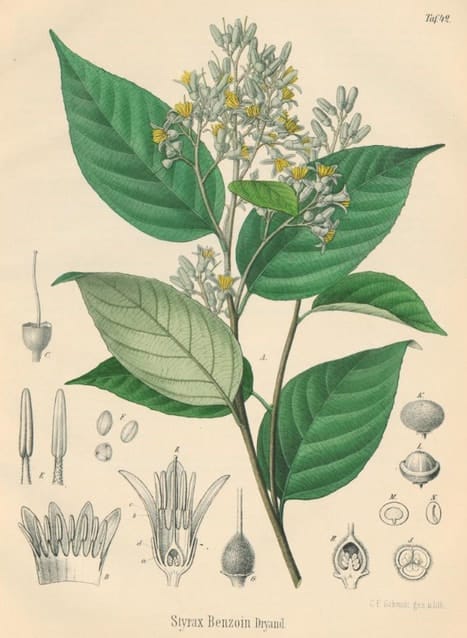
Atlas der Officinellen Pflanzen, Berg & Schmidt, Leipzig, 1893
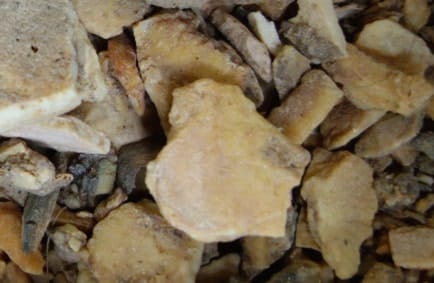
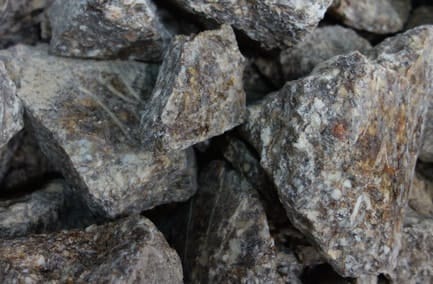
Two Different varieties of Benzoin available at the Chengdu Medicine Market (Adam, 2016)
Left: is Benzoin Amygdaloides; Right: was called Benzoin in sortis;
Botanical name:
Styrax benzoin,
Also S. tonkinensis (in China)
Several types were traditionally known.
Parts used:
Gum; two distinct varieties supplied the market:
- Benzoin Amygdaloides; fragile masses composed of white tears united together; clean and bright fracture.
- Benzoin in sortis; reddish or blackish brown masses
Temperature & Taste:
Warm, dry. Pungent, Bitter, aromatic
attenuates
Classification:
Uses:
1. Opens the Orifices of the Brain:
-delirium, unconsciousness, coma, Apoplexy and syncope
-the scent is uplifting and opens the orifices of the Brain
-Nightmares and nightcrying in infnats (TCM)
2. Clears Cold Phlegm:
-good for the Lungs, for Catarrhs, Coughs, Bronchitis, Asthma
-distention of the chest or abdomen from Phlegm.
3. Moves Qi and Blood, Clears Obstructions, Stops Pain:
-chest or abdominal pain from Qi and Blood stagnation
-muscle and joint pain or difficulty moving from Wind-Cold-Damp obstruction: arthralgia, arthritis, rheumatism
-Neuralgia
4. Resists Poison:
-added to antidotes
-used for Consumptive and Infectious diseases
-“disperses attacks of vicious agents, evils and devils” (TCM: Da Ming)
-“Bum the drug to keep evils and devils away” (TCM: Xiao Bing)
5. Externally:
-externally to purge the brain (by promoting Sneezing)
-cures Toothache by chewing
-cleanses the Face of Spots and Pimples etc.; used in cosmetics (esp. the tincture with Rose water)
-much used in Perfumery
Dose:
300–1500mg in pills or powders.
Tincture: 5 drops up to 4 mls.
Used topically in various preparations.
Substitute:
1. Mastic (Unani)
2. Storax
Main Combinations:
1. Abdominal pain or pain from Cold and Damp obstruction, combine Benzoin with Aloeswood, Clove, Costus
2. Cough:
i. Benzoin with Myrrh, Opium, Galbanum (as in Expert Pills for Cough)
ii. Benzoin with cold phlegm: combine with Storax, Balsam of Tolu and Aloe (as in Friars Balsam or Compound Benzoin Tincture)
3. Catarrh:
i. Benzoin with Myrrh, Saffron, Indian Spikenard (as in Confection for Catarrh)
ii. Benzoin with Balm, Marjoram, Betony, Nutmeg, Clove, Frankincense, Mastic (as in Powder for Catarrh)
4. Asthma, Benzoin with flowers of Sulphur, Pearl, Musk, Cinnamon, Saffron (as in Asthma Powder of Sennertus)
5. Sclerosis of the Liver, Benzoin with Gum Ammoniac, Bdellium (as in Pills for Fibrosis of the Liver)
6. Infectious diseases, Heart pain, Dysentery, sudden obstruction of Qi and Blood: combine Benzoin with Costus, Aloeswood, Clove, Sandalwood, Cyperus, Chebulic Myrobalan, Atracylodes Bai Zhu, Long Pepper, Frankincense, Storax and Camphor (as in Benzoin Pills of TCM)
7. Freckles: Benzoin Tincture, Borax, Bitter Almond oil
8. Mouthwash, Tincture of Benzoin, Myrrh, Pyrethrum root, Violet root, Mint, mixed with Oil
Major Formulas:
Expert Pills for Cough
Pills of Storax (Mesue)
New Rose Powder (Rosata Novella) (Nicolas)
Warming Pearl Powder (Diamargariton Calidum) (Mesue)
Powder of Happiness (Letificans)
Surgeon’s Musked Troches (Alipta Muscata) (Nicholas)
Confection for Catarrh
Pills for Fibrosis of the Liver (Riverius)
Electuary of Frankincense (Diaolibanum) (Nicholas)
Electuary of Orris Root (Diaireos Salomonis) (Nicholas)
Antidote Proven for Diverse Diseases (Nicholas)
Antidotum Immortale
Tincture Against Schirrus of the Spleen
Su He Xiang Wan
Zhi Bao Dan
Shi Xiang Fan Sheng Wan
1. Compound Tincture of Benzoin:
i. Benzoin (3 oz.), Storax (1 oz.), Rectified Spirit (2 pounds) (Pharmacopoeia Herbipolitania, 1796)
ii. Benzoin (3 oz.0, Storax (2 oz.), Balsam of Tolu (1 oz.), Aloes (½ ounce), Rectified Spirit (2 pints) (London Pharmacopoeia)
iii. Benzoin (3 parts), Storax (2 parts), Balsam of Peru (1 part), Aloes, Myrrh, Olibanum (each ½ part), Alcohol (36 parts). Digest in a warm place for 3 days, then let sit for 6 days (shaking daily), and filter.
2. Balsam of Life
i. Benzoin (4 oz.), Storax (3 oz.), Aloe, Myrrh 1 ½ oz.), Angelica root, St. John’s wort (2 oz. each). Steep in 3 pints rectified spirit for 3 weeks. Dose is 13–14 drops in a teaspoonful of wine twice daily.
Used for Consumption, Weakness, Whooping Cough etc. (Madame Young’s Guide to Health, 1858)
3. Balsamum Commendatoris
Angelica (½ ounce), St. Johns wort (1 oz), Alcohol (22%, 4 ounces). Digest in warmth for 15 days, shaking frequently, then filter and add: Myrrh, Frankincense, Aloes (each ½ ounce), Storax, Benzoin (each 3 oz.), Ambergris (6 grains) (Pharmacopoeia Gallica, 1818)
This was used as a Stimulant, Cordial, Stomachic, Anti-catarrhal, Anti-gonorrheal and Vulnerary.
Dose: 1–2 drams. Externally used as a friction for Articular Rhematism and leuo-phlegmatic Tumors.
4. Species for Fumigation (Incense):
i. Benzoin, Mastic, Juniper (½ ounce), Olibanum (2 oz.), Amber (3 oz.) (Pharmacopoeia Pauperum Hamburgensis, 1804)
ii. Benzoin, Olibanum, Mastic, Amber (one pounds), Cascarilla (1 oz.) (Pharmacopoeia regni Poloniae, 1817)
iii. Juniper, Benzoin, Olibanum, Amber (each ½ pound), Cascarilla, Lavender, Rose petals (each 2 oz.). (Pharmacopoeia Sardoa, 1773)
iv. Cloves (6 oz), Benzoin (2 oz.), Storax (4 oz.), Cascarilla (2 oz.), Olibanum (7 oz.) (Niemann)
v. Benzoin, Amber, Mastic (each 6 drams), Storax (½ oz.), Cinnamon (2 drams), Clove (1 dram) (Pharmacopoeia Amstelodamensis, 1792)
vi. Mastic, Olibanum, Myrrh, Amber (each 3 parts), Storax (2 parts), Benzoin, Labdanum (each 1 part) (Pharmacopoeia Rossica, 1803)
vii. Lignum Rhodii (2 oz), Florentine Orris (20 oz.), Cassia Lignea, Cinnamon (each 4 oz.), Benzoin (2 lbs.), Storax (12 oz.), Amber (1 lb.), Olibanum, Mastic (each 2 lbs.), Rose petals, Lavender (6 oz.) (Pharmacopoeia Danica, 1805)
Cautions:
Not used in Heat from Yin deficiency (Heat with dryness)
Main Preparations used:
Tincture, Magistery, Flowers of Benzoin (Benzoic Acid), Oil
1. Tincture of Benzoin:
Traditionally used is a ratio of 1:8 or 1:12. A 1:10 tincture is often prepared today.
i. Benzoin in powder (1 part), Alcohol (26%) 4 parts
ii. Benzoin in powder (1 part), Alcohol (45%) 8 parts
It is used diluted as a stimulant antiseptic for the skin. A few drops placed in 100 mls of water makes an excellent toner and cleanser for oily, dirty skin. A few drops of the tincture turns the water white. Many very expensive facial toners are based on this old recipe, often known as ‘Sweetwater’, with just a little fragrance or perfume added.
It may be taken internally or inhaled as an expectorant etc.
Dose: 30-60 drops (2-4 mls)
2. Magistery of Benzoin.
The Tincture of Benzoin made with S.V. (Brandy) is precipitated by adding water, allowed to settle, then dried.
This is very good for diseases of the breast and Lungs including Asthma, shortness of Breath, Phthisic, old Coughs etc.; also a very good cosmetic externally; it is applied to spots, pimples, pustules, redness of the skin and tumours; then, to prevent their return, the White Water (or ‘Virgins Milk’), made by adding some of the tincture to water, is used as a wash daily. Dose of the Tincture: 4-20 drops, often given with an Egg Yolk; Of the Magistery: 10-25 grains with Egg Yolk, or in tablets etc.
3. Flowers of Benzoin:
(Sublimed Benzoin, Flores Benzoini, Benzoic Acid)
A number of methods may be used to produce Benzoic acid:
i. ‘Put powdered Benjamin into an earthen pot placed in sand, and with a small heat the flowers will rise, and may be caught by a paper cone placed over the pot. Or else the Benjamin may be put into a retort, and the flowers will ascend into and fasten themselvs upon its neck. The flowers, if tinged yellow, are to be mixed with Tobacco Pipe Clay, and sublimed again’. (The paper cone should have a small hole in the top which will cause the Flowers to rise easier; Every half hour the cone should be removed and the flowers collected by scraping with a feather; when oily parts rise to the paper, it is a sign all has come; 1 lb. of benzion will give 2 drams of the Flowers)
This is how Benzoic Acid was originally made. It appears as colorless or white, soft, silky needles.
ii. Benzoin 1 ½ lbs.
Fresh Lime 4 oz.
Water 1 ½ gallons
Muriatic acid 4 fluid ounces
Rub together the Benzoin with the Lime, then boil in 1 gallon of water for 30 minutes, stirring continuously, then our off the clear water. Boil the remaining a second time in 4 pints of water, and pour off the liquor as before. Mix the liquors, boil down to half, strain through paper, and add the acid gradually until it ceases to precipitate. Having poured off the liquor, dry the powder in a gentle heat. Then put it into a suitable vessel, place it in a sand bath, and with a gentle heat, sublime the Benzoic acid. This is how it was ordered to be prepared in the early 19th century London Pharmacopeias.
iii. The Edinborough Pharmacopoeia first prepared Sodium Benzoate, then precipitated it with Sulphuric acid, then crystalise it after solution in hot water.
1 gram of the Flowers dissolves in 275 cc of cold water, 18 cc of boiling water, and 2.3 cc of cold alcohol; Borax increases its water solubIlity. It is incompatible with metallic salts. It has also been used as a food preservative, in dyeing, and for flavoring Tobacco.
Very good for the Lungs and Breast, and against Asthma; also promotes Sweat.
Dose: 2-5 grains, or 0.5-1 scruple. (Salmon, Pharmacopoeia Bateana)
Later, this preparation (Benzoic Acid) was recognised as being good for Phosphatic Gravel: 1 part was mixed with 4 parts of Phosphate of Soda, the dose being 10-20 grains.
The Merc Index of 1940 says Benzoic Acid is a “Mild antiseptic, Diuretic, Stimulating Expectorant, acidifier of Urine in which it appears chiefly as Hippuric Acid. Internally in cystitis, pyelitis and other urogenital diseases; phosphaturia, chronic bronchitis, rheumatic fever”.
Dose: 120–500mg (2-8 grains) as an expectorant; 300mg-1 gram (5-15 grains) for other purposes, taken several times daily.
Click the above Tabs for more information on this medicine
-Benzoin has been imported regularly into Europe from the 16th Century.
-All people who have traditionally used this resin have used it to ward off Evil spirits. In addition, it is regularly used to summon or encourage good Spirits. It has been used as an incense in Birthrooms for this purpose, for example. Burned in a room or house, it dispels negativity and brings protection.
-Magically, Benzoin was said to “dissolves” blockages. This is due to the strong effect of Benzoin in moving Qi.
–Mali magicians used burning Benzoin in rituals to transform into a Tiger.
-Benzoin applied topically to the face in creams, ointments or lotions was said to “Magically” maintain youthfulness.
-Benzoic acid, prepared from Benzoin or synthetically produced was much used earlier last century in Western Medicine as a stimulating and disinfecting expectorant in chronic Bronchitis and Phthisis; also to acidify alkaline urine and as an antipyretic in acute Rheumatism. Discovered in Gum Benzoin by Turquet de Mayerne in 1608, and prepared from Urine by Scheele in 1785.
GENERAL / REVIEW
–Styrax spp.: Habitat, Phenology, Phytochemicals, Biological Activity and Applications.
–Benzoin Resin: An Overview on Its Production Process, Phytochemistry, Traditional Use and Quality Control.
ANTIBACTERIAL
–Phytochemical characterization of Styrax benzoin resin extract, molecular docking, ADME, and antibacterial activity study.
AIR DISINFECTANT
–Unani medicinal herbs as potential air disinfectants: an evidence-based review.
ANTI-FUNGAL:
–Culturable endophytic fungal assemblages from Styrax sumatrana and Stryax benzoin and their potential as antifungal, antioxidant, and alpha-glucosidase inhibitory resources.
ANTI-OXIDANT:
–Culturable endophytic fungal assemblages from Styrax sumatrana and Stryax benzoin and their potential as antifungal, antioxidant, and alpha-glucosidase inhibitory resources.
NICOTINE DELIVERY:
–Transmucosal Delivery of Nicotine in Combination with Tincture of Benzoin Inhibits Apoptosis.
ALPHA-GLUCOSIDASE INHIBITOR::
–Culturable endophytic fungal assemblages from Styrax sumatrana and Stryax benzoin and their potential as antifungal, antioxidant, and alpha-glucosidase inhibitory resources.
You must be logged in to view this content, please login. If you're not a member then Click this link to subscribe