Belamcanda chinensis, She Gan 射干
Blackberry Lily, Leopard Lily
She Gan (TCM)
Surajkanti (Ayurveda)
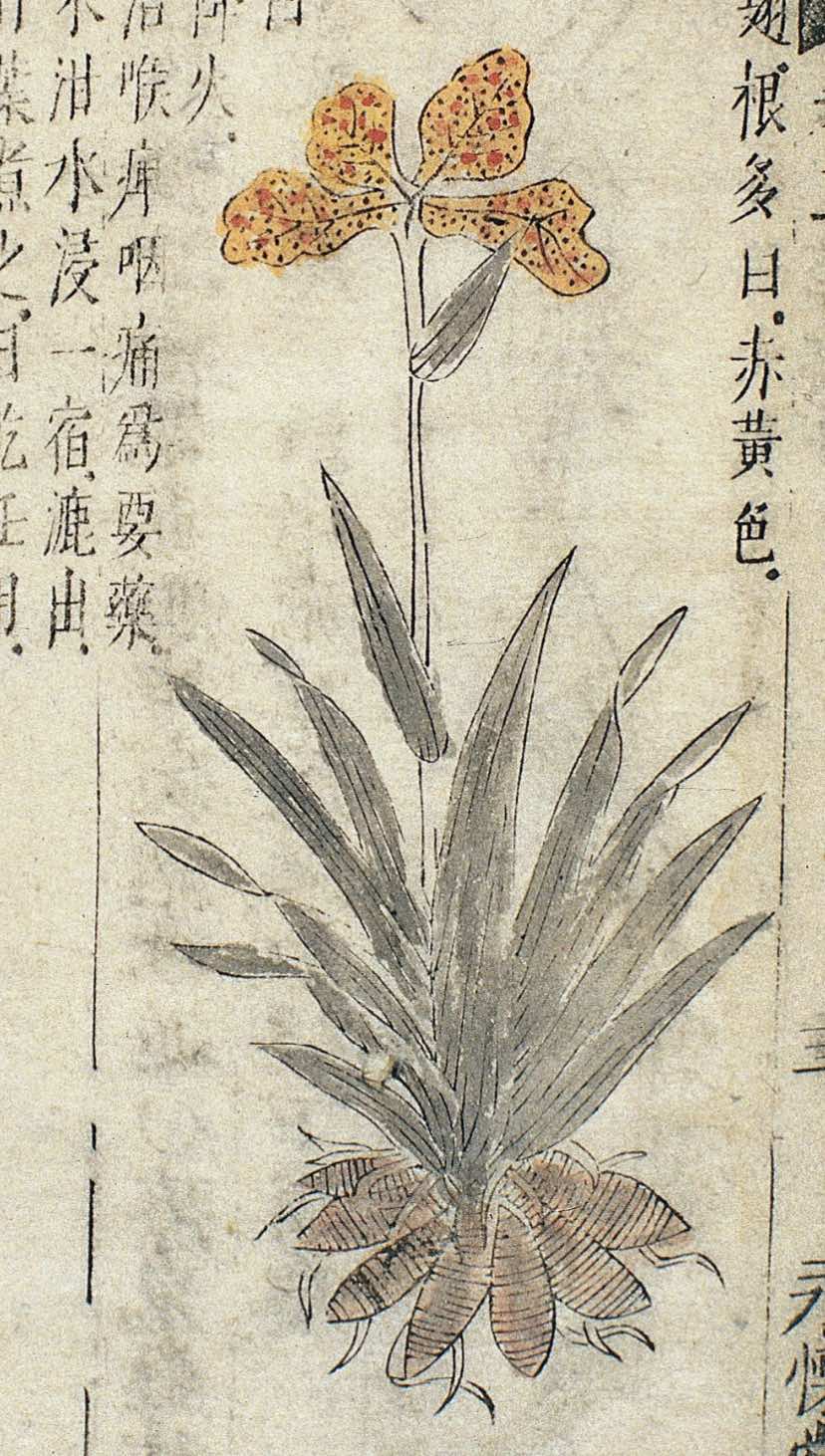
She Gan (Belamcanda) (Bencao yuanshi, 1612) (Welcome)
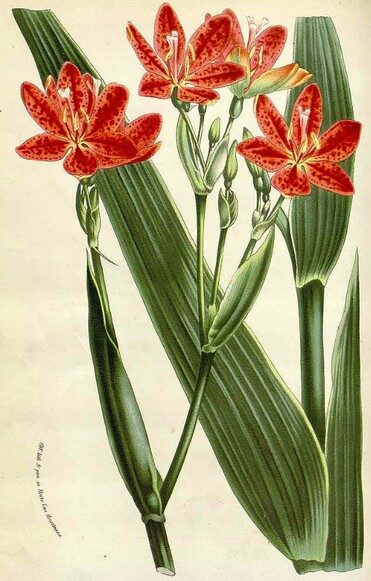
Houtte, L. van, Flore des serres et des jardin de l’Europe, vol. 16 (1845)
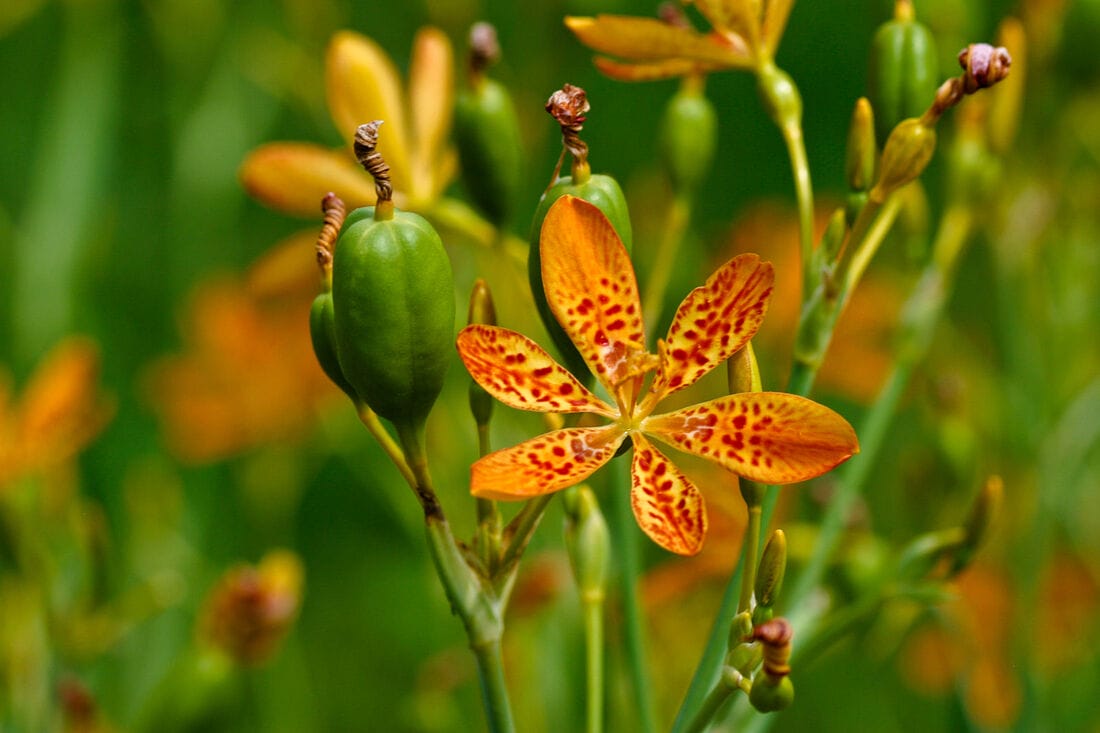
Belamcanda chinensis
(Photo by Brighterorange) (Wikimedia)
Botanical name:
Belamcanda chinensis (syn. B. flabellata, Iris domestica, Ixia chinensis, Moraea chinensis, Pardanthus sinensis)
Tibetan Medicine uses the Forked Iris (Iris dichotoma) which is called Bai Hua She Gan in China. While it is listed as an adulterant to Belamcanda She Gan by Bensky, the root has similar functions and uses to She Gan and can be used similarly, although not as strong.
Parts used:
Rhizome
Temperature & Taste:
Cold, dry. Bitter, Pungent
Classification:
Uses:
1. Clears Heat and Toxin:
-Sore Throat, Laryngitis, Pharyngitis, Tonsillitis from Phlegm-Heat or Toxic Heat (TCM, Ayurveda)
-it has been used as a single herb for acute Heat-type Sore Throat
2. Moves the Blood, Resolves Masses:
-Scrofula, Lumps, hardness of the Spleen
-Tumors and Cancers (including Breast, Prostate
-Triterpenoids and Flavonoids have shown anti-cancer and anti-tumor activity
-has also been used as an abortifacient
3. Clears Heat and Phlegm, Stops Cough:
-Cough and Wheezing from Heat-Toxin and Phlegm
-Pneumonia (Ayurveda)
4. Externally:
-topically to Rheumatism, Dermatitis
-skin infection with pus, (Mix powder with vinegar and apply)
-Tumors, Lymphadenitis, Goiter
-in India, it is applied to Snake Bite
Dose:
Decoction: 3–9 grams
Powder: 1–3 grams
Preparation:
1. Fried Belamcanda (Chao She Gan)
The root is dry-fried or baked until browned. This moderates its harsh and cold nature.
In Tibetan Medicine, the related Forked Iris (Bai Hua She Gan) is stir-fried with wheat to moderate it.
2. Washed Belamcanda
Soak the durg in Rice rinse water overnight. Remove, then dry in the sun.
Some add another process. After soaking in Rice rinse water they stew with Bamboo leaf (Zhu Ye), then dry in the sun.
This also moderates its harsh effects.
Main Combinations:
1. Cough and Wheezing:
i. Cough, Sore Throat, from Lung Heat, Belamcanda with Scutellaria Huang Qin, Platycodon Jie Geng
ii. from Cold Phlegm, Belamcanda with Ephedra Ma Huang, Ginger (Gan Jiang), Asarum Xi Xin, Pinellia Ban Xia, Coltsfoot (Kuan Dong Hua), Licorice (as in She Gan Ma Huang Tang)
iii. from Hot Phlegm, Belamcanda with Scutellaria Huang Qin, Mulberry bark (Sang Bai Pi)
2. Sore Throat, Tonsillitis:
i. Belamcanda with Lonicera Jin Yin Hua, Lasiophaera Ma Bo (as in Yin Qiao Ma Bo San)
ii. Belamcanda with Forsythia Lian Qiao, Platycodon Jie Geng, Isatis Ban Lan Gen
iii. Belamcanda with Chrysanthemum Ju Hua, Peppermint (Bo He), Forsythia Lian Qiao, Platycodon Jie Geng, Licorice
iv. Tonsillitis, Belamcanda with Forsythia Lian Qiao, Burdock seed (Niu Bang Zi), Figwort (Xuan Shen), Licorice
v. from Heat and Toxin, Belamcanda with Figwort (Xuan Shen), Cimifuga Sheng Ma
3. Tuberculosis, Belamcanda with Forsythia Lian Qiao, Self Heal (Xia Ku Cao)
4. Hard mass in the groin, stew a 3 inch piece of Belamcanda ropot with fresh Ginger. (Zhu Zhen Heng)
Major Formulas:
She Gan Ma Huang Tang
Yin Qiao Ma Bo San
Gan Lu Xiao Du Dan
Cautions:
1. Not used during Pregnancy.
2. Caution in people with loose stool. The Fried root is most suitable in weak stomachs.
3. “Long-term use makes one debilitated” (Ming Yi Bie Lu). This effect is negated by preparation.
Main Preparations used:
Click the above Tabs for more information on this medicine
GENERAL / REVIEW
–Medicinal Importance, Pharmacological Activity and Analytical Aspects of Flavonoid ‘Irisflorentin’ from Belamcanda chinensis (L.) DC.
–Belamcanda chinensis (L.) DC-An ethnopharmacological, phytochemical and pharmacological review.
–Chemical constituents from Belamcanda chinensis.
ANTI-INFLAMMATORY
–Anti-Nociceptive and Anti-Inflammatory Activities of the Ethyl Acetate Extract of Belamcanda chinensis (L.) Redoute in Raw 264.7 Cells in vitro and Mouse Model in vivo.
–Iridal-Type Triterpenoids Displaying Human Neutrophil Elastase Inhibition and Anti-Inflammatory Effects from Belamcanda chinensis.
–[Determination of six active ingredients in different parts of Belamcanda chinensis and Iris tectorum and their anti-inflammatory activity].
ANTIOXIDANT
–Antimutagenic and anti-oxidant activities of isoflavonoids from Belamcanda chinensis (L.) DC.
–Antimutagenic and antioxidant activity of the extract from Belamcanda chinensis (L.) DC.
–Antioxidant activities of isoflavones from the rhizomes of Belamcanda chinensis on carbon tetrachloride-induced hepatic injury in rats.
ANTI-MUTAGENIC
–Antimutagenic and anti-oxidant activities of isoflavonoids from Belamcanda chinensis (L.) DC.
–Antimutagenic and antioxidant activity of the extract from Belamcanda chinensis (L.) DC.
ESTROGEN RECEPTOR MODULATOR
–Belamcanda chinensis and the thereof purified tectorigenin have selective estrogen receptor modulator activities.
PHYTOESTROGENIC
–Phytoestrogens from Belamcanda chinensis regulate the expression of steroid receptors and related cofactors in LNCaP prostate cancer cells.
–Phytoestrogens derived from Belamcanda chinensis have an antiproliferative effect on prostate cancer cells in vitro.
ASTHMA
–Exploring Asthma Mechanism of Belamcanda Chinensis by “Dose-effect Weighted Coefficient” Network Pharmacology and Experiment Validation.
HYPOGLYCEMIC / DIABETES
–Hypoglycemic activity of the extracts of Belamcanda chinensis leaves (BCLE) on KK-A(y) mice.
–Hypoglycemic effect of Belamcanda chinensis leaf extract in normal and STZ-induced diabetic rats and its potential active faction.
–Isoflavonoids from the rhizomes of Belamcanda chinensis and their effects on aldose reductase and sorbitol accumulation in streptozotocin induced diabetic rat tissues.
COLITIS
–The impact of mangiferin from Belamcanda chinensis on experimental colitis in rats.
RENAL FIBROSIS
–Belamchinanes A-D from Belamcanda chinensis: Triterpenoids with an Unprecedented Carbon Skeleton and Their Activity against Age-Related Renal Fibrosis.
ISCHEMIC STROKE
–Physicochemical Properties and Cytoprotective Effects on PC12 Cells of Polysaccharides from Belamcanda chinensis (L.) DC. Obtained via a Gradient Ethanol Precipitation Method.
CYTOTOXIC
–New iridal-type triterpenoid derivatives with cytotoxic activities from Belamcanda chinensis.
–Belamchinenin A, an unprecedented tricyclic-fused triterpenoid with cytotoxicity from Belamcanda chinensis.
ANTI-ANGIOGENIC
–Anti-angiogenic and anti-tumor activities of isoflavonoids from the rhizomes of Belamcanda chinensis.
ANTI-TUMOR
–Chemical constituents of the ethyl acetate extract of Belamcanda chinensis (L.) DC roots and their antitumor activities.
–Anti-angiogenic and anti-tumor activities of isoflavonoids from the rhizomes of Belamcanda chinensis.
CANCER
BREAST
–Cytotoxic Compounds from Belamcanda chinensis (L.) DC Induced Apoptosis in Triple-Negative Breast Cancer Cells.
–Phenolic constituents of the rhizomes of the Thai medicinal plant Belamcanda chinensis with proliferative activity for two breast cancer cell lines.
LIVER
–An arabinose-rich heteropolysaccharide isolated from Belamcanda chinensis (L.) DC treats liver cancer by targeting FAK and activating CD40.
LUNG
–Belamcanda chinensis extract inhibits non-small cell lung cancer proliferation and induces apoptosis via inhibiting the MAPK (Ras/Raf) and Akt pathways.
PROSTATE
–Phytoestrogens from Belamcanda chinensis regulate the expression of steroid receptors and related cofactors in LNCaP prostate cancer cells.
–Tectorigenin and other phytochemicals extracted from leopard lily Belamcanda chinensis affect new and established targets for therapies in prostate cancer.
–Phytoestrogens derived from Belamcanda chinensis have an antiproliferative effect on prostate cancer cells in vitro.
You must be logged in to view this content, please login. If you're not a member then Click this link to subscribe