Astragalus et al., Srad ma སྲད་མ
Srad ma (Tibet)
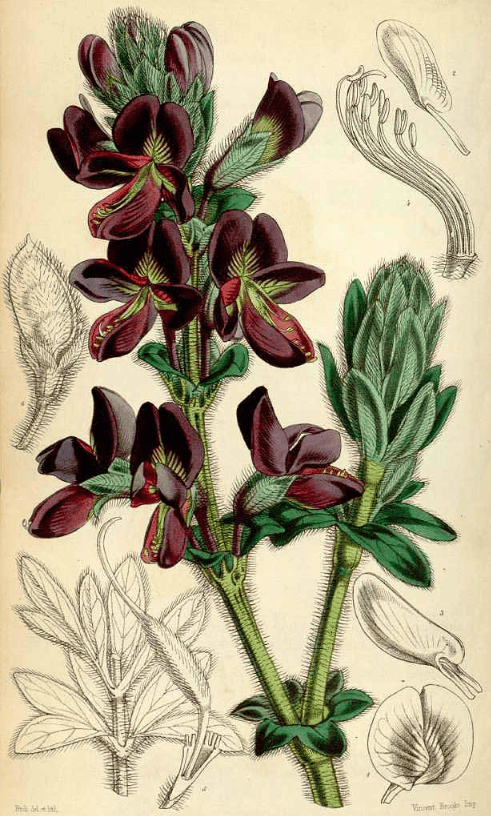
Thermopsis barbata
Curtis’s Botanical Magazine (1855)
Botanical name:
Sources of Srad ma are complex and varied, but are primarily from:
1. Astragalus spp.
2. Oxytropis spp.
3. Hedysarum spp.
There are 9 varieties of Srad ma
1. srad ma dkar po (srad dkar), flowers of Astragalus floridus, Oxytropis ochrantha. Also reportedly used are A. adsurgens,, A. dahuricus, A. galactites, A. melilotoides, A. scaberrimus, A. uliginosus
2. srad ma sngon po (srad sngon, rgyal ba chu ‘thub)-Blue-Green: whole plant of Astragalus pastorius; also A. tanguticus and Oxytropis melanocalyx
3. srad ma nag po (srad nag, na kha’i spra ba chhung)-Black: whole plant of Oxytropis subpodoloba; O. williamsii is used in Nepal. also A. kialensis
4. srad ma dmar po (srad dmar): Red: whole plant of Hedysarum sikkimense, H. pseudastragalus; other sources list Oxytropis and Astragalus spp.
5. srad ma smug po (srad smug)-Brown: whole plant of Tibetia himalaica (syn. Gueldenstaedtia himalaica); ; other sources list Oxytropis and Astragalus spp.
6. srad ma ser po (srad ser)-Yellow:, whole plant of Astragalus yunnanensis; several sources list Astragalus floridus
7. Gla ba srad ma, whole plant of Thermopsis barbata
8. Dug srad, whole plant of Oxytropis ochrocephala
9. byi’u srad ma, whole plant Astragalus membranaceus
It is worth noting that Hedysarum spp. supplies a variety of Huang Qi (Astragalus) in TCM.
Parts used:
Whole plant (see above)
Temperature & Taste:
Warm, dry. Sweet
Uses:
1. Tonifies Qi, Strengthens the Spleen:
-abdominal pain
-Spleen disorders
2. Strengthens Defense Qi:
-clears pathogens
-recurring colds
3. Promotes Urine:
-Edema, Fluid Retention
-Swelling
Dose:
Decoction: 3–9 grams
Powder: 1–3 grams
Comment:
Five different genus supply the 9 varieties of Srad ma in Tibetan Medicine. Two of the Astragalus species are used as sources for Astragalus Huang Qi of TCM. In addition, Hedysarum spp. are used as a source in TCM of a variety of Huang Qi (called Hong Qi or Duo Xu Yan Huang Qi). In Tibetan Medicine, the whole plant is used whereas TCM uses the root. Nevertheless the indications and source plants are similar enough to be considered similar medicines. Despite this we have separated the entries because of these differences and the complex sources of Srad ma.
Substitute:
1. Above-ground parts of a local Astrgalaus spp. is used in Buryat. This includes Astragalus adsurgens,, A. dahuricus, A. galactites, A. melilotoides, A. scaberrimus, A. uliginosus etc.
2. Hedysarum spp. are used as local varieties of Huang Qi (Astragalus) in TCM. As Hedysarum and Astragalus species are both listed as sources of Srad ma, it suggests Astragalus Huang Qi root may be used.
3. Parochetus communis and Phyllolobium donianum are used as sources of Srad sngon in Nepal.
Main Combinations:
Major Formulas:
Cautions:
None noted
Main Preparations used:
You must be logged in to view this content, please login. If you're not a member then Click this link to subscribe