Anagallis, Scarlet Pimpernel
Bird’s Eye, Bird’s Tongue, Red Chickweed, Red Pimpernel, Adder’s Eyes
Blue Pimpernel (‘Female’)
Anaghalis (Unani)
Jian Feng Hong, Liu Li Fan Lu, Hai Lu (TCM)

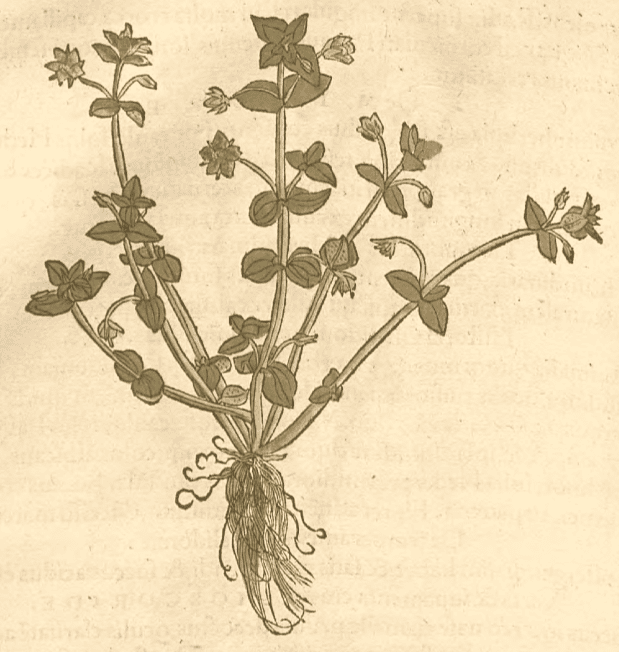
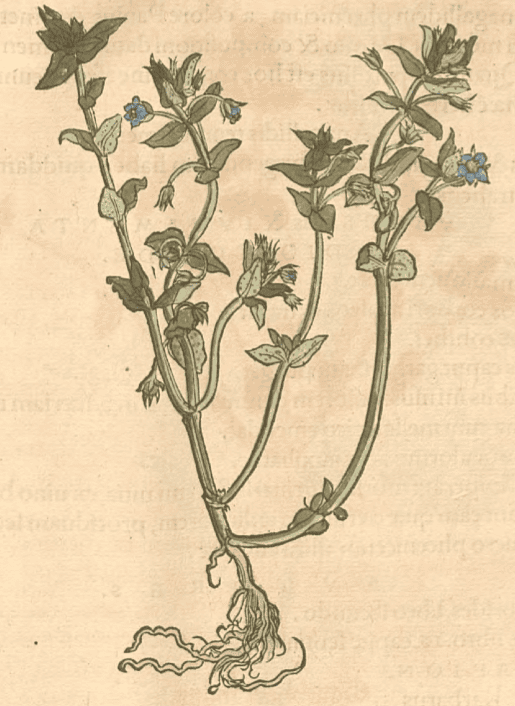
Male (Left) and Female (Right)
Herbarum Vivae Eicones, Otto Brunfels, 1530
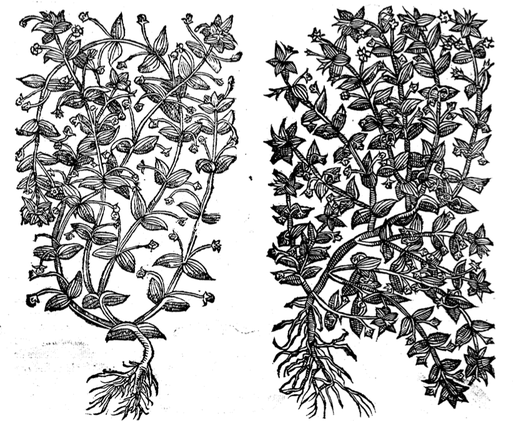
Male (left) and Female (right)
Dioscorides Materia Medica, Mathias, 1563
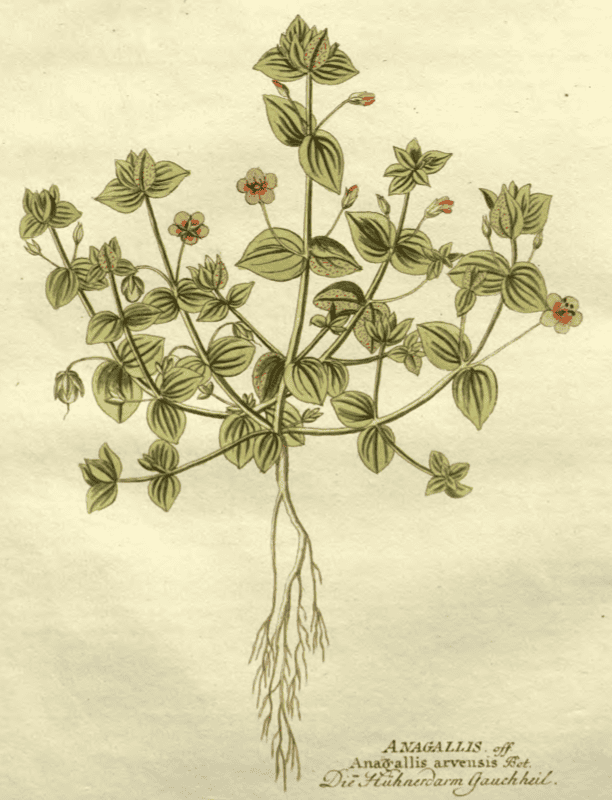
Icones Plantarum Medcio-oeconomico, Vietz, 1800
Botanical name:
Anagallis arvensis
Two varieties are known, both used similarly:
1. ‘Male’ is red (‘Scarlet’, A. arvensis);
2. ‘Female’ with blue flowers (A. cerulea and A. foemina)
A. phoenicea has also been used.
Parts used:
Herb (fresh or dried)
Galen said the Blue-flowered variety is most effective, although in general, the red ‘Scarlet Pimpernel’ is preferred.
Temperature & Taste:
Cool, dry. Bitter, Sour
Some said Warm and Dry in the First degree.
Cleansing, anti-inflammatory
Classification:
Uses:
1. Clears Heat, Resists Poison (TCM, West)
-Common Cold; Contagious and Epidemic diseases (boiled in wine)
-Venomous Bites: Bites of Snakes, Rabid Dogs (TCM, West)
-“useful in Snake-bite when taken with wine”. (Avicenna)
-Nettle rash; Poison Oak; Pruritus (int. & ext.)
-“Measles and other eruptive fevers” (John Hill, 1772)
-Seafood Poisoning (in Taiwan)
-proven Anti-Viral effect (Herpes, Adenovirus, Polio)
2. Clears Heat, Stops Cough:
-“In all Distempers of the Lungs it is looked upon by some Authors as a Very effectual Remedy: In a Phthisis, Ulcer or Impostume [abscess] of the Lungs, fetid and purulent Spitting (The Compleat Herbal, Tournefort, 1719)
-Tuberculosis (esp. early-stage); “Hill says there are many authenticated cases of this dire disease being absolutely cured by the herb”. (Herbal Simples, Fernie, 1897)
3. Clears Heat and Damp, Promotes Urine:
-Edema, Burning Urine
-Gravel and Stones of the Bladder or Gall Bladder
-“useful for Nephralgia when given with wine”. (Avicenna)
-Pain and Ulcers of the Kidney or Bladder (Culpeper)
-Rheumatism: “a fluid extract of the herb is given for rheumatism, in doses of one teaspoonful with water”. (Herbal Simples, Fernie, 1897)
4. Calms the Liver, Stops Wind, Calms the Mind:
-Epilepsy (TCM, West)
-Melancholy, Depression, Mental Illness, Madness, Mania (TCM, West)
-“Maniac Depression” (Gray, 1818)
-“This has had some reputation in cases of madness”. (Flora Medica, 1838)
5. Moves the Blood, Resolves Swellings, Promotes Healing: (TCM, West)
-Scrofula, Swellings, Inflammations, Tumors, Cancer
-Liver and Spleen Swelling; Hepatitis
-chronic Sores or Slow-healing Wounds from poor circulation (no redness or inflammation) (TCM)
6. Clears Liver Heat, Benefits the Eyes:
-red, swollen painful eyes; Blood-shot eyes
-trauma, bleeding or films on the Eyes (Pliny)
-poor or dim eyesight (Galen)
-“Very good against the inflammations, or heat of the eyes”. (Dodoens, 1578)
7. Externally:
-Wounds; Old, Foul and “Running Ulcers” (int. and ext.) (since Dioscorides)
-“Both the kinds cleanse the Wounds, stop their Swellings, pull out the Thorns and other foreign bodies and prevent
spreading of Ulcers”. (Avicenna)
-decoction or distilled water ‘old filthy fretting and running Ulcers, which it very effectually cureth in short spaces’ (Culpeper)
-applied to Piles
-the blue treats anal prolapse. (Dioscordies)
-cosmetic for Freckles and Spots, and to improve Complexion
-“The distilled Water or Juice is much esteemed by French Dames to cleanse the Skin from any Roughness, Deformity, or Discolouring”. (Culpeper)
-draws Thorns and Splinters (since Dioscorides)
-as a snuff or gargle to purge the Head
-Juice has been used for Toothache: snuffed up the opposite nostril (since Dioscorides)
-applied with Honey for dimness of sight (since Dioscorides)
-topically to Cataracts
Dose:
Taken with or boiled in wine to promote Urine, for Viper bites, and Liver diseases.
Herb in Powder: 500mg–2 grams;
Flower in Powder: 250mg–1 gram
Tincture (1:5): 1–3 mls.
Fluid Extract: 30–60 drops
Decoction: 6–12 grams
Comment:
Don’t confuse with Pimpernel, Pimpinella saxifraga. It was usually listed as Pimpernel, and the root of it was used whereas Scarlet Pimpernel has a very small root and the whole herb is used.
Main Combinations:
1. For Melancholy:
i. Scarlet Pimpernel with Borage
ii. Scalet Pimpernel, St. John’s wort, Balm
iii. Scarlet Pimpernel, Borage, Fumitory, Senna
iv. Scarlet Pimpernel, Borage, Apple, Sal Prunella
2. Depression or Mental illness:
i. Scarlet Pimpernel with St. Johns wort
ii. Scarlet Pimpernel, Borage, Balm
3. Against Poison and Infection,
i. Scarlet Pimpernel, Blessed Thistle, Angelica, Zedoary
ii. Scarlet Pimpernel, Cinnamon, Tormentil, Aloe, Juniper berry, Blessed Thistle, Angelica
4. Inflammation of the Liver, Scarlet Pimpernel with Liverwort, Walnut leaf, Juniper berry, Heartsease, Alder Buckthorn (Frangula) bark (Ulrich)
5. Liver hardness, Scarlet Pimpernel with Rhapontic, Indian Spikenard, Asarum, Agnus Castus, Senna (as in Troches Proven for Hardness of the Liver of Nicolas)
6. Gall Stones, Scarlet Pimpernel with Bitter Orange peel, Centaury, Dandelion, Chicory root, Calamus, Couch Grass, Hemp Agrimony (Kroeber)
7. Consumption, distilled Waters of Scarlet Pimpernel and of Cow’s Milk in equal parts
8. Poor eyesight, mix the juice with Honey and apply (Galen)
Major Formulas:
Troches Proven for Hardness of the Liver (Nicolas)
Cautions:
1. Large doses are narcotic
2. Not used for more than 3 or 4 weeks without a break in treatment.
3. Not used in Blood deficiency
4. Avoid in Nephritis, Kidney or Liver disease
Main Preparations used:
Distilled Water of the whole plant, Tincture
1. TINCTURE of PIMPERNEL.
Fresh Pimpernel leaves 10 oz.
Diluted Alcohol 1 pint
Steep for a week, then strain. Dose: 1-5 drops
Click the above Tabs for more information on this medicine
-“No Heart can think, no tongue can tell, The virtues of the Pimpernel”.
-Its generic name Pimpernel was given by Dioscorides, and is derived from the Greek meaning ‘to laugh’ because it removes depression and melancholy.
Pliny on Anagallis:
“The anagallis is called ‘corchoron‘ by some. There are two kinds of it, the male plant, with a red blossom, and the female, with a blue flower. These plants do not exceed a palm in height, and have a tender stem, with diminutive leaves of a rounded form, drooping upon the ground. They grow in gardens and in spots covered with water, the blue anagallis being the first to blossom. The juice of either plant, applied with honey, disperses films upon the eyes, suffusions of blood in those organs resulting from blows, and argema [blood-shot eyes] with a red tinge: if used in combination with Attic honey, they are still more efficacious. The anagallis has the effect also of dilating the pupil; hence the eye is anointed with it before the operation of couching for cataract. These plants are employed also for diseases of the eyes in beasts of burden.
The juice, injected into the nostrils, which are then rinsed with wine, acts as a detergent upon the head: it is taken also, in doses of one drachma, in wine, for wounds inflicted by serpents. It is a remarkable fact, that cattle will refuse to touch the female plant; but if it should so happen that, deceived by the resemblance— the flower being the only distinguishing mark— they have accidentally tasted it, they immediately have recourse, as a remedy, to the plant called ‘asyla,’ but more generally known among us as ‘ferusoculus.’ Some persons recommend those who gather it, to prelude by saluting it before sunrise, and then, before uttering another word, to take care and extract the juice immediately; if this is done, they say, it will be doubly efficacious.” (The Natural History of Pliny, trans. by Bostock and Riley, Vol. 5, 1856)
Last Updated 09/25
GENERAL / REVIEW
–Therapeutic propensities, phytochemical composition, and toxicological evaluation of Anagallis arvensis (L.): A wild edible medicinal food plant.
ANTIBACTERIAL / ANTIFUNGAL
–Biological activities of three medicinal plants from district Mirpur, AJK, Pakistan.
–Antifungal activity and cytotoxicity of extracts and triterpenoid saponins obtained from the aerial parts of Anagallis arvensis L.
–Pharmacological properties of Anagallis arvensis L. (“scarlet pimpernel”) and Anagallis foemina Mill. (“blue pimpernel”) traditionally used as wound healing remedies in Navarra (Spain).
–Antifungal activity of plant extracts against dermatophytes.
ANTIVIRAL
–Antiviral activity against HSV-1 of triterpene saponins from Anagallis arvensis is related tothe fusion-inhibitory activity of desglucoanagalloside B.
–In vitro antiviral activity of a saponin from Anagallis arvensis, Primulaceae, against herpes simplex virus and poliovirus
–Investigation of phytochemical composition and enzyme inhibitory potential of Anagallis arvensis L.
ANTI-INFLAMMATORY
–Therapeutic propensities, phytochemical composition, and toxicological evaluation of Anagallis arvensis (L.): A wild edible medicinal food plant.
–Pharmacological properties of Anagallis arvensis L. (“scarlet pimpernel”) and Anagallis foemina Mill. (“blue pimpernel”) traditionally used as wound healing remedies in Navarra (Spain).
ANTIOXIDANT
–The cupric ion reducing antioxidant capacity and polyphenolic content of some herbal teas.
UROPROTECTIVE:
–Uroprotective and Hepatoprotective Potential of Anagallis arvensis against the Experimental Animal Model.
HEPATOPROTECTIVE:
–Hepatoprotective potential of Anagallis arvensis (L.) extract against carbon tetrachloride (CCl4)-induced hepatic injury and oxidative stress in rabbits.
–Uroprotective and Hepatoprotective Potential of Anagallis arvensis against the Experimental Animal Model.
ANTISPASMODIC / HYPERTENSION
–Ethnopharmacological basis for folkloric claims of Anagallis arvensis Linn. (Scarlet Pimpernel) as prokinetic, spasmolytic and hypotensive in province of Punjab, Pakistan.
MUSCARINIC AGONIST
–Ethnopharmacological basis for folkloric claims of Anagallis arvensis Linn. (Scarlet Pimpernel) as prokinetic, spasmolytic and hypotensive in province of Punjab, Pakistan.
ENZYME INHIBITION
–Investigation of phytochemical composition and enzyme inhibitory potential of Anagallis arvensis L.
–Therapeutic propensities, phytochemical composition, and toxicological evaluation of Anagallis arvensis (L.): A wild edible medicinal food plant.
CANCER
–Anagallis arvensis Induces Apoptosis in HL-60 Cells Through ROS-Mediated Mitochondrial Pathway.
–Therapeutic propensities, phytochemical composition, and toxicological evaluation of Anagallis arvensis (L.): A wild edible medicinal food plant.
You must be logged in to view this content, please login. If you're not a member then Click this link to subscribe